

Suhail Khan
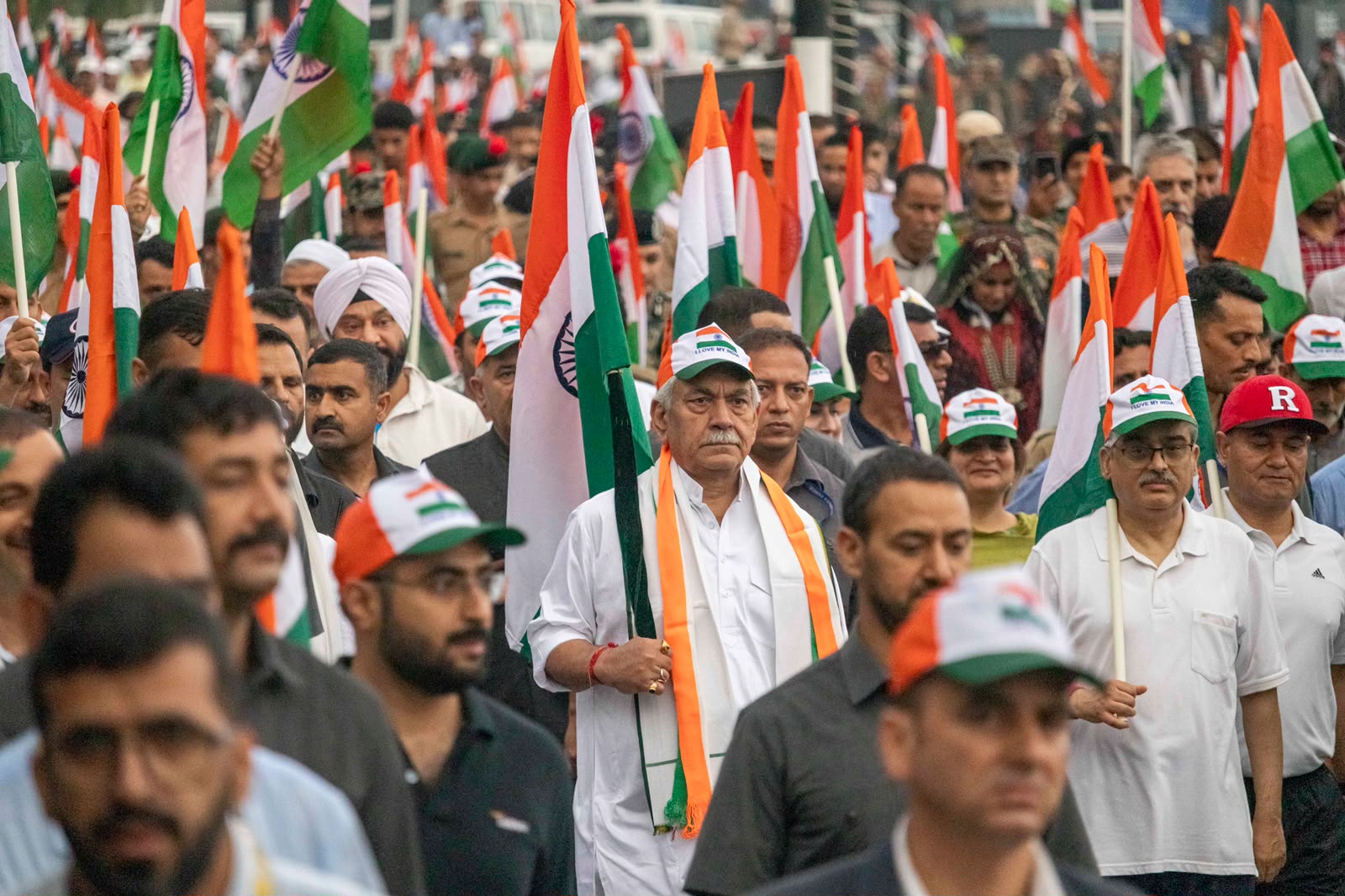
Srinagar, Aug 15: For three decades, August 15 in Kashmir was a day of fear, confinement, and enforced emptiness. Today, as the tricolour flutters over Bakshi Stadium, the crowd below tells a different story—one of normalcy slowly reclaiming a day that once belonged to terrorists and curfews.
The transformation wasn’t sudden. It was earned through years of violence, shutdowns, and political turbulence. But for the ordinary Kashmiri, the change is deeply personal.
‘We no longer live in a fortress’
Muzaffar Shah, a shopkeeper in his 50s from the summer capital city of Srinagar, remembers the 1990s, when his home—barely a kilometre from the stadium—became a prison each August 14.
“Back then, we couldn’t step out for days. Shops were shuttered, buses vanished, and the silence was terrifying,” Shah told Kashmir Convener, his voice carrying the weight of memory. “Today, my shop is open. My children are attending the function. This is our day too—a day where we feel happiness like other parts of our country.”
Ishfaq Ahmad, a retired government employee from Sopore town, recalls barricaded lanes and sharpshooters perched on rooftops. “Even buying milk and bread was a gamble. The atmosphere was so frightening that families huddled indoors,” he said. “Now, I see young boys and girls walking to the stadium with flags. That’s the change.”
The preparation itself tells the story. For days before the function, schoolchildren across the Valley have been rehearsing cultural programmes with an enthusiasm that was unthinkable a decade ago. “We have been practising for weeks,” said 14-year-old Ayesha, a student from a local school participating in the celebrations. “My parents are coming to watch me. It feels like we are part of something big.”
If one must define change in Kashmir in simple terms, look no further than mobile networks. Internet and mobile services, routinely suspended on every August 15 occasion in the past, now function without disruption. High-speed connectivity is available as per routine—a quiet but powerful testament to the Valley’s shifting reality.
Social activist Touseef Raina told Kashmir Convener the shift is significant. “For years, August 15 was weaponised by both the state and non-state actors. It became a symbol of division, but today, when I see ordinary families, schoolchildren, and even elderly women attending the function without fear, I feel hope. It’s our day. We too are celebrating with patriotism, fervour, and zeal—like any other Indian.”
He added, “This doesn’t mean the political questions have vanished. But it does mean that Kashmiris are no longer willing to let conflict dictate their calendar.”
Another activist, Farooq Ahmad, noted that now every function—whether Republic Day or Independence Day—sees Bakshi Stadium throw open its gates to thousands without special passes. Traffic moves through Kashmir, shops function as normal, and while security remains, it now secures a celebration, not a lockdown.
“August 15 once measured whether the state could protect a ceremony,” the article notes. “Increasingly, it measures whether the conflict can still stop the city from living.”
Parents, too, have become active participants. “My daughter is performing a patriotic dance today. We are going to watch her at the stadium,” said Ghulam Nabi, a parent from Natipora. “Earlier, we never dared to gather in large numbers. Today, we are going with pride.”
Schoolteacher Zainab Shafi, who has been preparing students for the cultural show at the district-level function, said the atmosphere is unlike anything she has seen in her two decades of teaching. “The children are genuinely excited. They ask questions about the history of Independence Day. Their parents are actively involved in helping with costumes and rehearsals. This is a different kind of enthusiasm—organic, not forced,” she said.
The festive spirit was palpable across the Valley, from the bustling streets of Srinagar to the remote mountains of Karnah, Tangdhar, and Gurez. The sight of the tricolour flying proudly at Lal Chowk carried deep emotional meaning for ordinary Kashmiris. Traders opened their shops beneath the fluttering tricolour, students took photographs with friends, and families walked through the heart of the city together—a picture that spoke of confidence, normalcy, and belonging.
Stringent security arrangements were in place at all venues, but no restrictions were placed on the movement of people. Mobile internet services functioned without disruption, allowing citizens to share photographs and messages of national celebrations with relatives and the wider world.
In schools and colleges, students prepared cultural programmes, debates, sports events, and patriotic performances with genuine enthusiasm. “The excitement seen in children carrying small tricolours is not created by formality; it comes from a natural sense of pride and participation in the life of the nation,” said a local observer.
The transformation in Kashmir cannot be adequately understood merely through the prism of administrative measures. It is, in equal measure, an expression of a broader social metamorphosis. The younger generation is appropriating national occasions in its own idiom—through sports, cultural programmes, educational initiatives, and social media. The tricolour is no longer a spectacle confined principally to government edifices; in numerous places, it has become visible in the public sphere as an emblem of celebration and national belonging.
As the tricolour fluttered over Bakshi Stadium and thousands gathered without fear, one message was unmistakable for the ordinary Kashmiri: August 15 is no longer a day of enforced silence—it is a day of hope, participation, and celebration. The journey is by no means complete, but the Valley appears to be moving forward.
Meanwhile, Srinagar celebrated the 80th Independence Day with patriotic fervour, with Chief Minister Omar Abdullah presiding over the main function at Bakshi Stadium.
Abdullah unfurled the national flag and was given a ceremonial Guard of Honour as he inspected the contingents taking part in the independence parade.
A helicopter showered flower petals over the stadium amidst applause from the audience.
Former chief ministers, National Conference president Farooq Abdullah and PDP chief Mehbooba Mufti, Leader of Opposition in the Legislative Assembly Sunil Sharma, and National Conference MLAs from Srinagar attended the function.
Senior civil administration and police officials were also present.
Independence Day was celebrated at all district headquarters in the Valley.
While Agriculture Minister Javed Ahmad Dar took the salute at Baramulla, School Education Minister Sakina Itoo presided over the function in Anantnag.
In the remaining districts, the respective deputy commissioners unfurled the national flag and took the salute at the parade.
Comments are closed.