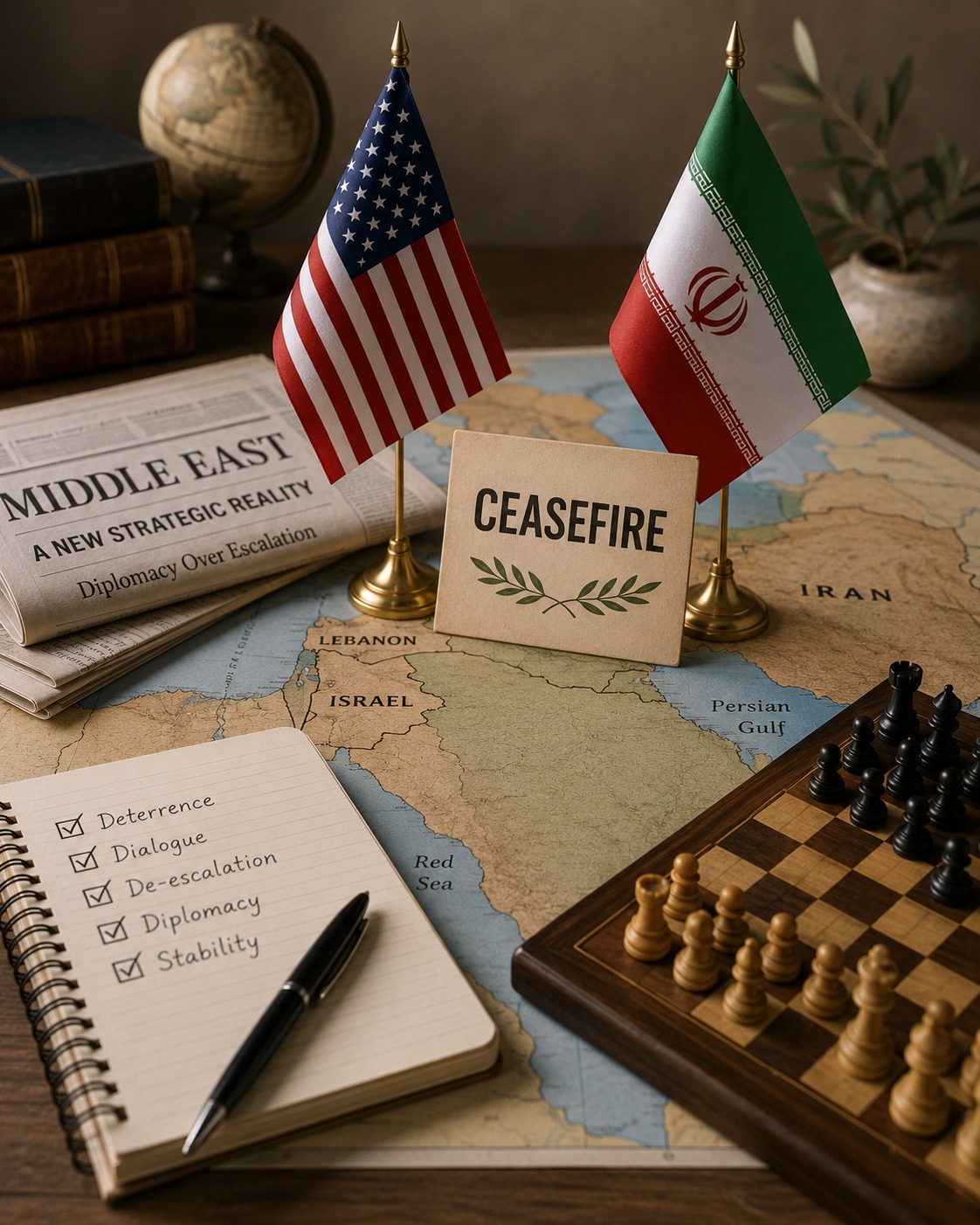

Beyond the Ceasefire: The Middle East’s New Strategic Reality

Dr. Vandana Aggarwal


“The guns may have fallen silent, but the decisive contest has shifted from the battlefield to the negotiating table, where diplomacy will determine whether this pause becomes peace or merely postpones another war.”

The recent ceasefire framework between the United States and Iran has understandably been welcomed as a much-needed pause after months of escalating hostilities. The headlines have focused on what has ended—the missile strikes, military operations and the immediate danger of a wider regional war. Yet the most important story may not be the ceasefire itself. Rather, it is what the agreement reveals about a changing Middle East and the shifting calculations of its principal actors.

For decades, the region’s security architecture revolved around a relatively simple assumption: American military power, backed by close partnerships with regional allies, could shape political outcomes. The latest conflict has challenged that assumption. While no party emerged as a decisive victor, every actor has been compelled to reassess both the utility and the limits of military force.

Israel entered the conflict determined to reinforce deterrence and degrade the capabilities of Iran and its regional partners. Iran sought to demonstrate that it could withstand military and economic pressure while preserving its regional influence. The United States aimed to prevent the conflict from spiralling into a broader regional war while protecting its allies and strategic interests. In different ways, each side achieved some of its objectives. Yet none achieved all of them. The return to diplomacy was therefore not a diplomatic defeat but a recognition that military operations had reached the limits of what they could realistically accomplish.

This is precisely why the ceasefire deserves closer attention. It marks a transition from the politics of military escalation to the politics of strategic bargaining. Throughout modern history, wars have often ended not because one side achieved complete victory but because all sides recognised the rising costs of continued confrontation. The latest agreement appears to fit that pattern. It is less a celebration of peace than an acknowledgement of the limitations of coercion.

The ceasefire has also exposed a less discussed but equally significant development: the growing divergence between Washington and Tel Aviv over the post-war regional order. The reported differences over Lebanon illustrate that even the closest allies can arrive at different conclusions about how security should be maintained after a conflict.

From Israel’s perspective, preserving operational freedom against Hezbollah remains central to its national security. Israeli policymakers argue that any easing of military pressure risks allowing hostile actors to regroup. For the United States, however, prolonged instability in Lebanon threatens to undermine broader diplomatic efforts aimed at preventing another cycle of regional escalation. Washington increasingly appears to view political stabilisation as an essential component of regional security rather than merely a consequence of military success.

These differences should not be interpreted as a rupture in the U.S.-Israel partnership. Alliances rarely require complete agreement on every strategic question. Rather, they highlight an important reality of contemporary geopolitics: allies often share common objectives while disagreeing on the methods required to achieve them. The debate over Lebanon is therefore not simply about one country. It reflects a broader conversation about the future of regional security in an increasingly multipolar Middle East.

Equally important is the global dimension of the conflict. The disruption of maritime trade routes, fluctuations in energy markets, and heightened concerns about global supply chains demonstrated that modern regional conflicts rarely remain geographically confined. A missile launched in the Middle East can influence oil prices in Asia, shipping insurance in Europe, and inflation expectations across the global economy. Security today extends well beyond the battlefield; it encompasses economic resilience, diplomatic credibility and international cooperation.

Yet caution remains essential. A ceasefire is not synonymous with peace. It suspends violence without resolving the political disagreements that produced it. The future of Iran’s regional influence, Israel’s long-term security concerns, Lebanon’s internal stability and broader questions surrounding sanctions and regional diplomacy remain unresolved. Unless these issues are addressed through sustained negotiations, the current agreement may become another temporary pause rather than a durable settlement.

Nevertheless, dismissing the ceasefire as merely tactical would overlook its wider significance. It signals that even in an era of advanced military technology and precision warfare, no state can rely on force alone to secure lasting political outcomes. Military power remains indispensable for national defence, but it cannot substitute for diplomacy when the objective is sustainable peace.

Perhaps that is the most enduring lesson of the recent conflict. The true measure of strategic success is not simply the ability to wage war but the capacity to shape a stable political order once the fighting ends. History is filled with military victories that failed to produce lasting peace. The challenge for today’s leaders is to avoid adding another chapter to that record.

The ceasefire should therefore be understood not as the conclusion of a conflict but as the opening of a new geopolitical phase. Whether it evolves into a lasting peace or merely postpones another confrontation will depend on whether regional and global powers can translate a pause in hostilities into a framework for durable political engagement.

The guns may have fallen silent, but the real contest has only just begun—not on the battlefield, but at the negotiating table.


The author is an Assistant Professor at Chandigarh University. She can be reached at vandana.aggarwal@cumail.in

Comments are closed.