

S Ahmad
India’s micro, small and medium enterprises are no longer peripheral players in the economy. They have become the country’s most powerful engines of employment, innovation and inclusive development. The challenge now is not simply helping them survive, but enabling them to lead India’s journey towards becoming a developed economy.
For decades, discussions about India’s economic transformation have largely revolved around multinational corporations, billion-dollar startups, large manufacturing plants and mega infrastructure projects. These sectors undoubtedly play an important role in shaping the country’s growth story. Yet beneath these headline-grabbing developments lies a far larger and quieter revolution—one driven by millions of small entrepreneurs operating from workshops, villages, industrial clusters, family-owned enterprises and modest manufacturing units across the country.
They may not command media attention like unicorn startups or global corporations, but collectively they represent one of India’s greatest economic strengths. India’s micro, small and medium enterprises (MSMEs) have evolved from being supplementary contributors to becoming indispensable pillars of the national economy.
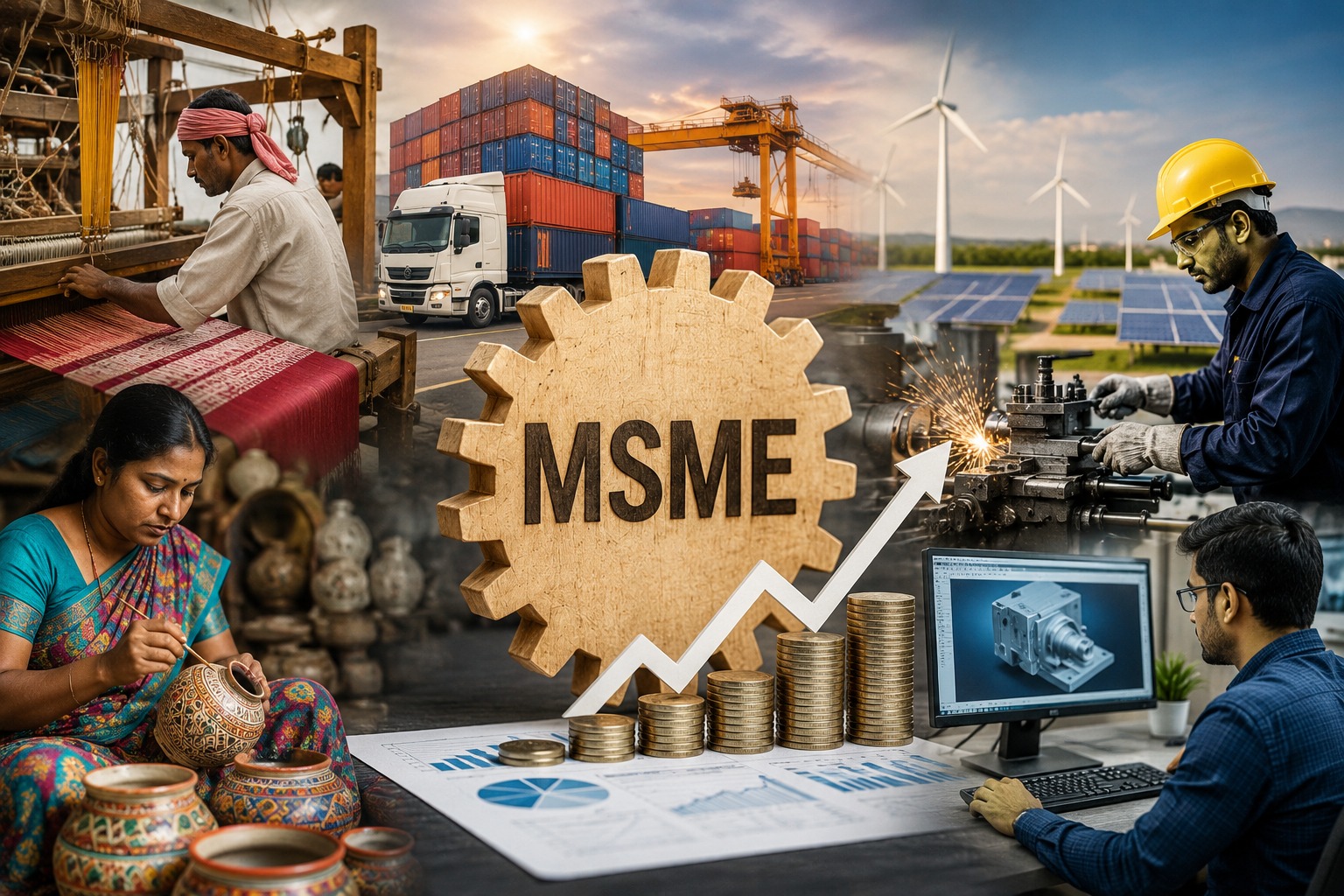
Whether it is a weaver preserving generations of craftsmanship in Kutch, a furniture manufacturer in Punjab, a coir producer in Kerala, a machine component supplier in Coimbatore, a food processing unit in Bihar or a woman entrepreneur running an online handicraft business from a small town, these enterprises demonstrate the remarkable diversity of India’s entrepreneurial landscape. They are proving that economic transformation is not driven only by large corporations but equally by millions of ordinary citizens who convert skills into livelihoods and ideas into enterprises.
Their contribution extends well beyond economic statistics. MSMEs generate employment where it is needed most, create opportunities in regions often overlooked by large industries, preserve traditional skills while embracing modern technologies, and serve as the bridge between local aspirations and national development.
In many ways, the future of India’s economy may depend less on how many billion-dollar companies it creates and more on how effectively it empowers its millions of smaller enterprises.
The Invisible Backbone of the Economy
The scale of India’s MSME sector is staggering.
According to recent government estimates, MSMEs contribute around one-third of India’s Gross Domestic Product, over one-third of manufacturing output and nearly half of the country’s exports. More importantly, they employ close to 39 crore people, making them the second-largest source of employment after agriculture.
These numbers reveal an important reality often overlooked in economic debates.
While large corporations dominate market capitalisation and public attention, employment generation in India continues to depend overwhelmingly on smaller businesses. Every successful MSME supports not just entrepreneurs but entire ecosystems of suppliers, transporters, retailers, artisans, service providers and skilled workers.
Unlike capital-intensive industries that rely heavily on automation, MSMEs remain labour-intensive. Their growth therefore translates directly into livelihoods.
This becomes especially significant for a country where millions of young people enter the workforce every year.
India’s demographic dividend can become an economic dividend only if sufficient employment opportunities are created. MSMEs possess the unique ability to absorb this workforce across manufacturing, services, agriculture-related industries and emerging digital sectors.
In that sense, strengthening MSMEs is not merely an industrial policy objective. It is an employment strategy, a poverty reduction strategy and a social stability strategy rolled into one.
From Informality to Formalisation
One of the most significant transformations witnessed over the past decade has been the gradual formalisation of India’s small business ecosystem.
Historically, a large proportion of micro enterprises operated outside the formal economy. Limited documentation, poor access to banking, lack of official registration and dependence on informal credit constrained their growth.
Formalisation has begun changing that landscape.
The rapid expansion of the Udyam Registration Portal and the Udyam Assist Platform has brought millions of enterprises into the formal economic system. Registration is no longer merely an administrative exercise. It opens doors to institutional finance, government procurement, technology support, training programmes and market access.
Digitalisation has further accelerated this transition.
Unified Payments Interface (UPI), GST compliance systems, digital bookkeeping, e-commerce platforms and online banking have fundamentally altered how small businesses operate. Even enterprises located in remote districts increasingly conduct transactions digitally, access online marketplaces and connect with customers beyond geographical boundaries.
This digital transformation has reduced transaction costs, increased transparency and improved financial inclusion.
Perhaps more importantly, it has expanded aspirations.
Today’s village entrepreneur is no longer limited by the boundaries of the local marketplace.
Entrepreneurship Beyond Metropolitan India
India’s entrepreneurial story is no longer confined to metropolitan cities.
Some of the most exciting developments are taking place in smaller towns, rural districts and aspirational regions.
Women entrepreneurs are building home-based enterprises through digital platforms. Traditional artisans are finding international buyers through e-commerce. Young innovators are establishing manufacturing units in districts once considered economically backward.
This decentralisation of entrepreneurship carries profound implications for balanced regional development.
Large industries naturally gravitate towards urban centres with better infrastructure and logistics. MSMEs, however, possess the flexibility to flourish even in semi-urban and rural areas, provided they receive adequate policy support.
This dispersal of economic activity reduces migration pressures, generates local employment and stimulates regional economies.
It also contributes to greater social inclusion.
For first-generation entrepreneurs lacking inherited wealth or business backgrounds, MSMEs often provide the most accessible pathway into enterprise ownership.
Women Changing the Enterprise Landscape
One of the most encouraging aspects of India’s MSME transformation is the growing participation of women entrepreneurs.
Across sectors ranging from food processing and textiles to digital services and handicrafts, women are increasingly establishing businesses that combine economic independence with social empowerment.
Government initiatives encouraging women’s entrepreneurship, easier credit access, self-help group networks and digital commerce have created new opportunities.
Yet significant challenges remain.
Women-led enterprises continue to face barriers in accessing institutional finance, formal property ownership, business mentorship and market networks.
Bridging these gaps represents not merely a gender equity objective but an economic imperative.
Numerous international studies have consistently shown that increasing women’s participation in entrepreneurship contributes substantially to GDP growth, employment generation and household welfare.
When women build enterprises, communities often prosper alongside them.
Traditional Skills, Modern Markets
Perhaps one of the most remarkable aspects of India’s MSME ecosystem is its ability to combine tradition with innovation.
For centuries, India’s artisans have preserved extraordinary skills in weaving, pottery, carpentry, metalwork, handloom, bamboo products, leatherwork and numerous other crafts.
Many of these traditional occupations faced decline as industrialisation, changing consumer preferences and imported products altered market dynamics.
Recent policy interventions have attempted to reverse this trend.
Schemes supporting artisans, cluster development, skill upgradation, digital marketing and design innovation are helping traditional enterprises compete in modern markets.
The success of many artisans illustrates that preserving heritage need not conflict with economic growth.
Instead, heritage itself can become a source of competitive advantage.
Consumers increasingly value authenticity, sustainability and handcrafted products—qualities deeply embedded in India’s traditional industries.
Supporting these sectors therefore preserves both livelihoods and cultural identity.
Credit Remains the Lifeblood
Despite remarkable progress, access to affordable finance continues to be one of the greatest challenges facing MSMEs.
Banks have historically perceived smaller enterprises as higher-risk borrowers due to limited collateral, inadequate financial records and uncertain market conditions.
Consequently, many entrepreneurs have depended on informal lenders charging prohibitively high interest rates.
Collateral-free credit guarantee schemes, digital credit assessment models and equity support mechanisms have improved access to institutional finance.
However, the financing gap remains substantial.
Many viable businesses continue struggling to obtain working capital precisely when expansion opportunities emerge.
Access to timely finance often determines whether a promising enterprise evolves into a successful business or remains trapped at a subsistence level.
Addressing this financing gap must therefore remain a policy priority.
Innovation Is No Longer Optional
The popular perception that innovation belongs exclusively to technology startups is increasingly outdated.
Today’s MSMEs compete in highly dynamic markets shaped by automation, artificial intelligence, digital commerce and rapidly changing consumer expectations.
Innovation is no longer confined to research laboratories.
It includes improving production processes, enhancing product quality, adopting environmentally sustainable manufacturing, reducing waste, strengthening supply chains and responding quickly to market demand.
Technology centres, incubation programmes and design support initiatives have begun equipping MSMEs with these capabilities.
Yet technological adoption remains uneven.
While many enterprises have embraced digital tools, countless smaller firms continue operating with outdated machinery and limited technical expertise.
Bridging this technological divide will determine whether India’s MSMEs merely survive or emerge as globally competitive enterprises.
The Persistent Challenges Beneath the Success Story
While the achievements of India’s MSME sector are substantial, celebrating its progress without acknowledging its persistent vulnerabilities would present an incomplete picture. Behind every success story lies a host of structural challenges that continue to limit the sector’s full potential.
Access to finance, though improving, remains uneven. Many micro-enterprises—particularly those operating in rural and semi-urban areas—still struggle to obtain affordable working capital. Financial institutions often demand documentation, collateral, or credit histories that first-generation entrepreneurs simply do not possess. As a result, countless businesses continue to rely on informal borrowing, where high interest rates erode already thin profit margins.
Delayed payments remain another chronic problem. Large corporations and even government departments frequently take months to clear dues owed to small suppliers. For a large company, delayed payments may be an accounting issue; for a micro-enterprise, they can become an existential crisis. Salaries must still be paid, raw materials purchased, and production maintained, even when invoices remain unpaid.
Although initiatives such as the MSME Samadhaan Portal and the Online Dispute Resolution mechanism have strengthened grievance redressal, technology alone cannot solve a problem rooted in business culture. Timely payment must become a legal and ethical obligation rather than an administrative formality. Protecting cash flow is perhaps the single most effective way to strengthen the resilience of small businesses.
Infrastructure gaps also continue to constrain growth. While India’s highways, logistics networks and digital infrastructure have improved significantly, many MSMEs still operate in industrial estates with unreliable electricity, inadequate warehousing, limited testing facilities and poor last-mile connectivity. These deficiencies increase production costs and reduce competitiveness, particularly for enterprises attempting to integrate into global supply chains.
Competing in a Rapidly Changing World
The global economy is undergoing profound transformation. Automation, artificial intelligence, advanced manufacturing, digital commerce and shifting consumer preferences are redefining competitiveness across industries.
For MSMEs, adapting to these changes is no longer optional.
Small enterprises that fail to modernise risk losing relevance in increasingly competitive domestic and international markets. Productivity, quality assurance, design innovation and technology adoption have become essential determinants of survival.
This is where India’s expanding network of Technology Centres, incubation hubs and programmes promoting lean manufacturing and Zero Defect Zero Effect (ZED) certification assume strategic importance. They are helping enterprises move beyond low-cost production towards higher quality, greater efficiency and environmentally sustainable manufacturing.
However, technology adoption remains uneven. Thousands of MSMEs continue to rely on outdated machinery, manual production processes and limited digital capabilities. Many lack awareness of available support schemes, while others struggle to absorb the costs associated with technological upgrading.
Building a globally competitive MSME sector therefore requires more than financial incentives. It demands sustained investments in skill development, research, innovation, design capabilities and technology transfer.
In the coming decade, India’s competitive advantage will increasingly depend not on cheap labour but on productive, technology-enabled enterprises capable of delivering high-quality goods and services.
Exports: Unlocking Global Opportunities
One of the most encouraging developments in recent years has been the growing contribution of MSMEs to India’s exports.
Nearly half of the country’s exports now originate from this sector, reflecting its ability to integrate with international markets. Whether in engineering goods, pharmaceuticals, textiles, leather products, handicrafts, food processing or information technology services, MSMEs have demonstrated remarkable adaptability.
Yet their export potential remains far from fully realised.
Many enterprises continue to face challenges in complying with international quality standards, obtaining certifications, understanding foreign regulations and accessing overseas buyers. Logistics costs remain relatively high, while fluctuating global demand creates additional uncertainty.
The emergence of digital commerce presents a significant opportunity. Online marketplaces have made it possible for even the smallest enterprises to reach customers across continents. A handloom cooperative in Assam, a bamboo craftsman in Tripura or a spice producer in Kerala can now access global markets without maintaining an international distribution network.
Supporting MSMEs in branding, packaging, certification and digital marketing could substantially increase India’s export competitiveness while diversifying its export basket.
Sustainability Is Becoming a Business Imperative
The future of manufacturing will be shaped not only by productivity but also by sustainability.
Consumers worldwide increasingly demand environmentally responsible products. Investors are evaluating companies through Environmental, Social and Governance (ESG) criteria. International markets are introducing carbon border adjustment mechanisms and stricter environmental standards.
Indian MSMEs cannot remain insulated from these developments.
The transition towards green manufacturing presents both challenges and opportunities.
Initially, adopting cleaner technologies, energy-efficient machinery and sustainable production processes may require additional investment. Over time, however, these changes reduce operating costs, improve resource efficiency and enhance market competitiveness.
Programmes encouraging Zero Defect Zero Effect certification represent important steps in this direction. They recognise that economic growth and environmental responsibility need not be mutually exclusive.
For India, promoting green MSMEs aligns with broader national objectives of sustainable development, climate resilience and resource efficiency.
The enterprises that adapt early are likely to enjoy significant competitive advantages in tomorrow’s markets.
Rural India and the Promise of Inclusive Growth
Perhaps the greatest strength of the MSME sector lies in its capacity to create opportunities where they matter most.
Unlike large manufacturing plants concentrated around metropolitan centres, MSMEs flourish across villages, small towns and emerging districts.
This geographical spread makes them uniquely positioned to reduce regional inequalities.
Schemes supporting artisans, village industries, coir production, traditional crafts and rural entrepreneurship are contributing to a more diversified rural economy. They help reduce dependence on agriculture alone while generating non-farm employment that supplements household incomes.
For millions of young people unwilling or unable to migrate to major cities, local enterprise offers dignity, income and stability.
This has profound social implications.
Strong local economies reduce distress migration, strengthen communities and allow development to become more balanced.
India’s aspiration of inclusive growth cannot be achieved through urban industrialisation alone. It requires vibrant local economies where entrepreneurship becomes accessible regardless of geography.
Entrepreneurship as Social Transformation
The true significance of MSMEs extends beyond economics.
Every successful enterprise transforms lives far beyond the entrepreneur’s own family.
It creates employment, supports suppliers, strengthens local markets and generates tax revenues that finance public services. It encourages innovation, builds confidence and inspires others to pursue entrepreneurship.
For women, entrepreneurship often translates into greater financial independence and decision-making power.
For artisans, it preserves traditional knowledge while generating sustainable livelihoods.
For young innovators, it offers an alternative to conventional employment.
For historically disadvantaged communities, enterprise becomes a pathway towards social mobility.
This multiplier effect explains why strengthening MSMEs yields benefits that extend far beyond GDP statistics.
Enterprise creates empowerment.
Building the Ecosystem of the Future
If India is serious about becoming a developed economy by 2047, supporting MSMEs cannot remain confined to isolated schemes or periodic financial packages.
What the sector requires is an integrated ecosystem.
Access to affordable finance must be complemented by simplified regulations. Skill development should be linked with technological upgrading. Research institutions must collaborate more closely with industry. Universities should encourage entrepreneurship alongside traditional employment pathways.
States and local governments also have a critical role.
Many of the obstacles confronting MSMEs—land availability, municipal clearances, infrastructure, power supply and local logistics—fall within their jurisdiction. Cooperative federalism will therefore be essential for building a nationally competitive MSME ecosystem.
Equally important is reducing compliance burdens.
Small entrepreneurs should spend more time producing goods, serving customers and innovating—not navigating excessive paperwork.
Ease of doing business should be measured not only by global rankings but by the everyday experiences of small enterprises operating across India’s districts.
The Road to Viksit Bharat Runs Through MSMEs
India’s ambition of becoming a developed nation by 2047 will require sustained high economic growth, large-scale employment generation, technological innovation and balanced regional development.
No single sector is better positioned to contribute simultaneously to all four objectives than MSMEs.
They create jobs faster than capital-intensive industries.
They stimulate local economies more effectively than highly centralised production systems.
They nurture entrepreneurship at the grassroots level.
They preserve traditional industries while embracing modern technologies.
They empower women, artisans, youth and first-generation entrepreneurs.
And they strengthen India’s resilience by diversifying the economic base.
The challenge now is to ensure that these enterprises do not merely survive but flourish.
Policy support must evolve from protection towards competitiveness. Financial inclusion must lead to business expansion. Digitalisation must translate into productivity gains. Innovation must become accessible not only to startups in metropolitan incubators but also to manufacturers in industrial clusters and artisans in remote villages.
India has often been described as a nation of entrepreneurs. What distinguishes the present moment is that public policy increasingly recognises entrepreneurship as a driver of national development rather than merely individual success.
The story of India’s MSMEs is therefore much larger than the story of small businesses.
It is the story of millions of aspirations finding expression through enterprise.
It is the story of ordinary citizens creating extraordinary economic value through determination, innovation and resilience.
It is the story of artisans preserving heritage while embracing digital markets, women transforming household skills into successful businesses, young innovators building manufacturing capabilities in small towns, and rural entrepreneurs proving that opportunity need not be confined to metropolitan India.
As India charts its course towards becoming a developed economy, skyscrapers, expressways and industrial corridors will undoubtedly remain visible symbols of progress. Yet the true strength of that transformation will continue to rest in the workshops, factories, clusters and enterprises that quietly power the nation’s economy every single day.
India’s MSMEs have already demonstrated what they can achieve when given access to finance, technology, skills and markets.
The next chapter of India’s economic story will depend on how boldly the country chooses to invest in their future.
For in the journey from enterprise to empowerment lies not only the future of millions of businesses, but the future of India’s development itself.
Comments are closed.