Baramula, Aug 12 ; For the Gujjar-Bakkarwal families living in the remote dhoks of Bandibala in north Kashmir’s Baramulla district, the arrival of the Indian Army’s community outreach team on Wednesday brought more than just medical aid—it brought the promise of a brighter future, quite literally.
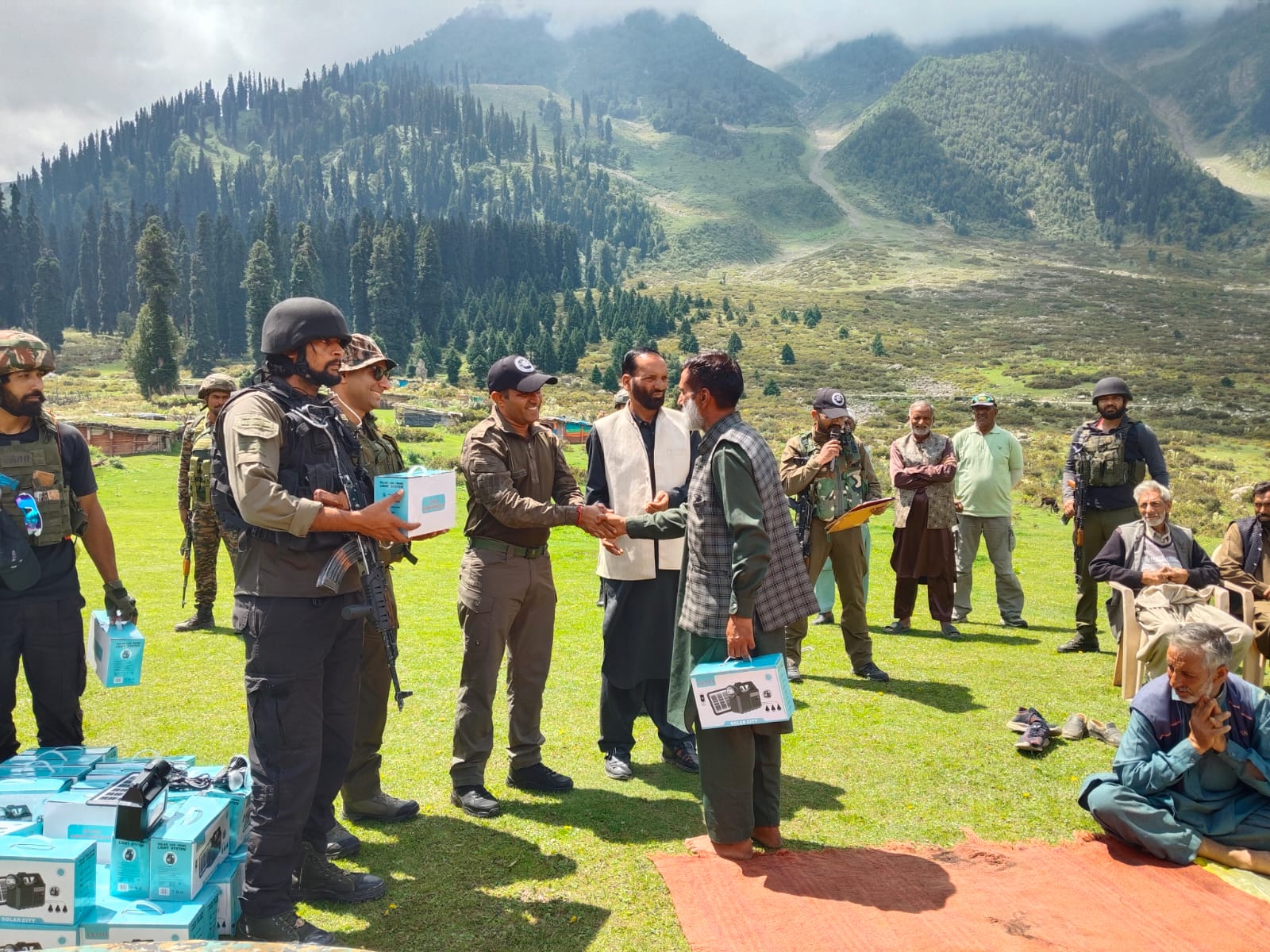
The 52 Rashtriya Rifles Battalion, under Headquarters 10 Sector Rashtriya Rifles/Counter Insurgency Force (Kilo), organised a comprehensive welfare programme at Sultanpur Kandi, distributing solar lighting systems to families and setting up a free medical camp for the nomadic tribal community. A total of 143 locals from the adjoining areas attended the event.
“Earlier, when the sun went down, the children had to stop studying. Now, with these solar lights, my grandchildren can read and write even after dark,” said Mohammad Yousuf, a community elder who has lived in the dhoks for over four decades. “This is not just a light. It is a future for our young ones,” he told Kashmir Convener.
The solar lamps, a key component of the outreach, were distributed with a specific objective: to remove a fundamental barrier to education for children in the high-altitude seasonal settlements that lack grid electricity. The initiative aims to empower students to continue their studies and build better futures.
“My son wants to become a teacher one day. But without light, how could he study? The Army sahibs have given us hope today,” shared Fatima, a young mother who brought her two children to the camp.
Beyond the distribution of solar lamps, the programme featured a free medical camp where Army medical teams provided essential healthcare services and distributed medicines to residents who often lack access to such facilities. Awareness sessions were also conducted to inform the community about various government welfare schemes and skill development opportunities.
The event also provided a platform for meaningful dialogue, with Army personnel interacting with community elders and youth to discuss local issues, explore career pathways, and encourage contributions to nation-building.
“We have lived here for generations, but rarely does anyone come to ask about our problems. Today, the Army listened to us—our health issues, our children’s education, our needs,” said Abdul Rashid, a Gujjar community leader from the area. “This interaction made us feel like we are part of this country’s progress.”
A senior Army official said the programme reflects the force’s commitment beyond its primary responsibility of safeguarding the nation’s borders. “The local populace plays a vital role in societal and nation-building. Our effort is to strengthen civil-military relations and convey the enduring message of Aman and Awam (peace and people),” the official said.
The initiative, part of Operation Sadbhavana, comes as the Army continues its efforts to bridge the gap between security forces and the local populace in the Kashmir Valley, with a focus on inclusive development and community welfare.
Notably, the Army—and especially the 52 RR—has always been on the ground to protect and safeguard the masses during any crisis, be it natural calamities or otherwise.
In the past, the 52 RR has been a ray of hope for many villages in the Kandi belt, where it played a vital role in securing the lives of the people, while also providing a helping hand and acting as a bridge between the administration and the public.


Comments are closed.