

Fiza Bashir
“Women who have a reputation, like journalists or students, or even those who publish posts frequently, are usually subjected to more coordinated forms of harassment. Anonymous users and organised groups attack them not in one comment, but in a concerted effort to humiliate them and discourage them from doing what they do.”
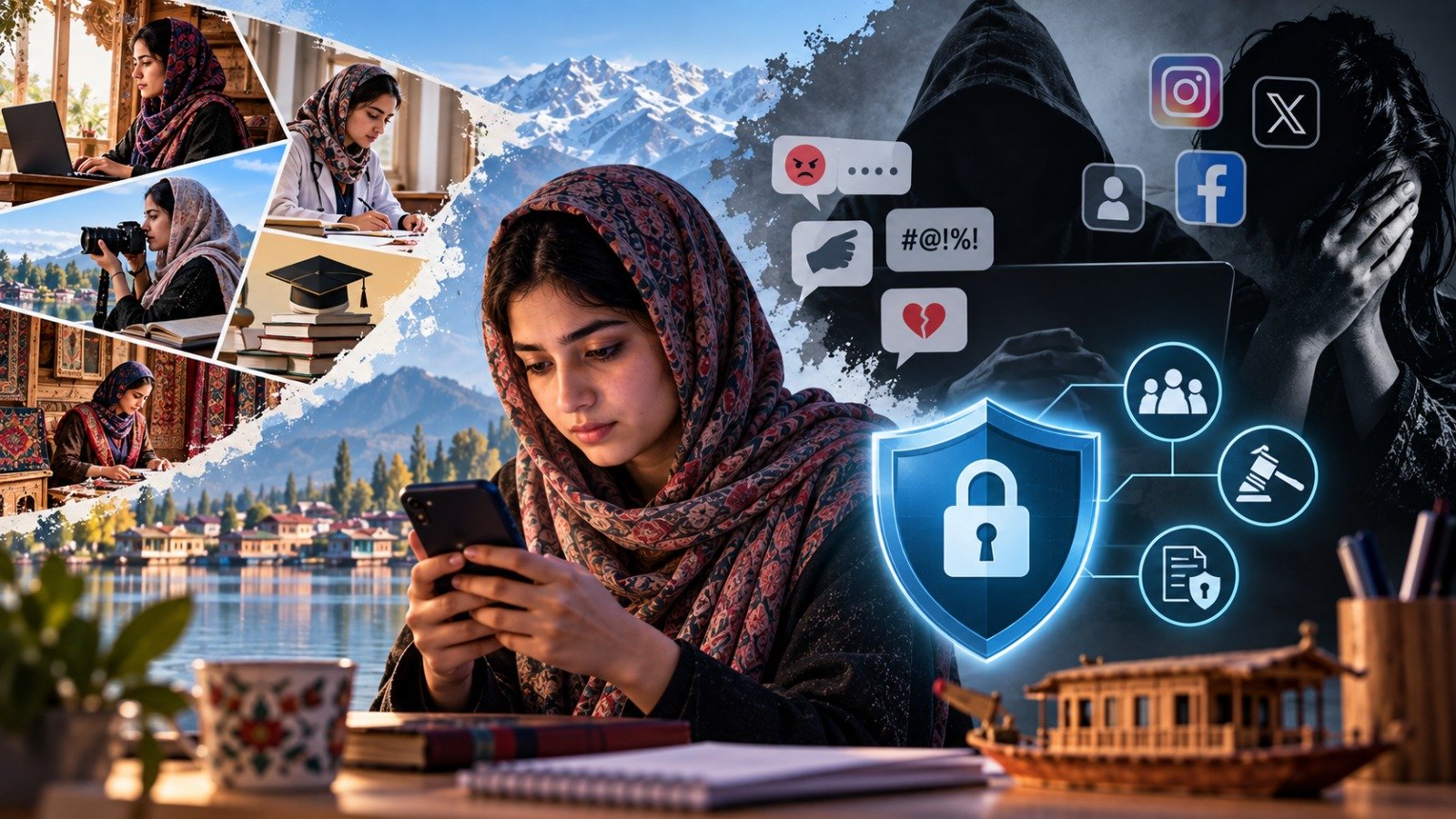
In Kashmir, women have used the internet to run businesses, earn degrees through shutdowns, and even to create content communities. However, while women gained access to such benefits, they have also become exposed to a particular kind of harassment that Kashmiri institutions have just started addressing.
According to a study at the University of Kashmir, which appeared in the peer-reviewed Journal of Cybersecurity in 2025, women experience a disproportionately high risk of cyber victimization, and it results not only in economic but physical, sexual, psychological and sexual damage. The survey of female students revealed that the major problem for women did not lie in their accounts being hacked or any financial loss but in constant messages received by strangers. Two-thirds of respondents claimed that they had to deal with continuous messaging. Moreover, about a quarter of respondents faced outright stalking or harassment. Women also experienced abusive messages on the likes of Instagram as well as account hacking, which is when someone hacks a person’s account and uses personal information against the user.
This data was considered against an even tougher background. Violence faced by women in Kashmir in their homes and out in the public sphere is common, ranging from harassment and molestation to unwanted stares and trafficking, stemming from patriarchal values. This context is the reason, according to the article, why online violence is experienced, and there is no point in reporting it.
Women who have a reputation, like journalists or students, or even those who publish posts frequently, are usually subjected to more coordinated forms of harassment. Anonymous users and organized groups attack them not in one comment, but in a concerted effort to humiliate them and discourage them from doing what they do. Not all of it is reported. Women did not see the point in reporting since they did not believe in their ability to make a difference, or they were afraid of social backlash.
A widening access gap
Such mistrust is further aggravated due to an access divide that can actually be quantified. According to data from the National Family Health Survey, it has been found that just 43 percent of the women living in the state of Jammu and Kashmir have ever gone online. The figure is somewhat higher in urban areas at 55 percent. Most of the women are those living in rural areas, which constitute the majority of the union territory’s population.
What the numbers show, and what they hide
However, there have been some years of increase in cybercrimes in Jammu and Kashmir till recently; there were 120 cases in 2020, 154 in 2021, 173 in 2022, 185 in 2023, followed by a decrease in 2024 to 114 cases, according to figures given by the National Crime Records Bureau presented by the Home Ministry in the Lok Sabha in 2024. However, Jammu and Kashmir as well as Ladakh are some of the union territories with low reporting of crimes in India; the case of Ladakh in 2024 was only one throughout the year. Nine of the 2024 cases of cybercrime in Jammu and Kashmir are related to the theft of information, three cases relate to psychological or predatory motivation, while one case relates to blackmail and fake news in social media.
This does not mean it is an improvement. According to a report that was released in 2024 by Buzz Bytes, Jammu and Kashmir reported a total of 184.91 crore rupees of cyber fraud in 2025 alone, out of which only 32.64 crore rupees were recovered by the Cyber Investigation Center, which amounts to less than 18 percent. The number is based on media information and therefore
The country-wide scenario also confirms that fear. A Parliamentary Standing Committee on the Empowerment of Women, which published its report on cyber safety in March 2026, revealed that the number of cybercrimes against women increased 239 percent at the national level between 2017 and 2022, based on NCRB statistics. However, both the committee and independent researchers have pointed out that the numbers released by the NCRB most probably underestimate the scale of the issue. According to NCRB statistics in 2023, out of 86,000 cases registered for the entire spectrum of cybercrimes at the national level, there were only 10,730 cases reported of cyberstalking and cyberbullying – a category that, according to researchers, was severely underestimated when compared to the actual cases women are subjected to. An analysis of the crime statistics related to the National Cybercrime Portal, tracked separately by The420.in from 2020 to 2024, reported a 118 percent increase in crimes committed against women in cyberspace, and specifically cyberstalking, which increased by about 400 percent.
Where women can turn
However, cybercrime.gov.in remains the primary website for lodging complaints in connection with cases of crime against women and children, leading to FIR in concerned police station. In case of financial fraud, there exists a different mechanism, namely, CFCFRMS, which is also supported by the 1930 helpline, having recovered 11,158 crore rupees worth of financial losses from 32.8 lakh cases till date. Locally, it would include the Jammu & Kashmir Police Cyber Wing as well as the Women’s Police Station at Anantnag town.
Scholars studying the system of reporting have identified significant problems related to the rate of FIR registration and also concerning the caste-based differences in terms of language and connectivity, which influence the very possibility of reporting abuse. The latest development in this regard is the launch of the ‘e-Safe HER’ scheme on 22nd April, 2026, which aims to replicate the successful experience of the Digital Literacy programme implemented by the National Commission for Women, but excluding Jammu & Kashmir from its scope.
Awareness efforts, national and local
Digital Shakti, initiated by the National Commission for Women in collaboration with CyberPeace Foundation and Meta, has so far trained 4.5 lakh women across the country since 2018 and is currently in its fifth year. The Cyber Peace Foundation has created a digital resource library containing 650 hours of material in fifteen languages, including Kashmiri, which is important considering most of the safety material is available in English and Hindi. Locally, the police in Jammu & Kashmir conduct an ongoing campaign called Seva Pakhwada to educate people about scams, social media safety, and other online security measures.
Anantnag’s push
The third most populous district in Jammu and Kashmir and largely rural, Anantnag has been an increasingly prominent proving ground for the experiment. The police conducted an awareness program among the students and staff of Jawahar Navodaya Vidyalaya, Aishmuqam, in December along with awareness drives regarding new criminal laws in all the blocks of the district. Around 750 to over 1,000 policemen in different subdivisions, including Kokernag and Pahalgam have undergone internal assessments in the same laws.
However, the most significant event has been the two-day seminar on “Digital Danger: Exploring Gender-Based Cyber Violence in Jammu & Kashmir” conducted in September 2025 in Shaheed Himayun Muzammil Memorial Government Degree College Anantnag, which had sessions on cyber laws, cyber police and their operations, cyber literacy and mental health and digital platform accountability. Recently, a cyber awareness program has been conducted by the police in Government Degree College Larnoo, located about 40 kilometers away from Anantnag Town, where there was high attendance, especially by women, according to police.
The deepfake threat
Synthetic media is another growing concern. After a 2023 case wherein the face of a Bollywood actress had been superimposed on a different woman’s body in a popular video, the Indian regulatory approach to tackling synthetic media has gathered momentum. As part of the response to such cases, the government issued an advisory in November 2023 that required platforms to take down flagged deepfakes within 36 hours, and further notified new intermediary guidelines for AI-based content in February 2026, leaving a time window of three hours to respond to any takedown order.
What India needs in addition, say the researchers, is a specific law addressing this wrong in particular. There is no statute yet in India that directly addresses the problem of synthetic media; prosecutors use clauses never intended to deal with artificial intelligence, such as provisions related to voyeurism, stalking, extortion and obscenity contained in the Bharatiya Nyaya Sanhita as well as the IT Act. The consequence is what some legal experts refer to as “nudify” extortion, already driving women away from being active online.
“The numbers released by the NCRB most probably underestimate the scale of the issue. For many women, online violence remains underreported because they do not believe reporting will make a difference or fear the social backlash that may follow.”
Comments are closed.