IIT Madras Campus Shows How Wildlife Can Coexist With People
At IIT Madras, spotted deer and blackbuck share a 661-acre campus with thousands of students; offers Kashmir some lessons on habitat protection and managing human-wildlife interaction.
Chennai: In most cities, a deer crossing a busy road would be an unusual sight. At the Indian Institute of Technology (IIT) Madras, it is part of everyday campus life.
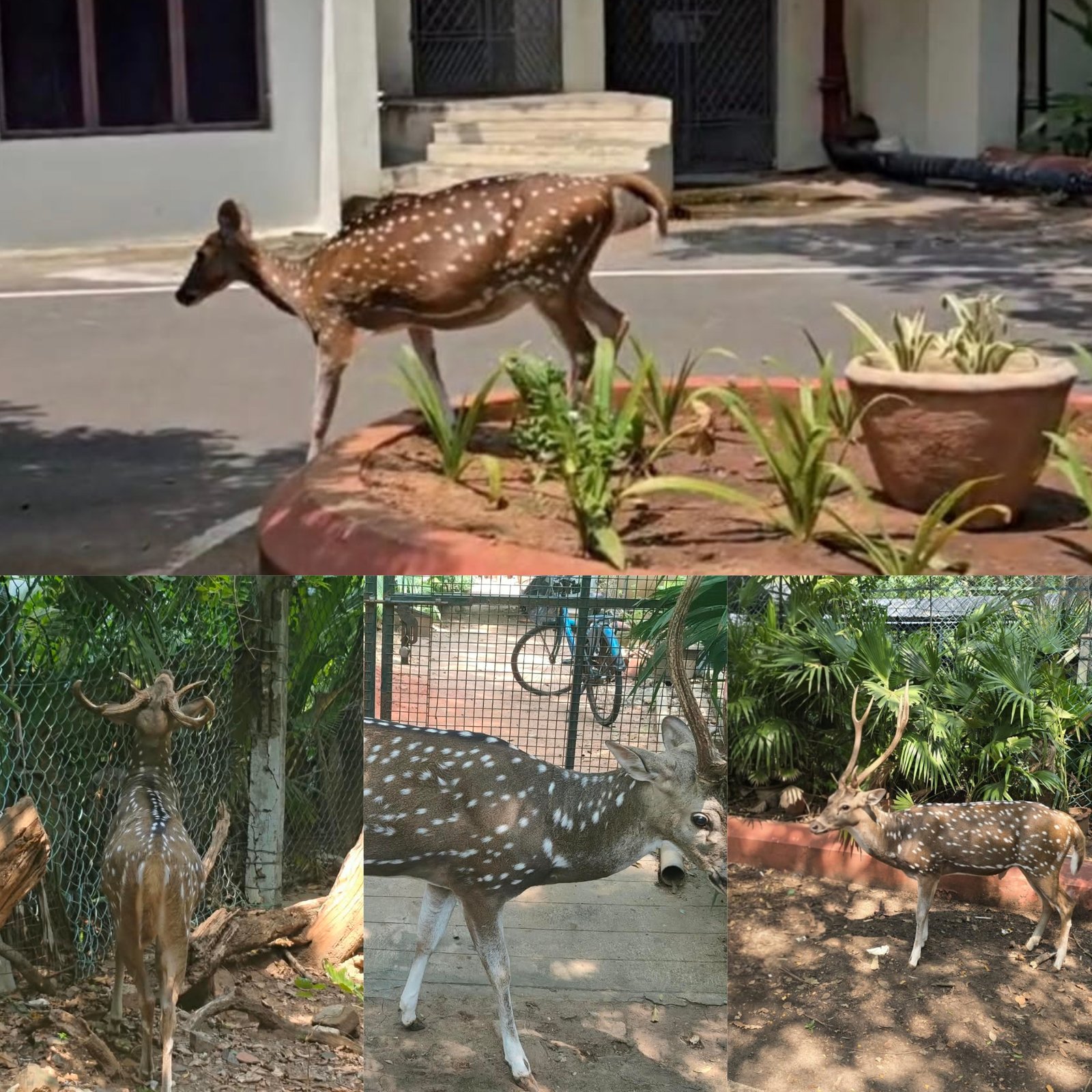
Inside the institute’s 661-acre campus, spotted deer move through lawns, forest patches and open spaces while thousands of students, faculty members and staff go about their daily routines. Deer can be seen near hostels, crossing campus roads or grazing close to academic buildings.
The animals are not kept completely separate from human activity. Instead, students and wildlife share the landscape, with campus practices aimed at limiting disturbance and reducing risks to animals.
“In fact, humans have become part of their ecosystem and they have wholeheartedly accepted the intrusion,” a student told Kashmir Convener.
The experience offers an interesting point of comparison for Kashmir, where the conservation of the Hangul, or Kashmir stag, remains a major concern.
IIT Madras is located next to Guindy National Park and describes its campus as an “ecological island” outside protected areas. The institute says its green landscape supports around 300 species of trees and plants and about 35 species of fauna, including blackbuck. The campus also supports a large variety of birds, butterflies, reptiles and other wildlife.
Spotted deer are among the most visible animals on the campus. IIT Madras has reported that its blackbuck population increased from 12 in 2021 to 77 in 2025.
Officials said the campus itself contains several distinct habitats, including open grasslands, wetlands, forest patches and scrubland. “These provide space for different forms of wildlife, from blackbuck and spotted deer to jackals, mongoose, monkeys and squirrels, as well as reptiles and insects,” he added.
He said the ecological character of the campus is linked to the natural landscape of the Coromandel Coast.
The institute campus was carved out of a natural forest that was once part of the area now associated with Guindy National Park. “Both the campus and the national park contain vegetation associated with the tropical dry evergreen forest ecosystem, one of the less common vegetation types in India”.
However, the campus’s biodiversity has not remained entirely untouched. Institutional material notes that following the establishment of IIT Madras, some native species were replaced by exotic avenue trees and garden plants. The continuing presence of native wildlife has nevertheless made biodiversity management an important part of the campus environment.
One of the most visible measures aimed at reducing human-wildlife conflict is the regulation of vehicle movement.
“One of the simplest measures is a speed restriction and ban to physically touch any animal,” an official said. Vehicles on the campus are limited to 20 kmph, reducing the risk of collisions with animals moving across roads and open spaces.
The campus also has a strong cycling culture. Students commonly use bicycles to travel between hostels, academic departments and other facilities, while e-rickshaws provide another option for movement within the campus.
Students and visitors are discouraged from approaching or touching the animals. The objective is to minimise human interference and allow wildlife to retain its natural behaviour.
“We want to keep their habitat natural as much as possible,” an IIT Madras official said.
The institute has also sought to factor ecological considerations into campus development. Officials said wildlife habitats and movement corridors are considered while undertaking construction and other development activities.
A key part of this effort is Prakriti, the Wildlife Club of IIT Madras, which was founded in April 2002 by wildlife enthusiasts from among students, faculty, staff, residents and alumni.
The club emerged from a growing recognition of the need to protect the unique biodiversity of the campus. Its activities include creating awareness about wildlife and environmental issues through nature walks, treks, talks, discussions and publications.
Prakriti also documents the flora and fauna of the campus, helping residents understand the ecological character of an environment that is otherwise primarily known as an academic and research institution.
The IIT Madras experience raises a broader question for Kashmir: can educational and institutional spaces be planned in ways that allow wildlife to survive without constant conflict with people?
The comparison, however, is not about replicating the IIT Madras campus model in Kashmir. The ecological conditions of Chennai and Kashmir are very different. The relevant lessons are the underlying principles—retaining natural spaces, controlling vehicle speeds, protecting animal movement routes and limiting unnecessary human interference.
“The comparison is not about replicating the IIT Madras model in Kashmir. It is about examining the principles behind it—retaining natural spaces, controlling vehicle speeds, protecting animal movement routes and limiting unnecessary human interference,” Kashmiri journalist Faisal Bukhari, who visited the campus, told Kashmir Convener.
Bukhari said Kashmir had also been witnessing growing pressure from construction and the conversion of natural and agricultural land, which, in his view, had contributed to increasing human-animal interaction.
“We have not been able to implement such strict measures to conserve wildlife,” he said.
For Kashmir, where the Hangul survives in a much more fragile conservation environment, the IIT Madras experience may therefore be less about deer roaming a campus and more about how human behaviour and institutional planning can influence the spaces available to wildlife.
“The IIT Madras campus shows that the presence of wildlife does not necessarily have to mean keeping people and animals completely apart. With planning, habitat protection and simple restrictions on human behaviour, an educational institution can remain a functioning urban space while also providing room for wildlife,” Bukhari said.
“The lesson is not that wildlife conservation requires turning campuses into forests. Rather, it is that even heavily used institutional spaces can retain ecological value when natural habitats are recognised as part of the landscape and development is planned around them”.


Comments are closed.