


Paul Mohsin Ali
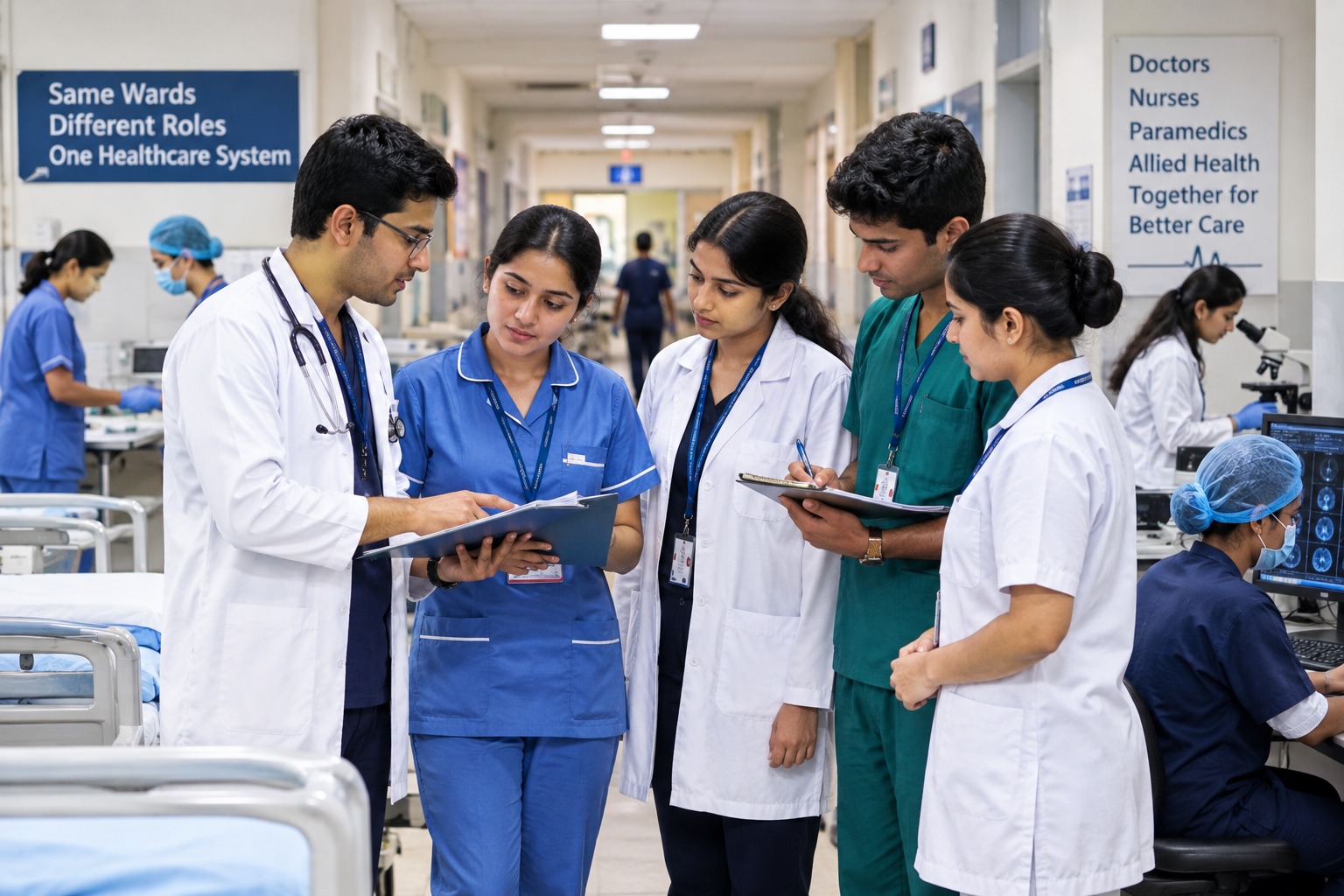
The hospital corridors may have different uniforms, different responsibilities and different professional titles. But behind every uniform is a student preparing to become a healthcare professional. They deserve to learn. They deserve to be respected. And where their clinical contribution and financial burden justify it, they deserve to be supported as well.
The ongoing demand by MBBS interns in Jammu and Kashmir for an increase in their monthly stipend from ₹12,300 to ₹30,000 deserves serious consideration. Medical interns work long hours, face demanding clinical responsibilities, attend emergencies and night duties, and play an important role in the functioning of hospitals. Their demand for fair and dignified compensation is completely legitimate.
However, while this discussion is taking place, there is another important issue that deserves attention but often remains unnoticed. What about the nursing and allied-health interns who are working in the same hospitals, walking through the same corridors and contributing to the same healthcare system?
This is not an argument against MBBS interns or their demand for a higher stipend. Rather, it is a request to broaden the conversation about fairness and recognition to include the entire healthcare team.
A hospital does not function through doctors alone. Patient care is the result of the combined efforts of doctors, nurses, laboratory professionals, radiology and imaging professionals, operation theatre and anaesthesia professionals, physiotherapists, pharmacists, technicians and many other healthcare workers. Every profession has its own responsibilities, skills and areas of expertise, but together they form the foundation of a functioning healthcare system.
For nursing and allied-health students, internship is not simply a formality at the end of their course. It is the period when theoretical knowledge is converted into practical professional skills. Nursing interns learn to provide bedside care, monitor patients, assist in procedures, maintain records and work as part of a clinical team. Laboratory interns work with diagnostic investigations and specimens. Imaging interns learn to operate and assist with diagnostic equipment and patient procedures. Operation theatre and anaesthesia technology interns work around surgical procedures, equipment, infection-control practices and patient safety.
They may work under supervision, but their clinical training takes place in real hospital environments, among real patients and within departments that are often already under considerable pressure.
This raises an important question: if clinical internship is considered valuable enough to provide financial support to one category of healthcare interns, should the financial concerns of other healthcare interns not also be considered?
The answer does not necessarily have to be that every profession receives exactly the same amount. Different courses have different training structures, responsibilities, durations and regulatory requirements. Fairness does not always mean identical treatment. Fairness means having a transparent and rational system through which the contribution, workload and financial burden of different healthcare trainees are properly recognised.
The issue becomes even more important when nursing and allied-health students face significant educational and personal expenses. Many students already pay tuition fees, examination charges, registration fees, accommodation costs, transportation expenses and other costs associated with their education. If students are also required by particular institutions to pay charges associated with clinical training or internship, such practices deserve proper examination and transparency.
Students have a legitimate right to ask where such charges come from, what they cover, who collects them and whether they are part of an officially approved fee structure.
An internship is meant to prepare a student for professional life. It should be a period of learning, supervised clinical practice and development of confidence and competence. For students who are already carrying the financial burden of professional education, the internship period can become particularly difficult when they are required to bear additional expenses without any form of financial support.
At the same time, this discussion should not become a competition between doctors, nurses and paramedical professionals. Healthcare is not a race in which one profession has to prove that it works harder than another.
An MBBS intern’s contribution is important. A nursing intern’s contribution is important. An allied-health intern’s contribution is important. Their roles are different, but their importance to patient care should not be measured simply by the title of their degree.
When a patient enters a hospital, the outcome depends on a team. The doctor may diagnose and prescribe treatment, but the nurse provides continuous bedside care. Laboratory professionals provide essential diagnostic information. Imaging professionals assist in identifying disease. Operation theatre and anaesthesia teams support surgical care. Physiotherapists contribute to rehabilitation and recovery. Pharmacists and technicians support safe and effective treatment.
The healthcare system works because these different professionals work together.
Therefore, when the government considers the welfare of healthcare interns, it would be appropriate to consider the entire clinical ecosystem rather than looking at individual professions separately.
The present debate over the MBBS internship stipend can become an opportunity for a larger and more constructive policy discussion in Jammu and Kashmir. Instead of asking why one profession deserves support while another does not, policymakers can ask a more meaningful question: how can the government establish a fair, transparent and sustainable internship-support policy for all recognised healthcare disciplines?
Such a policy could consider the duration of internship, clinical workload, working hours, patient contact, responsibilities, emergency duties and the financial burden placed on students.
Supporting MBBS interns in their demand for a fair stipend does not require ignoring nursing or allied-health interns. In fact, recognising the concerns of one group should encourage us to look at the concerns of others as well.
The objective should not be to take something away from anyone. The objective should be to ensure that no group of healthcare trainees feels invisible.
Jammu and Kashmir needs skilled doctors, nurses and allied-health professionals. The future strength of the healthcare system depends on all of them. If we want young professionals to enter these fields with confidence and dedication, we must also ensure that their training years are not made unnecessarily difficult by financial burdens and unequal policies.
The question, therefore, is not whether doctors work harder than nurses or whether nurses contribute more than paramedics. Such comparisons only divide a system that depends on teamwork.
The real question is much simpler: If healthcare is a team, should the dignity and welfare of its trainees also be considered as a team?
The hospital corridors may have different uniforms, different responsibilities and different professional titles. But behind every uniform is a student preparing to become a healthcare professional.
They deserve to learn. They deserve to be respected. And where their clinical contribution and financial burden justify it, they deserve to be supported as well.
This is not MBBS versus nursing.
This is not doctors versus paramedics.
This is a call for fairness across the healthcare system.Same wards. Different roles. One healthcare system. One shared expectation of dignity.
Comments are closed.