

Rafeeq Masoodi
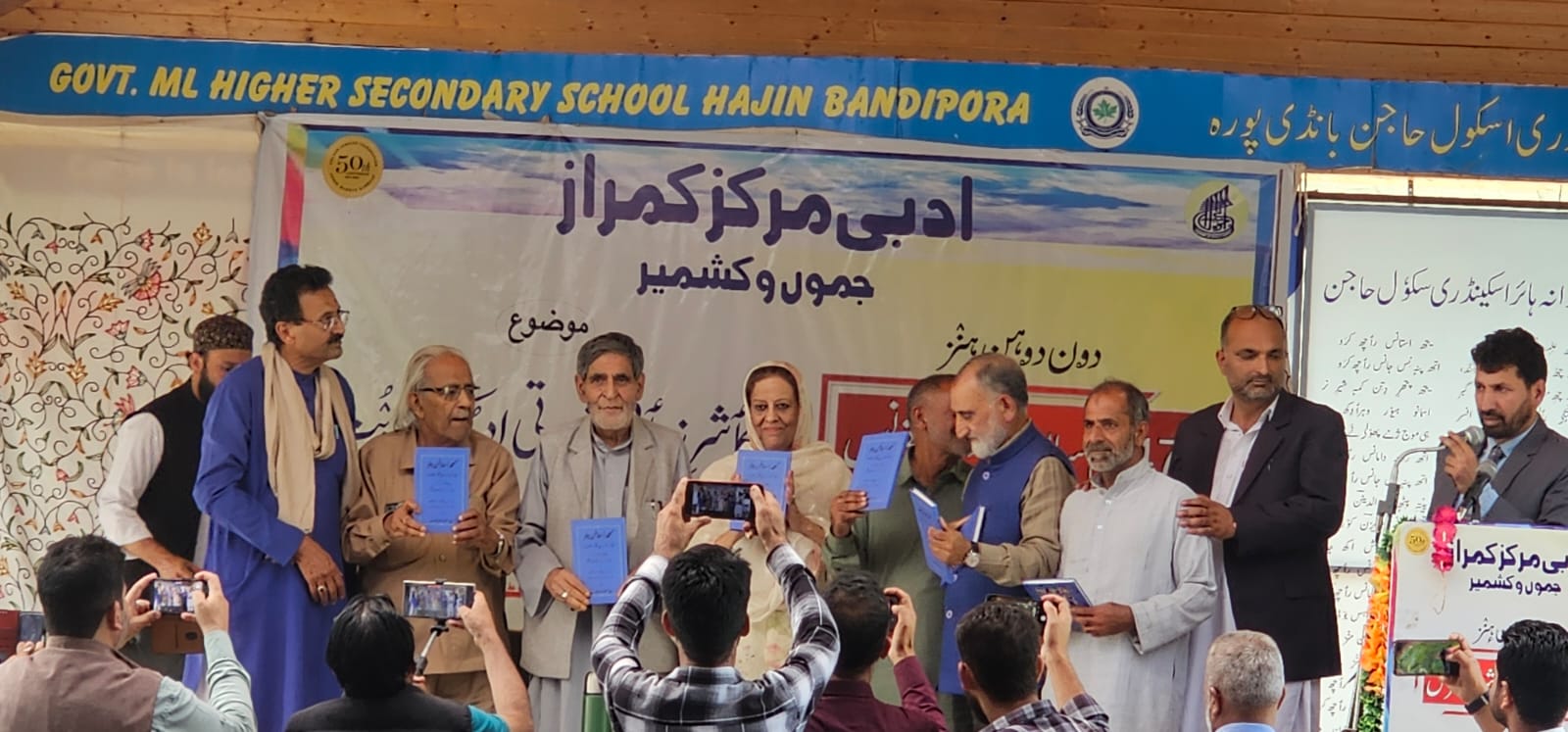
There are some books that one reads for information, some for pleasure, and some because they carry a part of one’s collective memory. The commemorative volume of Adbi Markaz Kamraz, released at Hajin during the inaugural session of its 47th two-day annual conference, belongs to the third category.
I do not wish to review this journal as a member or office-bearer of Adbi Markaz Kamraz. I approach it as an ordinary reader who loves his mother language and believes that love for a language is not merely an emotional attachment but a responsibility. I have always considered myself a servant of art, culture, languages and, in my own small way, of Adbi Markaz Kamraz.
It was in that capacity, rather than as a Patron standing on a stage, that I looked at Prave, the Kashmiri journal released at Hajin, Bandipora.
And what I saw in it was not simply a book. I saw memory being rescued from oblivion.
I saw a movement trying to remember where it came from, what it stood for and what it still owes to the language in whose name it has worked for decades.
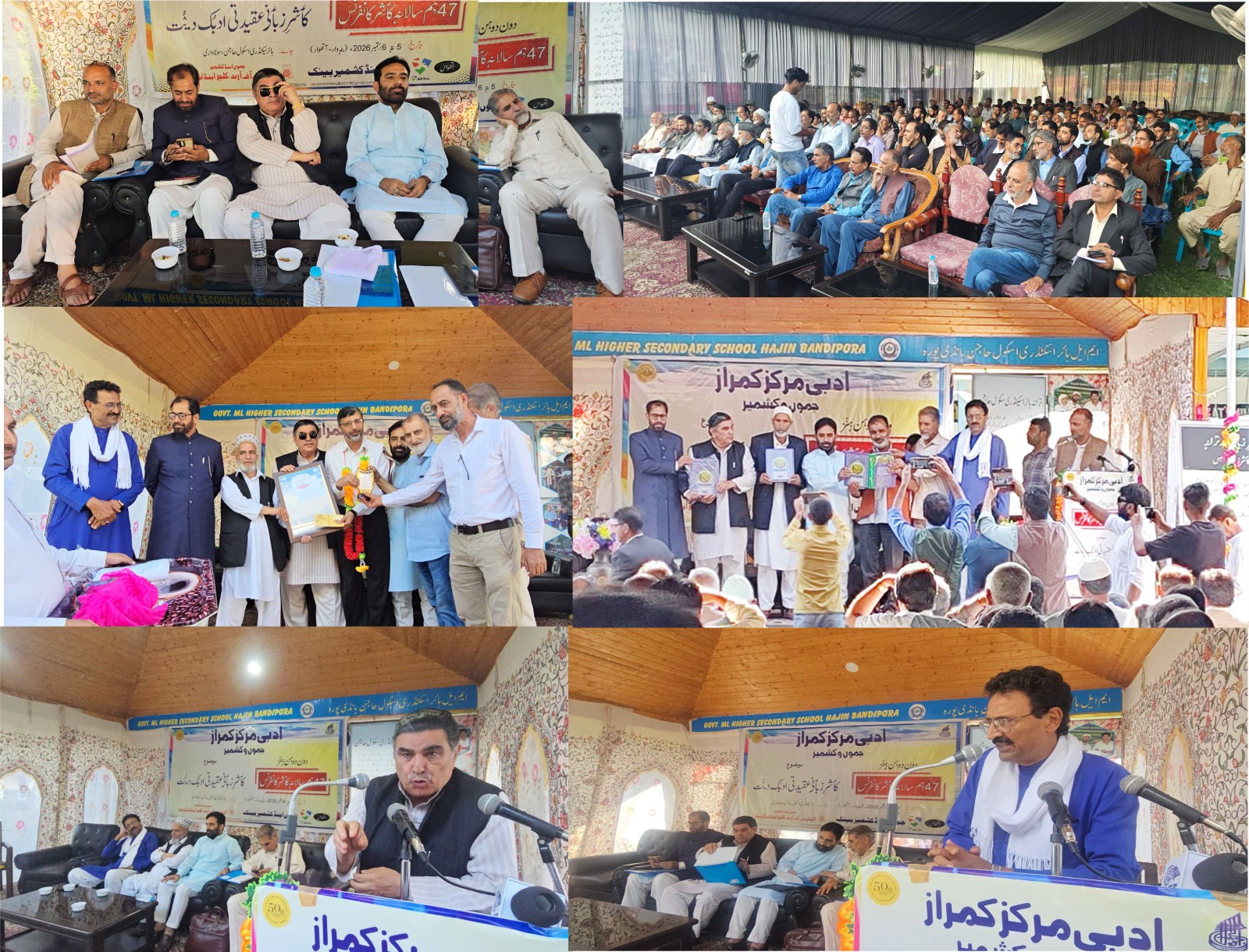
The occasion itself was historic. The 47th annual conference was held at Government M.L. Higher Secondary School, Hajin, under the chairmanship of Justice (Retd.) Bashir Ahmad Kirmani and Moulana Shoukat Hussain Keng, in the presence of veterans, scholars, writers and an audience of around 300 people drawn from different parts of the Valley.
The gathering deserved attention not simply because of its size, but because of where it took place.
Hajin was not selected as a venue merely for convenience. It was selected because history had brought the Kamraz movement here long before any of us standing on that stage were born.
In 1957, Halqa-e-Adab Sonawari was formed in Hajin in a small room by a few teachers who had neither money nor an office. What they possessed was something more powerful and, in retrospect, more enduring: a love for Kashmiri.
From that modest beginning emerged a wider literary movement. Today, Adbi Markaz Kamraz has around 30 units extending across different parts of the Valley, from Uri and Karnah to Sonawari.
To return to Hajin after all these years was therefore not simply to organise another conference. It was to return to a point of origin.
And to release a volume documenting that journey at the place where one chapter of the journey began was, in a sense, a debt being repaid.
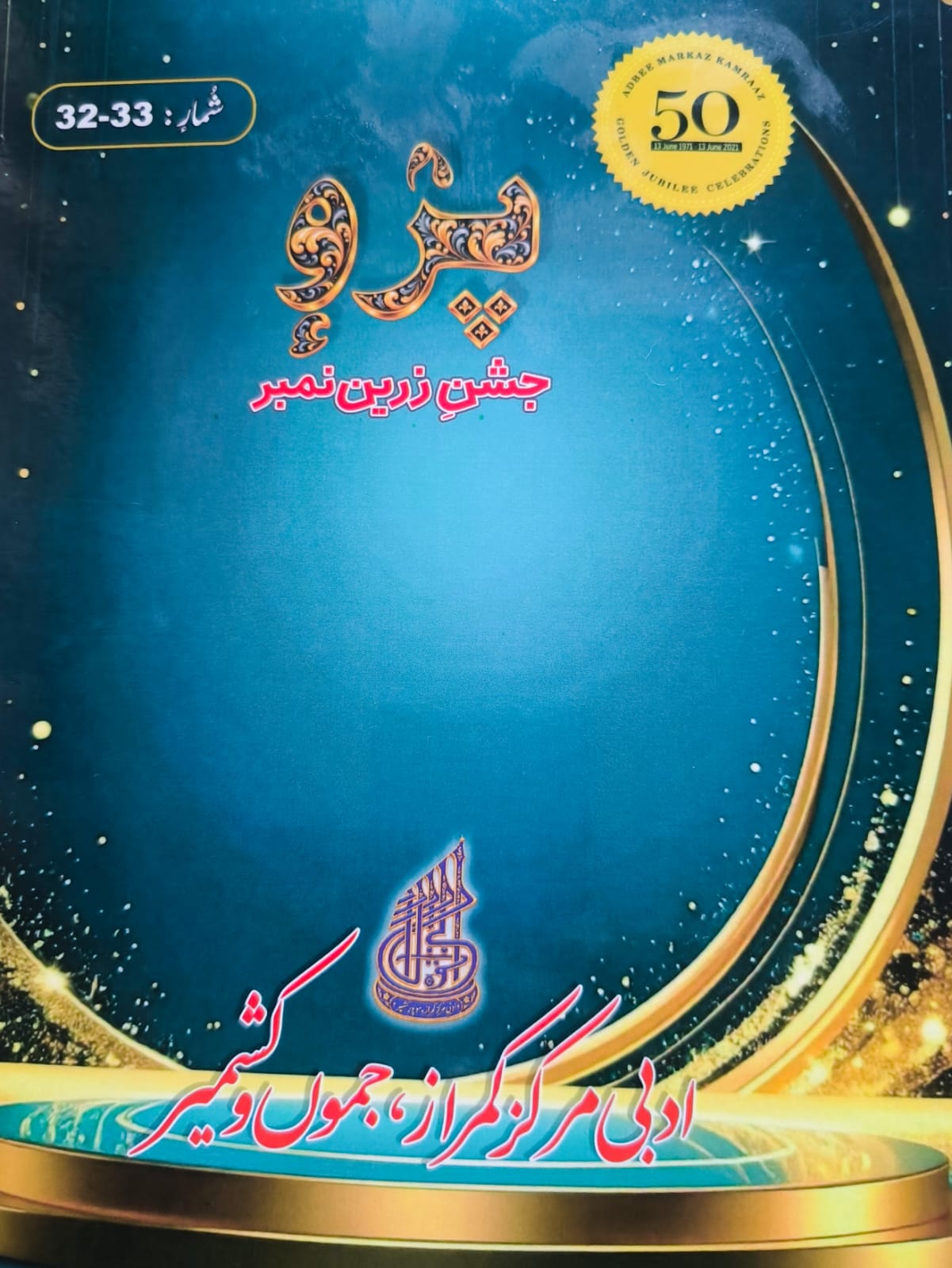
What exactly is Prave?
For years, people have asked what Adbi Markaz Kamraz really is. Is it a literary society? A cultural organisation? A club? A platform for poets and writers?
The volume attempts to answer that question through its pages.
Its arrangement—42 articles divided into nine sections and spread across nearly 250 pages—makes it much more than a commemorative publication. It is an attempt to assemble a scattered institutional memory.
Most importantly, it is not the work of one author. It is a book written by many. That distinction matters.
The history of literary movements is rarely preserved in official archives. Much of it survives in the memories of people who participated in it, in old resolutions, letters, journals, photographs, meeting records and personal collections. When those people pass away, an important part of that history can disappear with them.
For years, much of the story of Adbi Markaz Kamraz existed in exactly this fragile form—in memories, files and cupboards, including the material preserved at Kanispora, Baramulla.
Prave takes some of that history out of the cupboard and puts it into public memory.
The first two sections, Pout-e-Nazar and Rowte Raftaar, provide the foundation. Abdul Khaliq Shams, who has devoted five decades to the Markaz, contributes an account of its 50-year history. His essay is valuable precisely because it is not history reconstructed from distant sources. It is history remembered by someone who lived through much of it.
Majeed Majazi’s account of the early pioneers takes the reader back to a time when literary work did not have the institutional support that organisations often expect today. Writers and activists travelled from village to village, sometimes cycling long distances, collecting poetry and nurturing literary activity with very limited resources.
That picture is worth remembering in an age when cultural activity is often measured through conferences, banners, stages and official support.
Movements do not begin with large budgets. They begin with people who believe something is worth preserving.
Other contributions, including those by Dr Riyaz-ul-Hassan and Zameer Ansari, remind readers that the Markaz’s history was never limited to literary gatherings. Its resolutions and interventions reflected larger concerns about the place of Kashmiri in public life.
The demand for inclusion of Kashmiri in competitive examinations, the defence of the Nastaliq script and the advocacy for greater recognition of the language were not merely literary questions.
They were questions of linguistic dignity. Even the contemporary demand for Classical Language status for Kashmiri acquires a different meaning when one discovers that the organisation had raised the issue years ago.
A movement’s slogans become more meaningful when they are understood as part of a longer journey.
A literary organisation—or a movement?
The third section, Adbi Markaz Kamraz te Kashmir, perhaps comes closest to answering the question of what Kamraz has represented.
The contributions of scholars and writers such as Prof. Farooq Fayaz, Prof. Zaman Azurda, Prof. Shad Ramzan, Mushtaq Ahmad Tanqeedi and Shahida Dolly point towards a larger interpretation of the organisation.
Kamraz was never simply a society where poets gathered to read their latest compositions. It was a tehreek. A movement concerned with the survival, development and public presence of Kashmiri.
The phrase Akh Hijras Manz Tehreek carries particular weight in this context. Kashmir’s literary and cultural history has been marked by migration, displacement and separation, but it has also been marked by the persistence of cultural memory despite these disruptions.
One of the quieter achievements documented in the volume is the effort to rediscover forgotten poets.
More than 70 such poets have reportedly been brought back into literary discussion through the organisation’s work. That is an important form of cultural recovery.
Every language has a tendency to forget. Writers disappear from syllabi. Manuscripts remain unread. Oral traditions fade. Names that were once familiar become footnotes and eventually disappear altogether.
Recovering such voices is not merely an exercise in nostalgia. It enlarges the language itself. A language becomes richer when its forgotten voices are restored to the conversation.
The publication of more than 100 books with the support of public contributions, rather than dependence solely on government grants, is another part of this story.
Whatever one’s assessment of individual publications may be, the principle is important: cultural institutions become stronger when communities themselves participate in sustaining them.
A language cannot survive only because a government department allocates a budget for it. It survives when ordinary people believe that it belongs to them.
From the stage to the airwaves
The fourth section, Zariya-e-Nazar, offers another important dimension of the journey.
Languages survive not only through books. They survive through the media.
They survive when they are heard in homes, on radio programmes, on television, in public conversations and increasingly on digital platforms.
Kashmiri’s journey through radio and television helped take the language beyond literary gatherings and into everyday public life.
The work documented through contributions relating to Seerat campaigns, collective literary activities and Kashmiri news reflects this expansion.
There was a time when a literary language could remain confined to the stage—to poetry gatherings, literary conferences and publications.
Mass communication changed that possibility. Radio could take a Kashmiri voice into homes hundreds of kilometres away. Television could give the language a visual presence. Newspapers could bring Kashmiri writing into the daily rhythm of public life.
Today, the digital revolution has created an even larger opportunity.
But it has also created a greater challenge. Young people consume enormous amounts of content every day, much of it in English, Hindi and other languages. Their attention is fragmented across social media platforms, short videos, streaming services and digital entertainment.
If Kashmiri is absent from these spaces, it risks becoming increasingly associated only with older generations.
This is where the lessons of Kamraz’s past become relevant to its future. The organisation once helped take Kashmiri from the stage to radio and television. The next task may be to take it decisively from print and broadcast into the digital age.
That means podcasts, audiobooks, digital archives, children’s content, educational material, subtitled video, social media storytelling and new forms of literary expression.
A language cannot demand that young people return to yesterday’s mediums. It must meet them where they are.
Culture cannot live in museums
The later sections of Prave—covering culture, history, emotion and the visual landscape—serve as a reminder that language and culture cannot be separated.
An organisation that works for Kashmiri cannot restrict itself to poetry and literary criticism. Language is embedded in customs, family relationships, songs, food, ceremonies, folklore, architecture, humour and everyday speech.
The initiatives documented in the volume, from cultural programmes and library-building to the publication of Pragaash and the work around a traditional Kashmiri Nikah Nama, reflect an understanding of this broader responsibility.
Culture remains alive only when it is practised. The moment it becomes something displayed only on ceremonial occasions, it begins to lose its natural connection with society.
The most beautiful Kashmiri poem cannot compensate for a generation that no longer speaks Kashmiri at home. This is perhaps the uncomfortable truth that every cultural organisation must eventually confront.
We can organise conferences. We can publish journals. We can pass resolutions. We can honour scholars. We can speak passionately about the greatness of our language.
But if parents stop speaking Kashmiri with their children, if children begin to regard the language as unnecessary, and if young people find little modern content in it, the language will continue to weaken despite all our conferences.
This is why the theme of the 47th conference, concerning devotional literature in Kashmiri, was particularly relevant. Dr Satesh Vimal’s lecture on the subject connected literary heritage with the broader cultural and spiritual history of Kashmir.
Such discussions remind us that Kashmiri literature is not a narrow body of poetry and prose. It contains centuries of intellectual, spiritual and social experience.
The responsibility before today’s generation is to make that inheritance meaningful to tomorrow’s generation.
The people behind the pages
There is another part of Prave that deserves recognition: the people whose names may not occupy the centre of the stage but whose labour makes a publication possible.
A Patron’s name may appear on an invitation card. A dignitary may release a book before the cameras. But a book is actually created by people who work quietly, often without recognition.
The editorial work of Zameer Ansari and Abdul Khaliq Shams deserves particular appreciation.
They collected scattered papers, brought together material from the 46th Jammu Conference and preparations for the 47th Hajin conference, corrected texts, arranged contributions into nine sections and checked references.
This is not glamorous work. Editing rarely is. When a publication contains material in different languages and scripts, the task becomes even more demanding. Bringing different writing styles into a coherent volume requires patience and judgement.
The work of composers Manzur Shah and Jamil Ansari deserves similar acknowledgement.
Kashmiri composing in Nastaliq is not simply a matter of typing words into a computer. A misplaced zer, zabar or pesh can alter a word. Proofreading is consequently not a cosmetic exercise; it is essential to preserving meaning.
The fact that they worked late into the night, correcting and re-correcting pages, reflects the kind of invisible labour on which cultural publications depend.
And then there is Lubab Publications. The volume was reportedly taken from raw composed files to a finished, printed publication in just one week, enabling its release at Hajin.
In ordinary circumstances, book production can take considerably longer. For a publication tied to a particular conference date, the pressure must have been substantial.
Such work deserves acknowledgement not simply as a printing service but as a contribution to the preservation and promotion of language.
The names of the editors, composers and printers may not appear in the photographs that remain after a book release. But their labour remains in every page.
A movement must also examine itself
Yet a publication about 55 years of cultural work should not only celebrate the past. It should also ask difficult questions about the present. This is perhaps where Prave itself leaves an opportunity for future publications.
As a reader and servant of the institution, I would make one honest observation: the volume is perhaps too kind to the organisation it documents. Most of its contributors are associated with Kamraz. Naturally, the tone is appreciative. There is pride in the journey, and there should be.
But self-documentation can become self-congratulation if it does not leave room for uncomfortable questions. The most important question is obvious. If an organisation has worked for 55 years for Kashmiri, why is Kashmiri still losing ground in many homes?
Why do many young parents increasingly choose other languages for everyday conversation with their children? Why do many young Kashmiris consume literature and digital content almost entirely in languages other than Kashmiri? Why has Kashmiri not yet acquired the institutional and technological presence that its rich literary history deserves?
And what responsibility lies with literary organisations, families, educational institutions, governments, media organisations and the wider society? These are not questions meant to diminish Kamraz.
They are questions necessary to keep the movement alive. A future volume should therefore invite criticism from young writers, students, teachers, researchers and even people outside the organisation. An institution becomes stronger when it can listen to those who disagree with it.
The second issue is editorial. There is some repetition, particularly in the account of the organisation’s early years. The same period and events appear in more than one contribution.
This is understandable in a commemorative publication involving numerous writers, but a stronger editorial process in future editions could remove repetition and create greater narrative sharpness.
These are relatively small shortcomings when compared with the achievement of creating a permanent record. But acknowledging them is important. A servant must also tell the truth of the house.
The real patrons are elsewhere
I have been called a Patron and have sometimes been placed on the stage in that capacity. But I do not believe that the title tells the whole story. The real patrons of a cultural movement are often people whose names never appear on the invitation card.
They were the schoolteachers of Sonawari who kept literary circles alive without expecting payment. They were the writers who travelled from village to village.
They were the people who contributed from their own pockets to publish books. They were the editors who stayed awake to prepare manuscripts. They were the composers who corrected pages late into the night. They were the printers who worked against time. And they are the mothers and grandmothers who continue to sing the verses of Lal Ded to their children. That last image perhaps contains the whole argument.
A language survives not because someone declares it important but because someone speaks it to the next generation. A language survives because a mother sings it, a father tells a story in it, a child hears a proverb from a grandparent, a teacher encourages a student to write in it, a poet continues to create in it. Because a journalist gives it space, a publisher takes the risk of printing it and a young person discovers that the language of his or her grandparents can also be the language of contemporary thought.
What Kamraz must become next
The 47th conference, therefore, should not be seen merely as a celebration of longevity. Fifty-five years is an achievement, but longevity by itself is not relevance. The next chapter must be about renewal.
The organisation has already demonstrated that it can build a network, recover forgotten writers, publish books, engage with cultural questions and advocate for the language.
Now it must ask how that legacy can be transferred to a new generation. Young Kashmiris must not encounter Kashmiri only as an inheritance from their grandparents.
They must encounter it as a living language capable of expressing science, technology, artificial intelligence, economics, cinema, politics, humour, love, climate change and the complexities of contemporary life.
The discussion on AI and Kashmiri held around the conference is therefore especially timely. Artificial intelligence could either deepen the marginalisation of smaller languages or provide them with new tools for preservation and expansion.
Digital archives can preserve manuscripts. Optical character recognition can help convert old texts into searchable formats. Speech technologies can help document pronunciation and oral traditions. Translation tools can increase access to Kashmiri literature.
But technology will not save a language by itself. Technology can preserve what society values. It cannot create linguistic affection where none exists. That work remains human.
Comments are closed.