
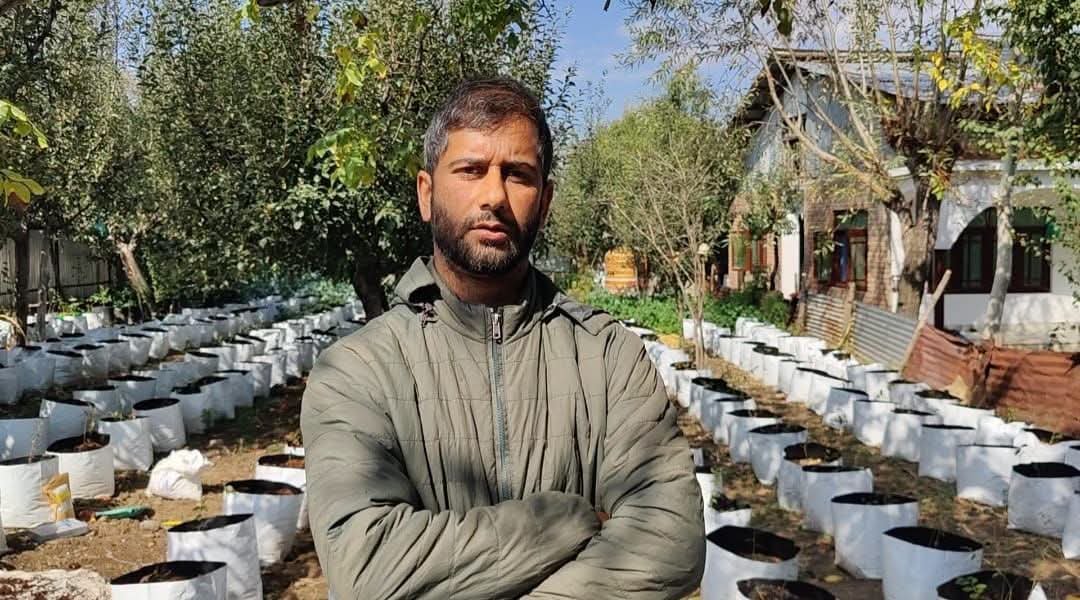
Kreeri farmer looks beyond apples, ventures into blueberry cultivation
After repeated losses in apple farming, Fayaz sees potential in high-value crop

Suhail Khan
Srinagar, Nov 2: Faced with mounting losses from traditional apple cultivation, a farmer in north Kashmir’s Baramulla district has turned to blueberries, planting around 500 saplings on two kanals of land in a bid to explore an alternative high-value horticultural crop.
Fayaz Ahmad, a resident of Kharchak Kreeri village, said repeated setbacks in apple farming, despite considerable investment and hard work, prompted him to explore alternative crops that could offer better returns.
“I started thinking about doing something different after facing losses in the apple business. During my search on the internet, I came across blueberries, which are known as a golden crop in other countries,” Ahmad told Kashmir Convener.
He said he subsequently researched blueberry cultivation and initially procured a few saplings to assess their suitability to Kashmir’s climatic conditions. Encouraged by their growth, he gradually expanded the experiment and decided to take up cultivation on a larger scale.
“After proper testing and getting satisfactory results, I decided to move to the next step. I have now planted around 500 blueberry plants on nearly two kanals of land,” he said.
Blueberries, small, round fruits belonging to the Vaccinium genus, are native to North America and are now commercially cultivated in several countries, including the United States, Canada, Chile and parts of Europe. The fruit is valued for its distinctive flavour and nutritional properties, particularly its antioxidant content.
Unlike conventional apple cultivation, blueberries require specific soil conditions, particularly acidic, well-drained soil rich in organic matter. The crop also demands careful management of irrigation, nutrients and plant health, making scientific guidance essential for commercial cultivation.
Ahmad said the fruit’s market value was among the key factors that encouraged him to invest in the crop. According to him, blueberries fetch between Rs 2,000 and Rs 3,000 per kilogram, depending on market conditions.
He estimated that establishing a blueberry plantation could require an initial investment of around Rs 5 lakh per kanal, while a mature plantation could potentially generate annual returns of Rs 8 lakh to Rs 10 lakh.
The plants, he said, take approximately three years to mature and start generating commercial returns, requiring farmers to sustain the initial investment during the gestation period.
“There is a good initial investment, but the expected returns are also encouraging. There is hard work initially, but the results can be fruitful,” he said.
Ahmad also claimed that India’s annual blueberry consumption stood at around 20,000 metric tonnes, while domestic production met only a small share of the demand, with the bulk being met through imports.
Growing interest in healthier food choices and the fruit’s nutritional properties have contributed to its popularity in domestic and international markets. Besides being consumed fresh, blueberries are used in juices, jams, desserts, bakery products and other processed foods.
The farmer believes Kashmir’s climatic conditions could offer scope for expanding blueberry cultivation, provided growers receive technical support and have access to quality planting material and markets.
He hopes the crop will encourage farmers in the Valley to diversify beyond traditional apple cultivation and develop an additional source of income.
Comments are closed.