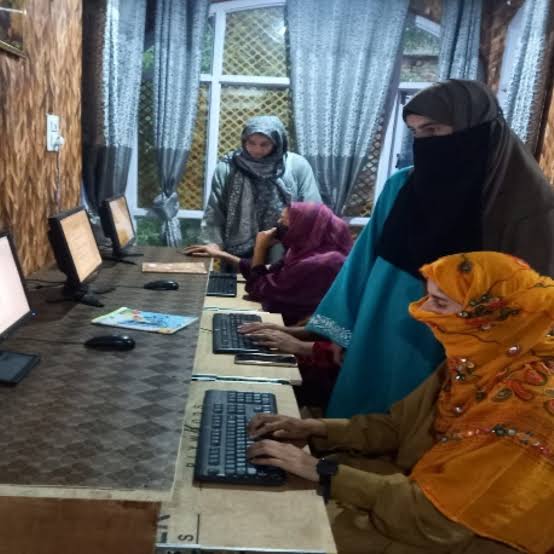

How Digital Literacy is Powering ‘Viksit JK’

Shabir Ahmad


Building a self-reliant, prosperous Viksit Jammu and Kashmir does not merely require highways and power grids; it requires ensuring that every student, artisan, and farmer holds the digital keys to unlock global opportunity.

For decades, accessing public services, marketing agricultural produce, or seeking financial assistance in Jammu and Kashmir meant braving rugged mountain roads, endless bureaucratic queues, and procedural bottlenecks. Today, an elder in Kupwara tracks land revenue records from a smartphone, an apple orchardist in Shopian benchmarks prices on electronic trading portals, and a young artisan in downtown Srinagar sells handcrafted Pashmina directly to global buyers across digital marketplaces.

As the national vision of Viksit Bharat @2047 takes shape, Jammu and Kashmir is demonstrating that true development (Vikas) is not merely built on physical concrete, but on digital fluency. The region’s ongoing evolution from administrative friction to technological agility rests on a singular pillar: empowering ordinary citizens with the skills to navigate, adopt, and lead the digital revolution.

The core of J&K’s governance model has shifted toward citizen convenience. Platforms like e-UNNAT (Unified, Integrated, Accessible and Transparent) have consolidated more than 1,500 government services under a unified single-sign-on architecture (Meri Pehchaan). Paired with the Auto-Appeal System (AAS) under the Public Service Guarantee Act (PSGA), administrative processing is bound to strict statutory deadlines. If an officer fails to process a certificate within the designated window, the system automatically escalates the file to higher authorities.

However, administrative digitization is only as effective as the public’s ability to use it. To make “Aapka Mobile Humara Daftar” (Your Mobile, Our Office) a reality rather than a slogan, widespread digital literacy initiatives have become crucial. Through village-level awareness camps and the expansion of the Common Service Centre (CSC) Digi Dost network, the administration has ensured that digital access is not confined to urban centers like Srinagar and Jammu, but penetrates remote border districts such as Poonch, Rajouri, and Bandipora.

Grassroots Impact: Orchards, Handlooms, and Agritech

Digital literacy in J&K is transforming traditional regional industries:

Agritech & Precision Farming: Under the Holistic Agriculture Development Programme (HADP), farmers leverage mobile dashboards for soil health advisories, weather warnings, and direct subsidy disbursals. Digital literacy drives have educated saffron growers in Pampore and cherry farmers in Ganderbal on registering with national commodity portals (such as e-NAM), bypassing middlemen to secure better profit margins.

Reviving Artisanal Heritage: Artisans in the Valley’s world-renowned carpet, papier-mâché, and shawl sectors are receiving targeted training in product photography, e-commerce listing, and digital payments. Integration with government e-marketplaces (GeM) and Open Network for Digital Commerce (ONDC) has turned traditional craft clusters into direct-to-consumer exporters.

Financial Inclusion & Direct Benefit Transfers (DBT): The widespread adoption of UPI and the Janbhagidari/BEAMS portals has democratized oversight. Village residents now routinely check public works allocations and contractor payouts online, establishing grassroots accountability.

Bridging the Gender and Youth Divide

Equipping the youth and women with modern digital capabilities is central to sustaining this economic momentum. Programs modeled after the Pradhan Mantri Gramin Digital Saksharta Abhiyan (PMGDISHA), combined with UT-level skill-building initiatives, have seen significant enrollment from young women across rural belts.

In schools and polytechnic colleges, the deployment of smart classrooms, coding laboratories, and robotics workshops is moving local education past rote learning. Local incubators and IT hubs are supporting young entrepreneurs launching startups in logistics, telemedicine, and software services. For young women in semi-urban areas, learning to use accounting software, digital banking apps, and remote freelancing tools has unlocked home-based entrepreneurship, dismantling longstanding geographic and cultural employment constraints.

The Terrain Ahead: Connectivity and Cyber Resilience

Despite notable strides, the pathway to complete digital empowerment faces practical hurdles:

Geographic Obstacles: Severe winters, landslides, and high-altitude topography regularly challenge physical telecom infrastructure, leading to intermittent broadband outages in cut-off valleys.

Cyber Awareness: As hundreds of thousands of first-time digital users enter online financial ecosystems, incidents of digital fraud, phishing, and identity theft require sustained public education on password security, OTP privacy, and safe transacting.

Language Accessibility: To truly bring non-literate and vernacular populations into the fold, platforms must expand beyond English and Urdu into intuitive, voice-enabled interfaces in Kashmiri, Dogri, and Gojri.

A Modern Blueprint for Transformation

The transformation visible across Jammu and Kashmir demonstrates that technology is the ultimate equalizer. A generation raised in isolation from mainstream tech opportunities is now building software, running border-district e-enterprises, and actively auditing governance delivery.

Building a self-reliant, prosperous Viksit Jammu and Kashmir does not merely require highways and power grids; it requires ensuring that every student, artisan, and farmer holds the digital keys to unlock global opportunity. In the quiet transition from paperwork to digital dashboards, Jammu and Kashmir is mapping its own future.

Comments are closed.