
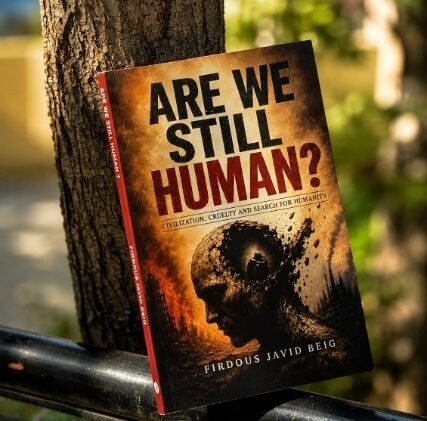

Are We Still Human? A Question That Refuses to Go Away

Being human is not merely a condition of birth; it is a choice we make through the way we treat others, the world, and ourselves”

BOOK REVIEW

By: Bisma Bhat


Are We Still Human? is a book on the difference between human progress and humaneness. Morality, civilization, violence, nature, and empathy are all interconnected by the question that runs through the book: what is being human?

Firdous Javid Beig’s ‘Are We Still Human?’ takes this question as its starting point and turns it into a wider reflection on human nature, morality, violence, empathy, civilisation and the meaning of progress. Spread across 104 pages, the book encourages readers to pause and look beyond modern society’s visible achievements. It asks us to consider not only what humanity has built, but also what humanity may be losing along the way.

Books that are supposed to give solutions to something are different from those books which generate new queries in us based on our solutions. The book ‘Are We Still Human?’ is one of the latter. The title appears to be quite simple, but the question it carries is terrifying: ‘In this era of tremendous scientific and material progress, have human beings progressed as well in the aspects of compassion, responsibility and moral consciousness too?’

This book does not deal with human beings in their biological aspect; rather, it is about whether humans practice the characteristics of humaneness in them.

Progress and Conscience

One of the central ideas of the book is progress. The development of human intellect has made connections between countries, brought changes in society, and created amazing inventions. However, human intellect is also responsible for creating destructive weaponry, exploiting nature, and causing violence and discrimination.

The question comes to mind – can technological development be regarded as progress if compassion and morality do not progress at all? Therefore, the book proposes to think about the concept of civilization more comprehensively – one should appreciate not just achievements and power, but also responsibility and humanity.

Humans and Nature

Another aspect which plays a significant role in the book is the connection between humans and nature. Humans understand the damage that is done to the environment – forests are being cut down, ecosystems are under threat, animals are endangered and our planet suffers more and more.

It is not an environmental issue only for Beig – this is a moral issue as well. Not only are the capabilities of humanity towards nature of interest, but also the things that people refuse to do.

When Civilization Fails

The author rejects the assumption that civilization is devoid of cruelty. History provides plenty of examples of wars, genocide, colonization, oppression, and organized violence on the part of societies that believed in their own civilization.

Progress might alter the manifestation of cruelty but not the essence itself. Without any moral values, increased knowledge and power would make destructive actions even more efficient.

Indifference and Empathy

One of the most uncomfortable topics covered in the article is indifference. Suffering, poverty, injustice, and violence might be present in front of people every day, but excessive familiarity can make such phenomena routine.

Thanks to digitalization, people get information about those problems instantly via photos, videos, and social media. However, Beig asks whether digital awareness is enough. Empathy should go further than reactions via a screen and become evident in our actions towards others.

Being Human By Choice

In spite of all its dark themes and ideas, the book does not end in despair. The book shows that there is still hope for humanity to take another way. Knowledge, education, contemplation, and conscious choices determine human actions.

Compassion is not weakness; compassion is strength. Being human is about choosing empathy rather than indifference, understanding instead of hatred, moderation in place of excess, and responsibility instead of silence.

Conclusion

Are We Still Human? is a book on the difference between human progress and humaneness. Morality, civilization, violence, nature, and empathy are all interconnected by the question that runs through the book: what is being human?

There is no answer in the book, and it is left up to the reader to think about the question. Indeed, people are human right from birth, but are they really humane?


Author can be mailed at bhatbisma044@gmail.com

Comments are closed.