


Jazib Jahangir
There is a history behind every town, but in some places, history is closely woven into the everyday lives of its people. Sopore is one such town. Often known as the “Apple Town of Kashmir,” Sopore is much more than a centre of horticulture and trade. Its identity has been shaped by the Jhelum, its busy markets, literary traditions, religious and social institutions, and above all, its people and their strong sense of community.
Located in north Kashmir, Sopore has long held an important geographical position. Its proximity to the Jhelum contributed to the town’s growth as a centre of communication, agriculture and commerce. In earlier times, the river was closely connected with the movement of people and goods and formed an important part of everyday life. Although its role has changed with modern transportation and infrastructure, the Jhelum remains an important part of Sopore’s landscape and identity.
The historical background of Sopore is reflected in the old neighborhoods, old buildings, holy sites, bazaars, and local folklore. However, the history of any town is not limited merely to the monuments and documented accounts. The history lives on in the collective memory of the people. It is passed down from one generation to the next by elders. The names of localities, traditions, photographs and memories of markets keep alive the links with the past.
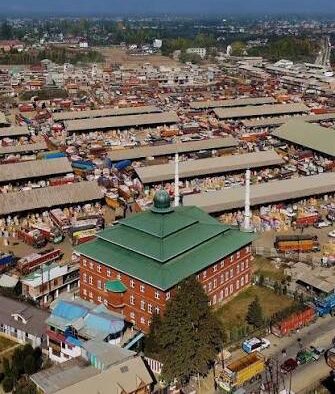
In this sense, Sopore’s heritage is a living heritage. Every generation adds something to it. Perhaps the most visible feature of Sopore’s present-day identity is its horticulture-based economy. The surrounding areas are well known for apple cultivation, while Sopore has developed into an important trading centre for Kashmir’s fruit industry. The fruit market supports thousands of people directly and indirectly and connects growers with traders, transporters, workers and markets beyond the region.
The importance of horticulture extends far beyond the orchard. Cultivation, harvesting, grading, packaging, transportation, storage and marketing all form part of a large economic chain. For many families, the orchard is not simply a source of income; it represents a relationship between people, land and generations of agricultural knowledge.
Yet Sopore cannot be defined by its economy alone. Its cultural identity is equally important.
The language, literature, traditions, hospitality and social relationships of its people give the town its distinctive character. Like much of Kashmir, Sopore has a strong oral and literary tradition. Kashmiri has been more than a means of communication. It carries memories, humour, emotions, stories and the wisdom of generations.
The social life of Sopore has traditionally been built around neighbourhoods and community relationships. People have shared one another’s happiness and stood together during difficult times. Weddings, funerals, religious occasions and other gatherings have provided opportunities for people to come together. Mosques, schools, markets and public spaces have served not only practical purposes but have also acted as important centres of community life.
This sense of belonging remains one of Sopore’s greatest strengths.
At the same time, Sopore, like every growing town, is experiencing social change. Urbanisation, technology, migration, changing economic conditions and new lifestyles are transforming the way people interact with one another. Young people today are more connected to the wider world through education, social media, travel and technology.
Change, however, does not necessarily mean losing one’s identity. The challenge is to make modern development compatible with the cultural values that have shaped the town.
For Sopore, development can become more meaningful when its heritage is treated as an asset rather than simply something belonging to the past. Local history can be introduced through schools and colleges, while heritage walks, cultural programmes, literary gatherings and community initiatives can help younger generations understand the story of their own town.
Young people can also play an important role in preserving local memories. Old photographs can be collected and digitised. Stories of elders can be recorded. Traditional practices and local histories can be documented before they disappear from collective memory. Such efforts can create a valuable record for future generations.
Sopore also has opportunities to connect its cultural identity with responsible tourism and local economic development. Its orchards, Jhelum landscape, traditional way of life, markets and literary heritage offer visitors an opportunity to experience a different side of Kashmir. Any such development, however, should remain sustainable and centred on the local community so that tourism strengthens rather than disturbs the character of the town.
The future of Sopore, therefore, would largely depend upon its people, especially the younger lot among them. Improved infrastructure, modern market facilities, good quality education and entrepreneurship and technology can all help Sopore become a better place to live in. However, economic development takes on greater significance when it is complemented by the respect shown for the community, culture and the collective memory of the people.
The most precious thing of Sopore could not perhaps be any buildings or markets or even orchards. It could be the memory that exists in the minds of its people.
Roads, buildings and markets are essential for the growth of any town, but they represent only one part of its identity. The deeper character of a place lives in its people.
Sopore has inherited a rich legacy from previous generations. The responsibility of the present generation is not simply to remember that legacy but to carry it forward, preserve what is valuable, and add something meaningful of its own.
A town remains alive when its history continues to live in the present. Sopore’s story, therefore, is not only a story of the past. It is a story that continues to be written every day by its people, its communities, and its young generation.
Comments are closed.