

Mir Nuzhath Fatima
There are crimes that injure the body, and there are crimes that leave a wound on the conscience of an entire society. Sexual violence belongs to the second category. It is not merely an attack on an individual; it is an assault on dignity, safety and the collective conscience of society.
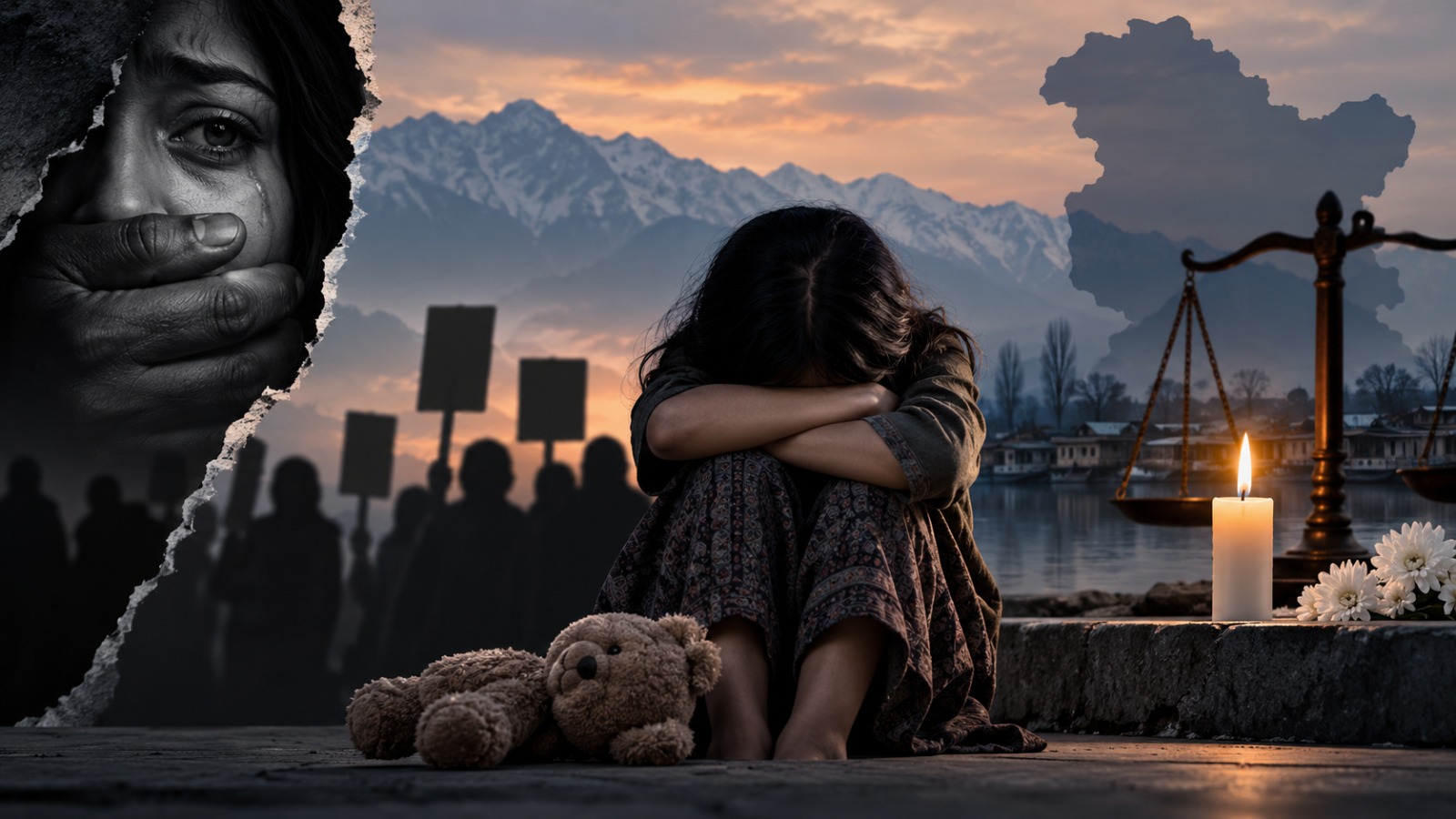
On 25 May 2026, Kashmir was shaken by the alleged rape and murder of a 12-year-old girl from Galwanpora in Budgam. The child had reportedly gone missing before her body was recovered. Police said the case appeared, prima facie, to involve rape and murder and constituted a Special Investigation Team to investigate the matter. The incident triggered grief, anger and demands for strict action.
The brutality of such incidents forces society to confront difficult questions: How safe are women and children in Kashmir today? Why do such crimes continue despite strict laws? And why does fear still overpower justice in so many cases?
Nearly three months later, these questions remain painfully relevant.
The disturbing reality is not simply that another case has emerged. It is that the pattern of public reaction remains familiar. A horrific crime occurs. Society reacts with anger. Social media fills with condemnation. Political statements follow. Demands for justice grow louder. Then, as the news cycle moves on, public attention gradually fades-while the victim and the family are left to live with the consequences.
In July, a 21-year-old woman approached Baramulla Police alleging that she had been sexually assaulted by two men in the Jalsheeri-Drangbal area earlier that month. Police arrested two suspects and said the mobile phone allegedly used to record the assault had been recovered. The allegations remain subject to investigation and due process.
These cases force us to look beyond the immediate crime.
The answer does not lie only in policing or delayed investigations. The roots of the problem are deeper. Sexual violence thrives where silence protects offenders more than victims.
In many communities, survivors fear social judgment almost as much as the crime itself. Families may hesitate to report abuse because they fear dishonour, gossip, threats, humiliation or social pressure. When reporting a crime becomes a source of shame for the victim instead of the perpetrator, silence becomes a shield for offenders.
The question, therefore, Is not simply Whether Kashmir has laws against sexual violence.
It does.
The harder question is whether our laws, institutions and society are doing enough to prevent such crimes and provide timely justice to those who survive them.
India has a legal framework dealing with sexual offences. The Protection of Children from Sexual Offences Act (POCSO) provides a specialised legal framework for offences against children, while the Bharatiya Nyaya Sanhita (BNS) governs offences under India’s new criminal-law framework. Laws relating to rape and other sexual offences prescribe severe punishments, including imprisonment for life in certain Circumstances.
But a law is only as strong as its implementation.
Delayed investigations, slow court proceedings, inadequate psychological support and insufficient protection for victims and witnesses can weaken public confidence in the justice system.
According to the National Crime Records Bureau (NCRB), the latest published Crime in India dataset covers 2024. It records crimes against women, rape and crimes against children, among other offences. In 2024, India registered 4,41,534 cases of crimes against women. However, statistics must be interpreted carefully: registered cases represent incidents that enter the criminal justice system, while sexual violence can be significantly underreported because of stigma, fear, pressure, threats or lack of trust.
Therefore, a rise in registered cases does not automatically mean society has become more dangerous, just as a decline does not automatically mean society has become safer.
Numbers tell us what is reported. They cannot fully tell us what remains hidden.
The concern over sexual violence in Kashmir is also not based on a single incident.
Over the years, several cases have shocked the Valley and left lasting scars on society. In 2018, the rape and murder of eight-year-old Asifa in Kathua became one of the most widely discussed crimes in the region’s history. The same year, reports of the gang rape of a nine-year-old girl in Baramulla intensified concerns regarding child safety. In 2021, a 17-year-old girl in Shopian was subjected to an acid attack, followed by another acid attack on a 24-year-old woman in Srinagar in 2022.
More recently, the reported gang rape and murder of a 45-year-old nomadic woman near Nishat in 2025 and the alleged rape and murder of a 12-year-old girl in Budgam in 2026 reignited public anger and demands for justice.
These incidents are separated by time and place. They involve different victims and circumstances. Yet together, they highlight a disturbing challenge: violence against women and children continues to test both society and state institutions.
And this is where the role of society becomes impossible to ignore.
A survivor should not have to fear society almost as much as the crime itself.
Families should not have to choose between protecting their reputation and seeking justice.A woman should not be questioned about her clothes, her movements or why she trusted someone before society asks the more fundamental question:
Why did another person choose to violate her?
We often tell girls how to stay safe. We tell Them not to walk alone, not to trust strangers, to share their location and to Remain cautious. Some precautions may be necessary. But precautions cannot become a substitute for accountability.
We must also ask what we are teaching boys. Are we teaching them about consent? Are we teaching them that masculinity is not dominance? Are families and educational institutions challenging harassment, stalking, misogynistic jokes and victim-blaming before such attitudes become normalised?
A society that teaches girls to remain silent instead of teaching boys respect cannot truly eliminate sexual violence. Children grow up observing the attitudes around them. When misogyny, harassment and victim-blaming are normalised, harmful behaviour becomes easier to excuse and, in extreme cases, violence becomes easier to justify.
The responsibility therefore cannot rest only with governments and courts. It also belongs to families, schools, religious leaders and communities. Prevention cannot begin after a crime has been committed. It has to begin in homes, schools and communities.
The justice system, meanwhile, has a responsibility that cannot be reduced to arrests. An arrest may be an important step when supported by evidence, but an arrest is not the same as justice.
Justice requires a fair investigation, proper collection and preservation of evidence, protection of victims and witnesses, a timely trial and appropriate support for survivors. Delay is particularly damaging. When a case takes years to reach its conclusion, the legal process itself can become another source of suffering for the victim and family.
At the same time, convictions in appropriate cases demonstrate that accountability is possible when investigations and prosecutions are effective.
We must therefore resist two extremes: claiming that nothing is being done, and claiming that everything is fine. Neither is true. The real challenge is to make justice consistent, timely and accessible.
There is also a responsibility on the media. Sexual violence should never be treated merely as sensational content. Victims-particularly children-deserve privacy and Dignity. Responsible journalism should inform society without turning a survivor’s suffering into public spectacle.
The media has the power to create awareness, but it also has the power to deepen trauma. The difference lies in whether a story is reported for public interest or merely for public attention.
Kashmir has lived through decades of Conflict, uncertainty and social trauma. That history cannot become an excuse for overlooking another form of insecurity. A society cannot claim to be healing while women and children continue to live with fear.
Every such incident should make us examine not only what happened during The crime, but what happened before and after it. What warning signs were missed? Could the crime have been prevented? How was the complaint handled? Was evidence collected properly? Were the victim and family protected? How quickly did the investigation progress? And, ultimately, did the case result in justice?
These questions matter because justice is not merely about punishment after a crime. It is also about preventing the next one.
Justice does not end with an arrest. Nor does it begin with a hashtag. Justice begins when a victim can approach the system without fear. It Continues through a fair and timely investigation and trial. And it becomes meaningful when society learns how to prevent the next victim.
Nearly three months after the outrage surrounding Budgam, perhaps the most important question is no longer simply: “Who will be punished?” It is: “What are we doing to ensure That there is no next victim?”
A civilised society is not one that merely demands severe punishment after a crime. It is one that creates an environment in which women and children can live with Dignity, freedom and security.
The silence must end-not only when a horrific case makes the headlines, but every day before the next headline appears.
Comments are closed.