

Firdous Ahmad Najar
One morning, a news report appeared in the newspaper:
“Muhammad Sadiq, a senior teacher at Government Middle School Sadiqabad, selected for the National Best Teacher Award.”
For the people of Sadiqabad, it was not just a piece of news. It was a moment of pride. His fellow teachers congratulated him. His students were happy. People in the neighbourhood felt proud that one of their own had received such a great honour.
Muhammad Sadiq truly deserved it.
He was well educated, hardworking, sincere and devoted to his profession. He had spent several decades teaching at different government schools. He had given his youth, his energy and the best years of his life to educating children.
Many of his former students had become successful in different fields. Some were doctors, some engineers, some professors, some judges and some senior government officers. One of them had even become a parliamentarian.
Sadiq often used to say:
“A teacher’s real success lies in the success of his students.”
For him, that was perhaps the greatest award of all.
But now he was going to receive another great honour: the National Best Teacher Award.
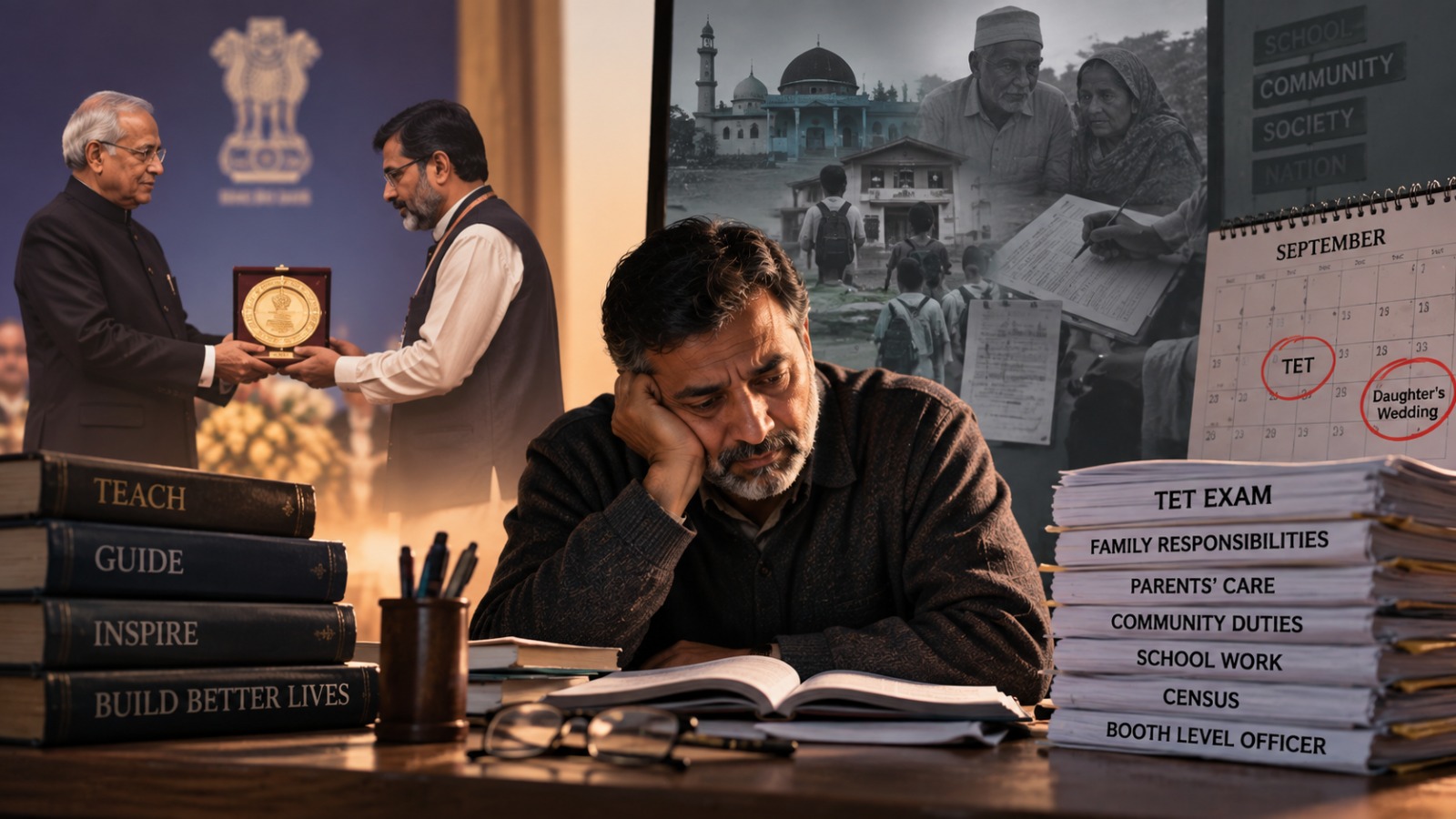
He had been invited to Vigyan Bhavan in New Delhi for a special ceremony. The honourable President of India was going to present the award to him.
It should have been one of the happiest moments of his life.
But at the same time, a new problem appeared before him.
A new order required teachers who had more than five years of service left to qualify the Teacher Eligibility Test, or TET. If they failed to qualify, their jobs could be at risk.
Muhammad Sadiq was 52 years old, so the new rule applied to him as well. He read the order carefully and then looked at the calendar.
It was September, and his daughter’s wedding was also fixed for the last week of the month.
He already had many responsibilities. His elderly parents were ill and needed his care. He had four daughters. His own health was also not very good.
But that was not all.
Alongside his teaching responsibilities, he was also a responsible and active member of his community. He had been entrusted with managing the affairs of the local mosque, while also performing his duties as a Booth Level Officer and was also engaged in national census.
And now he had to prepare for the TET.
The examination was also scheduled for the last week of September, at the same time he was expected to travel to Delhi to receive the award.
He looked at the invitation again.
On one side was Vigyan Bhavan, the honourable President of India, a national award, applause and recognition; on the other was the TET, an examination that could affect his job and his family’s future.
He sat quietly for a long time before saying to himself:
“The award is certainly a great honour, but my job is the support of my family. I must first protect my livelihood.”
He decided not to attend the award ceremony.
But the education authorities did not agree. They first tried to persuade him and later insisted that he attend the ceremony. When he still hesitated, he was warned that refusing to do so could invite departmental action against him.
Finally, he had no choice but to go to Delhi.
The ceremony at Vigyan Bhavan was grand. Teachers from different parts of the country were present. Senior officials, guests and media persons filled the hall.
When Muhammad Sadiq’s name was announced, his long teaching career was described. His hard work, dedication and achievements were praised. The success of his students was also mentioned.
The hall filled with applause.
The President smiled and presented the National Best Teacher Award to him.
Cameras flashed, the hall filled with applause, and Muhammad Sadiq smiled too. Yet deep inside, one question continued to trouble him: “If I fail the TET, will this award save my job?”
He returned home the next day, placed the award safely in his cupboard, and opened his books.
Now he was not preparing for an ordinary examination. For him, it had become a fight for his job, his dignity and the future of his family.
But he had very little time.
Whenever he opened his book, something else demanded his attention.
The census work came to his mind. Then he remembered his duties as a Booth Level Officer. At times, he had to manage the affairs of the mosque. At other times, he had to make arrangements for his daughter’s wedding. His elderly parents needed his care, while his own health was also deteriorating. Alongside all this, he still had his responsibilities towards his students and the school.
He would close the book and say, “I will start proper preparation from tomorrow,” but tomorrow never came.
Soon, the day of the examination arrived.
The same teacher who had spent his whole life preparing students for examinations was now sitting for an examination that could decide his own professional future.
He read the questions carefully, answered some, struggled with others, and found some of them confusing. Then time was over. He submitted his paper and walked out of the examination hall with heavy steps.
When a colleague asked him how the paper had gone, he replied, “It did not go well.”
That night, he could not sleep, as the same thoughts kept coming back to his mind again and again.
The ceremony at Vigyan Bhavan, the award from the President, the applause, his students, his family, his daughters, his sick parents, and, above all, the TET result, all these thoughts occupied his mind.
A fear had taken hold of him.
“What if I fail? What will people say? Will my entire teaching career be forgotten because of one examination?” His anxiety grew stronger, and his already weak health added to his distress.
Then, in the last days of September, the result was announced.
Muhammad Sadiq opened the result with trembling hands. He had failed. For a few moments, he simply stared at the screen. Then, suddenly, he felt severe pain in his chest. Before his family could understand what was happening, he collapsed.
The National Best Teacher Award remained quietly in the cupboard, while Muhammad Sadiq was gone.
His funeral was held after Maghrib, and people came from far and wide to pay their respects. Among them were many of his former students.
A doctor stood beside a professor, an engineer beside a judge, and a senior officer beside a parliamentarian. They had all once been students of Muhammad Sadiq.
As they talked to one another, they discovered something that deeply moved them.
One asked, “Were you also taught by Sadiq Sahib?” “Yes,” came the reply. Another said, “I studied under him too.” Someone else quietly added, “And I did too.”
They suddenly realised that behind the success of so many people stood the same teacher.
A young doctor could not control his tears as he said, “He did not only teach us from books; he taught us how to become good human beings.”
A senior officer said:
“He gave us a strong foundation. Whatever we became later was built on that foundation.”
An engineer said:
“If a teacher’s ability can be decided by one examination, then what do the achievements of his students mean?”
No one had an answer.
Then the parliamentarian, who had also been his student, spoke softly:
“We gave our teacher a national award, but we could not give him what he needed most; security, dignity and peace of mind.” His words left everyone in silence.
The story of Muhammad Sadiq raises an important question:
Can the ability of an experienced teacher really be judged by one examination?
There is nothing wrong with monitoring the quality of teachers. Teachers must have knowledge and continue to improve their professional skills. Examinations can help assess certain areas of knowledge, but they cannot measure everything that makes a good teacher.
They cannot measure decades of classroom experience, nor can they fully measure patience, understanding, compassion, classroom skills, or the ability to inspire children. They cannot measure the lives a teacher has changed or the success of thousands of students who carry their teacher’s lessons with them.
A test can measure how someone performs in a particular examination, but it cannot, by itself, measure the entire professional life of a teacher.
This does not mean that experienced teachers should be free from accountability. They should continue to be trained, evaluated and supported.
But there is a difference between a person who is seeking to enter the teaching profession and a teacher who has already spent twenty or thirty years in the classroom.
The first may need to prove that he or she is ready to become a teacher; the second has already spent decades proving it through actual teaching.
For experienced teachers, a broader system of quality assessment may therefore be more meaningful: one that considers regular professional training, classroom performance, teaching practices, student progress, professional conduct, and other relevant forms of evaluation.
The real question is not whether teachers should be accountable, but how their competence should be assessed fairly and meaningfully.
Muhammad Sadiq’s story reveals a painful contradiction: on the one hand, the nation honours him as its “Best Teacher,” while on the other, he is left worried that a single examination could take away his livelihood.
Teachers certainly deserve appreciation, but they need more than awards and speeches; they need dignity, security, respect for their experience, and a system that recognises the work they have already done.
On Teachers’ Day, we will once again celebrate teachers. We will give awards, deliver speeches and speak about their importance in building the nation.
But real respect for teachers goes beyond ceremonies; it means creating policies that protect their dignity, value their experience, and recognise the contribution they have already made.
Before we judge a teacher through one examination, let us also ask:
How many children has this teacher taught, how many lives has this teacher changed, and how many successful people are standing today because this teacher once stood in front of a classroom?
Muhammad Sadiq’s story may be fictional, but the question behind it is real.
A certificate can recognise a teacher.
An award can honour a teacher.
An examination can test a teacher.
But sometimes, a teacher’s greatest certificate is the generation of students he or she has helped to build.
And perhaps that is what teachers need most:
Not merely a gift, but dignity.
Not merely an award, but security.
Not merely applause for one day, but respect for a lifetime.
Comments are closed.