Srinagar, June 26: On a day when much of the Muslim world commemorates the martyrdom of Imam Hussain, the Kashmir Valley offered a rare counter-narrative to the sectarian bloodshed that often mars the observance of Ashura elsewhere in South Asia.
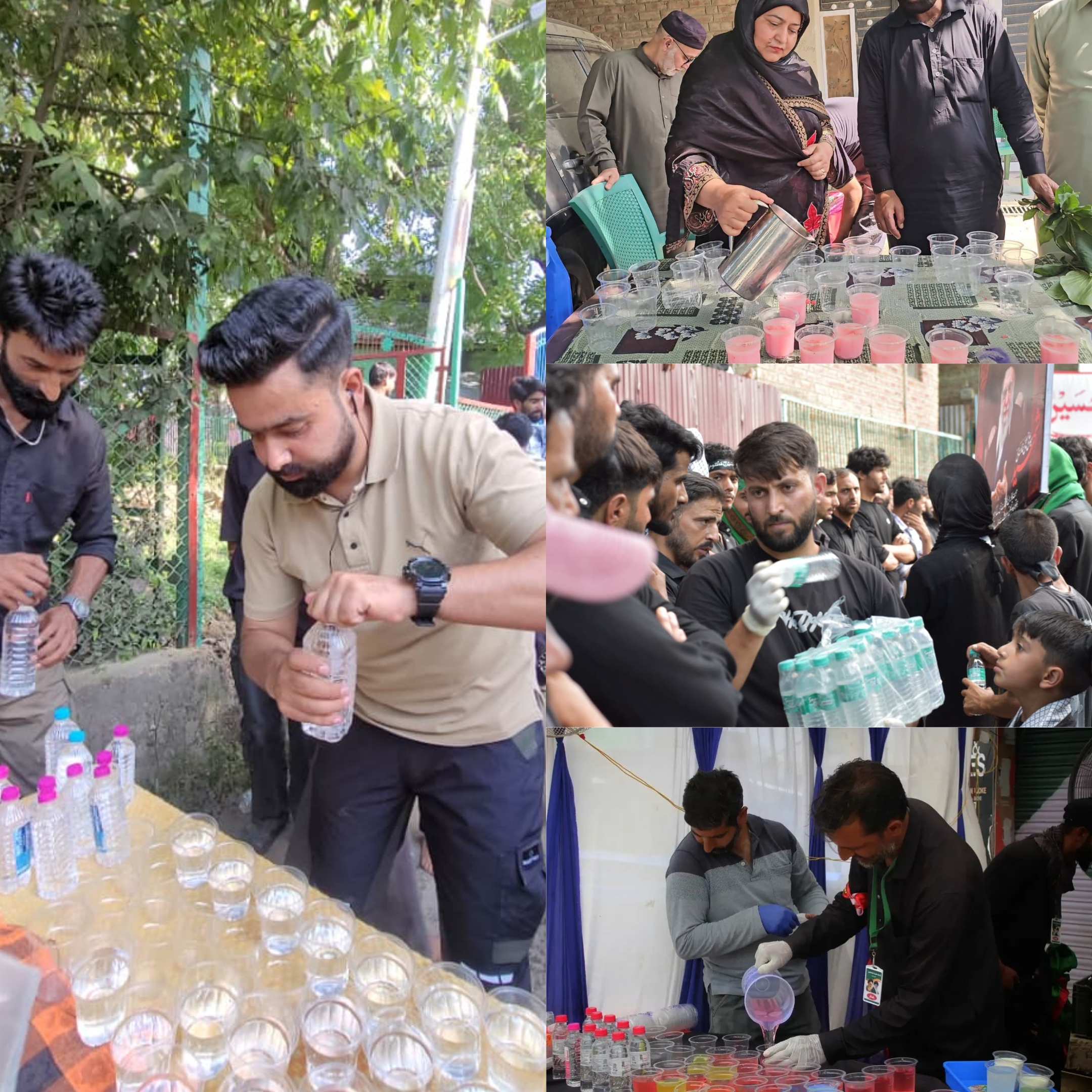
As processions wound through the narrow lanes of Zadibal and mourners beat their chests in unison, it was the scene outside the historic imambaras that told a different story. Sunni and Shia volunteers stood side by side, manning hundreds of sabeels – roadside stalls offering water, sherbet, and milk to passers-by.
For three days at Karbala in 680 AD, Imam Hussain and his 72 companions were denied water before being slaughtered by the forces of the Umayyad caliph Yazid. In Kashmir, the response to that historical thirst has become an annual ritual of communal solidarity.
“This is how we defeat hatred,” said Mudasir Ahmad, 24, a Sunni volunteer pouring chilled water at a stall near the Zadibal Imambara. “When we serve water in the name of Imam Hussain, we are serving humanity. This is Kashmir’s real identity.”
Across the Valley, from Anantnag in the south to Baramulla in the north, the scenes were remarkably consistent. Volunteers, many of them students who had saved from their monthly allowances, operated stalls through the night to serve mourners.
In Budgam, Sunni neighbours contributed milk and sugar to stalls run by their Shia counterparts. In Sopore’s Model Town, college student Aamir distributed water with his family – a gesture he said took a week of preparation.
“We did this to show the world – especially those engaged in spreading hatred – that this is a message of brotherhood,” Aamir told Kashmir Convener. “Hussain showed us at Karbala that while power may appear strong temporarily, it is ultimately truth and moral courage that prevails.”
Adding to the visual symbolism, several Sunni youth wore black – the traditional colour of Shia mourning – as a mark of solidarity. “I ironed my black shalwar kameez last night,” said Danish, a college student from Srinagar. “Here, we celebrate together, we live together. It hardly matters who is who.”
“The tradition of sabeels has been a binding force,” said a political analyst based in Srinagar, speaking on condition of anonymity. “The political class, both in Delhi and Islamabad, would do well to recognise that the Valley’s social fabric runs deeper than their strategic calculus.”
For many Kashmiris, the solidarity on display was also an implicit rejection of the polarisation that has crept into the region’s political discourse in recent years. “No outsider can divide us,” said Bilal Shah, a volunteer from Budgam. “The message of Karbala is universal – stand against tyranny, stand with the oppressed.”
Naira Jan, a teacher by profession based in Baramulla, told Kashmir Convener: “I am a Sunni woman, but I wore black yesterday and today. Some people ask me why. I tell them, ‘When a member of your family is grieving, you don’t ask if they’re from your clan – you simply grieve with them.’ Hussain is family to all of us. The sabeel we run is not just about water; it’s about saying, ‘We see your pain, we share your pain.’ That’s what makes us Kashmiri first.”
Saima Akhter, a college student from Baramulla, said: “Some of my relatives in other states asked me why I, a Sunni, was participating in Ashura. I told them, ‘Have you seen Kashmir? Here, we don’t ask which mosque you pray in before offering you water.’ At the sabeel in Baramulla, I stood next to a Sikh volunteer, a Shia elder, and my Sunni cousins. Everyone asked about everyone’s family, everyone helped. Hussain’s message is for all humanity – that’s what I believe,” she added.
As the sun set over the Valley and the final processions wound down, the defining image of this year’s Ashura was one of shared grief and shared humanity – a Sunni youth handing a glass of sherbet to a Shia mourner, both reciting the same words, “Ya Hussain.”
And it did not end there. In a further gesture of goodwill, a Sikh volunteer was seen serving water during the Muharram procession, reflecting the universal message of humanity and compassion in north Kashmir’s Baramulla town.


Comments are closed.