With nearly 65 per cent of its population under the age of 35, India is at a pivotal moment in its history. The Government recognises the immense potential of this demographic dividend. In the past 12 years, the nation has witnessed a fundamental shift in how the government engages with its young citizens.
This period reflects a systematic and transformational effort to turn India’s youth into a powerhouse of national growth. The change is visible across every sector, including education, skilling, sports, and entrepreneurship. No longer viewed as passive beneficiaries, the youth are now recognised as the “Amrit Peedhi”. They have emerged as the primary architects and co-creators of Viksit Bharat @ 2047.
From demographic dividend to developmental force, India’s young generation stands at the centre of the nation’s most ambitious transformation project.
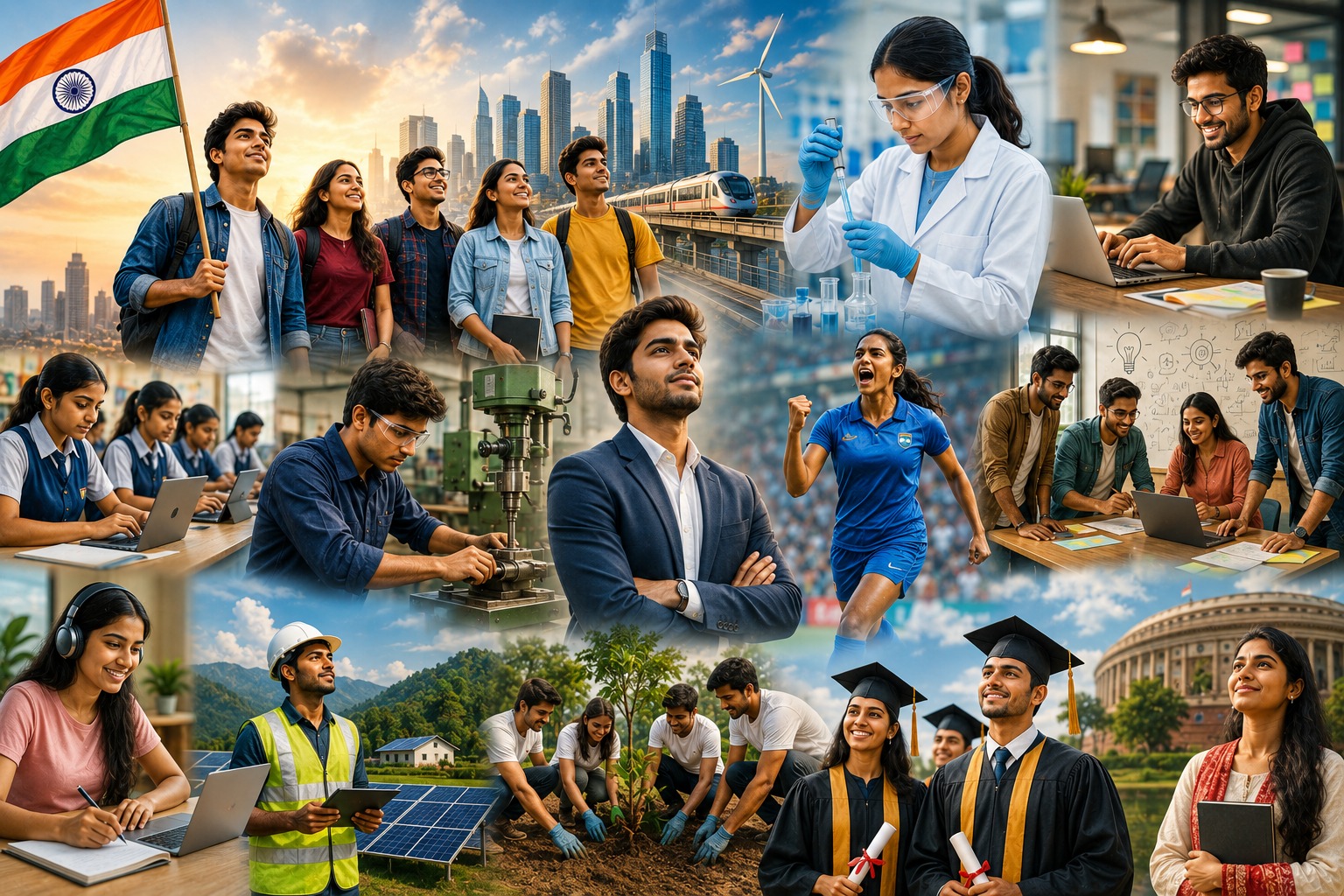
On any given morning in India, millions of young people step into classrooms, training centres, offices, workshops, factories, laboratories, sports academies and startup hubs. Some are learning coding in a government school equipped with digital tools. Others are pursuing online courses through national platforms. A young entrepreneur in a small town is pitching a business idea to investors. A sportsperson from a remote village is training with aspirations of representing the country. Across the nation, a generation is in motion.
This generation—often described as the Amrit Peedhi—is not merely inheriting India’s future. It is actively shaping it.
With nearly 65 per cent of the population below the age of 35, India possesses one of the world’s largest youth populations. Demographers have long described this as a demographic dividend. Yet demographics alone do not guarantee development. A youthful population becomes an asset only when it is educated, skilled, healthy, innovative and meaningfully engaged in the economy and society. Otherwise, the dividend can quickly become a liability.
The story of India over the past decade, therefore, is not simply about having a young population. It is about a conscious effort to transform that population into a productive force capable of driving economic growth, social change and national development.
As India advances toward its vision of becoming a developed nation by 2047, the success of that ambition will depend largely on one question: Has the country equipped its youth to lead the journey?
From Welfare to Partnership
One of the most significant shifts in India’s youth policy landscape has been conceptual rather than administrative.
For decades, young people were often viewed primarily as beneficiaries of government programmes. Policies focused on extending educational access, providing welfare support and addressing employment concerns. While these objectives remain important, the discourse has gradually evolved.
The emerging framework increasingly views young citizens as partners in development rather than passive recipients of state assistance. This shift is reflected in initiatives that emphasise entrepreneurship, innovation, leadership, volunteering, civic participation and digital engagement.
The proposed National Youth Policy 2025 embodies this transition. It recognises that the aspirations of today’s youth differ considerably from those of previous generations. Young Indians seek opportunities, flexibility, mobility and meaningful participation in shaping public life. They want not only jobs but also agency.
The transformation from youth development to youth-led development may ultimately prove to be one of the most consequential policy changes of the twenty-first century.
Education Beyond Enrolment
Perhaps nowhere is this transformation more visible than in education.
For many years, India’s educational challenge was largely about expanding access. The country needed more schools, more classrooms and higher enrolment. While substantial progress was achieved on these fronts, the next challenge was more difficult: ensuring quality.
The National Education Policy (NEP) 2020 represents an attempt to address this challenge comprehensively. Its significance lies not merely in structural reforms but in reimagining how learning occurs.
The policy seeks to move away from rote memorisation toward critical thinking, multidisciplinary learning and experiential education. It acknowledges that future generations will enter a world defined by rapid technological disruption, artificial intelligence, automation and global competition. Preparing students for such a world requires more than traditional academic instruction.
Equally significant is the emphasis on flexibility. Through mechanisms such as the Academic Bank of Credits, multiple entry and exit options, and the National Credit Framework, students are increasingly able to customise their educational journeys.
In a country where millions face interruptions due to economic pressures, family responsibilities or geographic mobility, such flexibility can make the difference between dropping out and completing higher education.
At the same time, digital learning ecosystems have expanded educational opportunities beyond physical classrooms. Platforms such as SWAYAM, DIKSHA and PM e-VIDYA have helped democratise access to knowledge, particularly in regions where quality educational resources remain limited.
The challenge ahead, however, extends beyond infrastructure and technology. Ensuring learning outcomes, improving teacher quality and reducing educational inequalities remain essential priorities. Access has expanded dramatically, but excellence must now become universal.
The Skill Revolution
If education provides the foundation, skills provide employability.
India’s labour market is undergoing profound transformation. Traditional occupations are changing rapidly. Emerging sectors such as artificial intelligence, renewable energy, robotics, drones, cybersecurity and advanced manufacturing are creating entirely new categories of work.
Recognising this reality, policymakers have increasingly focused on building a skill ecosystem capable of responding to changing industry needs.
The Skill India Mission, launched in 2015, marked an important milestone in this effort. Over time, the focus has shifted from generic vocational training to demand-driven, industry-aligned skill development.
Programmes such as the Pradhan Mantri Kaushal Vikas Yojana, National Apprenticeship Promotion Scheme and Industrial Training Institute reforms seek to bridge the longstanding gap between education and employment.
This gap has historically been one of India’s most persistent challenges. Employers frequently reported difficulties finding appropriately skilled workers even as millions of educated young people struggled to secure employment. The paradox highlighted a mismatch between educational qualifications and labour market requirements.
Apprenticeship programmes have emerged as particularly valuable interventions because they combine learning with practical workplace experience. The principle of “earn while you learn” offers both economic support and industry exposure.
More recently, initiatives focused on artificial intelligence and emerging technologies signal recognition that future competitiveness will depend on advanced skills rather than low-cost labour alone.
India’s young workforce must compete not only nationally but globally. The countries that dominate the next phase of economic growth will likely be those that successfully prepare their citizens for the knowledge economy.
Employment: Beyond Numbers
No discussion of youth development can avoid the employment question.
For young Indians, employment remains the ultimate measure of whether education and skill development efforts are translating into meaningful outcomes.
The employment debate often becomes polarised between competing narratives of success and failure. Reality is more complex.
India has witnessed significant formalisation of its economy in recent years. Millions of young people have entered organised employment systems, reflected in expanding social security coverage and formal workforce participation.
Employment-linked incentive schemes, internship programmes, digital job marketplaces and recruitment drives represent efforts to connect young job seekers with opportunities.
Yet challenges remain substantial.
India’s economy must generate employment at a scale rarely witnessed in modern history. Each year, millions of young people enter the labour market with aspirations for stable and rewarding careers. Meeting these expectations requires sustained economic growth, industrial expansion and entrepreneurial dynamism.
The quality of jobs matters as much as the quantity. Secure employment, fair wages, career progression and skill utilisation determine whether economic growth translates into genuine empowerment.
The future of employment in India may depend increasingly on sectors such as manufacturing, technology, green energy, healthcare, logistics and digital services. The challenge lies in ensuring that young people possess the skills required to participate in these emerging opportunities.
The Startup Generation
Perhaps the most visible symbol of India’s changing youth landscape is the rise of entrepreneurship.
A decade ago, entrepreneurship was often considered risky and uncertain. Career aspirations largely centred around government jobs, corporate employment or traditional professions.
Today, a different mindset is emerging.
Young Indians are launching startups in fields ranging from fintech and health technology to agriculture, education, artificial intelligence and sustainability. Innovation is no longer confined to metropolitan centres. Smaller cities and towns are increasingly contributing to the country’s entrepreneurial ecosystem.
The growth of startups reflects more than economic activity. It represents a cultural shift.
Young people are increasingly willing to experiment, take risks and pursue unconventional career paths. They are becoming job creators rather than merely job seekers.
Government initiatives have played a role by simplifying regulations, improving access to funding and supporting incubation ecosystems. Programmes such as Startup India, MUDRA loans, seed funding mechanisms and innovation missions have lowered barriers to entry.
However, entrepreneurship remains challenging. Many startups fail. Access to mentorship, markets and long-term capital continues to influence success rates.
The objective should not be to create entrepreneurs for the sake of entrepreneurship. Rather, it should be to foster an environment where innovation can thrive and where young people have the freedom to pursue ideas capable of generating economic and social value.
A Digital Generation in a Digital Nation
India’s youth are the country’s first truly digital generation.
They learn online, communicate through digital platforms, access services electronically and increasingly participate in governance through technology-enabled systems.
This digital transformation has implications far beyond convenience.
Digital literacy has become a fundamental requirement for economic participation. Access to information, online learning, telemedicine, financial services and employment opportunities increasingly depends on digital competence.
Government initiatives promoting digital literacy, digital public infrastructure and online service delivery have helped reduce barriers to participation.
Platforms dedicated to youth engagement, volunteering, mentorship and career development are creating new forms of interaction between citizens and institutions.
At the same time, digital inclusion remains a work in progress. Connectivity gaps, device affordability and digital skill disparities continue to affect millions.
The next phase of digital empowerment must focus not only on access but also on capability. Young people must be equipped to create technology, not merely consume it.
Sports, Fitness and National Confidence
For much of India’s modern history, sports occupied a marginal place in public policy.
Talented athletes often struggled with inadequate infrastructure, limited financial support and uncertain career prospects. Sporting excellence depended largely on individual perseverance.
That reality is changing.
The development of structured talent identification systems, training centres and athlete support programmes has transformed the sporting ecosystem.
The rise of initiatives such as Khelo India reflects recognition that sports contribute not only to medals but also to health, discipline, confidence and social mobility.
Young athletes from rural, tribal and economically disadvantaged backgrounds increasingly have pathways to professional success.
India’s improved performance in international competitions has generated a new sense of possibility. Sporting achievements inspire national confidence while demonstrating that excellence can emerge from every corner of the country.
Equally important is the promotion of fitness as a mass movement. In an era marked by sedentary lifestyles, digital dependency and rising health concerns, encouraging physical activity among youth carries long-term public health benefits.
Health, Well-being and the Human Dimension
Youth empowerment cannot be measured solely through education, employment or entrepreneurship.
Health remains fundamental.
India’s young population faces a complex range of health challenges, including nutrition concerns, mental health pressures, substance abuse risks and lifestyle-related diseases.
The growing recognition of mental health deserves particular attention.
For years, conversations about mental well-being remained marginalised due to stigma and limited awareness. Today, counselling services, helplines and public discussions are gradually normalising the importance of psychological support.
This shift matters because economic opportunity alone does not guarantee well-being. Young people navigating academic pressure, career uncertainty and social expectations require holistic support systems.
Similarly, investments in preventive healthcare, digital health infrastructure and adolescent health programmes contribute to building a healthier and more productive generation.
The strength of a nation ultimately depends not only on the skills of its youth but also on their physical and mental well-being.
Citizenship Beyond Careers
A developed nation requires more than economic prosperity. It requires engaged citizens.
Youth participation in volunteering, community service, environmental action and democratic processes plays a crucial role in strengthening social cohesion.
Platforms encouraging civic engagement help young people develop leadership skills while fostering a sense of responsibility toward society.
Environmental challenges, climate change, social inclusion and community development increasingly require active youth participation.
Young Indians today are more connected to global issues than any previous generation. They are also increasingly aware that development must be sustainable, inclusive and equitable.
The challenge is to channel this awareness into constructive action.
The Road to 2047
As India approaches the centenary of its independence, the vision of Viksit Bharat 2047 has become a national aspiration.
Achieving that vision will require sustained economic growth, technological innovation, institutional strength and social cohesion. Yet all these objectives ultimately converge on one factor: human capital.
The rise of the Amrit Peedhi represents one of the most ambitious nation-building projects undertaken in modern India. Over the past decade, significant efforts have been made to expand educational opportunities, strengthen skill development, promote entrepreneurship, improve health outcomes and enhance youth participation.
The results are visible across sectors. More young people are entering higher education. Millions have received skill training. Startup activity has expanded dramatically. Sporting achievements have improved. Digital participation has become widespread.
Yet success cannot be measured solely through statistics.
The real test lies in whether every young Indian—regardless of geography, gender, caste, income or social background—can access meaningful opportunities and realise their potential.
India’s demographic advantage will not last forever. Demographic windows eventually close. The coming two decades therefore represent a historic opportunity.
If India succeeds in educating, skilling, employing and empowering its youth, the country could emerge as one of the defining global powers of the twenty-first century. If it fails, the costs will be equally significant.
The story of the Amrit Peedhi is still being written. The foundations have been laid, institutions have been strengthened and opportunities have expanded. What remains is the collective effort to convert potential into achievement.
The journey to Viksit Bharat 2047 will not be driven by policies alone. It will be carried forward by millions of young Indians whose ambitions, talent and determination will ultimately determine the nation’s destiny. And if India’s future belongs to anyone, it belongs to them.
The article is based on the inputs and background information provided by the Press Information Bureau (PIB) Author is Writer, Policy Commentator. He can be mailed at kcprmijk@gmail.com


Comments are closed.