

One Man, One Story

Usuf Mir


This story is inspired by the life of an ordinary man who never received formal education, yet through hard work, honesty, and the values taught by his father, built a life that made him successful in the truest sense of the word.

                  It was a warm summer morning. On Wednesday, June 3, at around seven o’clock, Sahil left home for the local market. He had an appointment with an ENT specialist who visited the town once a week and ran a clinic there.

After a short ride in an auto-rickshaw, he reached the market at about nine. The doctor had not arrived yet, so Sahil decided to spend some time walking along the roadside.

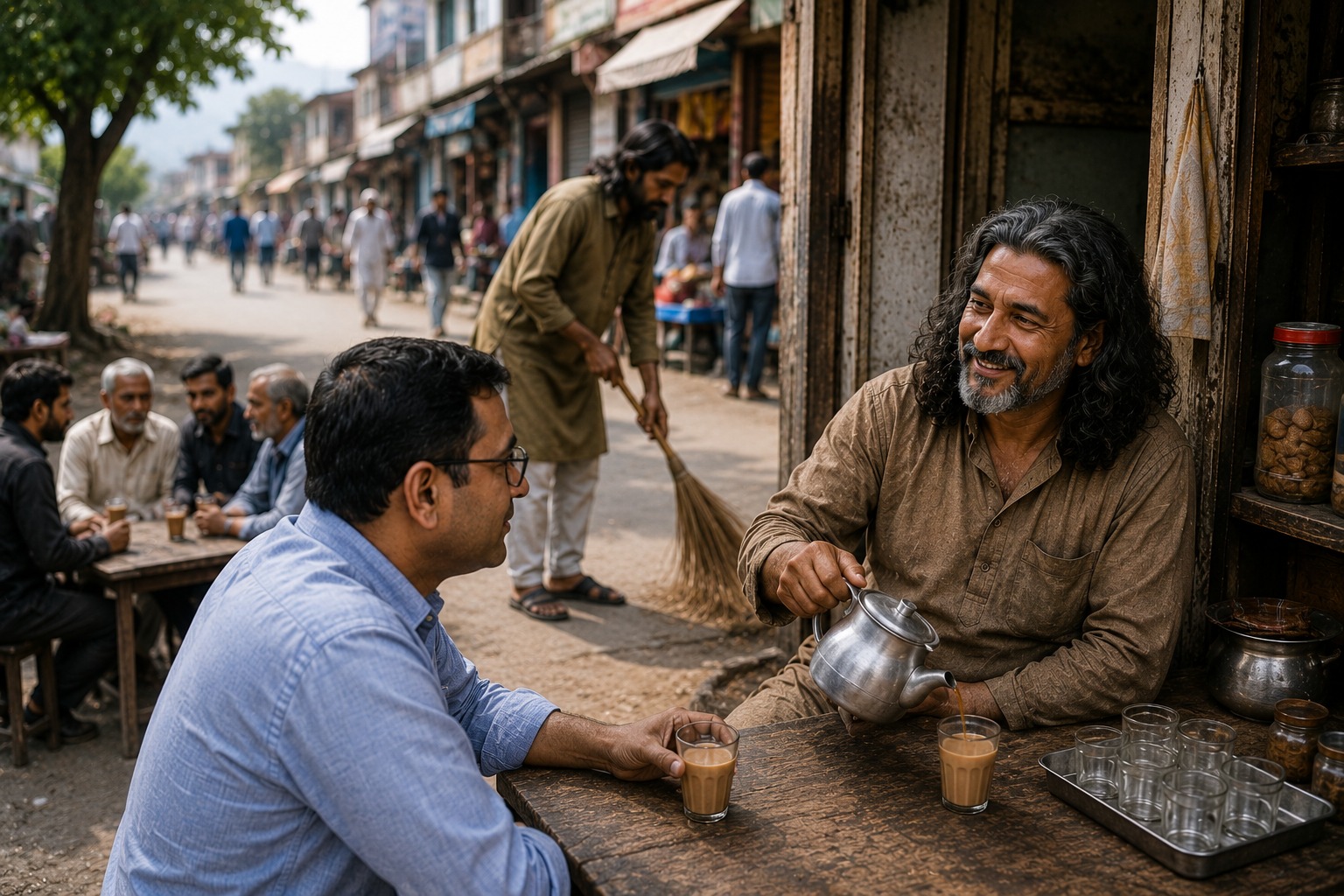
Shopkeepers were lifting shutters. Some swept the fronts of their stores. A few early customers sat in tea stalls, chatting over steaming cups of tea. As Sahil walked, his attention was drawn to a man sweeping the area outside Gash Tea Stall.

He had long hair, wore simple but neat clothes, and worked with quiet concentration. Looking up, he smiled and said,

“Would you like some tea?”

Sahil smiled back.

“Finish your cleaning first. I’ll come in a little while.”

A few minutes later, he took a seat at the stall. Tea was served, and conversation followed naturally.

“You seem like a cheerful man,” Sahil said. “What’s your name?”

“Tahir.”

“How long have you been doing this work?”

“Eighteen years.”

“And your age?”

“Fifty-five.”

Sahil looked at him in surprise.

“You don’t look fifty-five.”

Tahir laughed.

“Believe me, I’ve seen fifty-five springs.”

Then he added, “I live within my means. I don’t run after more than I need. I take care of my health. Every day I walk twelve kilometres—six in the morning and six in the evening.”

“Every day?”

“Every day. Eid or Holi, rain or snow, summer or winter. I walk to work and back. By the grace of God, I’ve been doing it for eighteen years.”

Sahil nodded.

“That explains why you don’t look your age.”

Just then a customer arrived. Tahir prepared tea, collected the payment, and returned.

“Who lives at home with you?” Sahil asked.

“My wife, my children, and my father.”

“How is your father?”

Tahir’s expression changed.

“He’s been unwell for quite some time. Breathing problems.”

For a moment, silence settled between them.

Then Sahil said, “The way you speak, it sounds as if you’ve learned a lot from life.”

Tahir replied immediately.

“I haven’t learned much myself. Whatever I’ve learned, I’ve learned from my father.”

“What did he teach you?”

Tahir was quiet for a few seconds.

“My father always said, ‘Son, never lie. Never take what belongs to someone else. Never waste time. And never do anything that will keep your own conscience awake at night.’”

A faint smile appeared on his face.

“I may not be highly educated, but I’ve never forgotten those words.”

Sahil asked another question.

“What do you do when there are no customers?”

Tahir reached into his pocket and pulled out a small electronic prayer counter.

“This.”

“You spend your time in remembrance of God?”

“Yes. A shop needs cleaning every day. So does the heart.”

Sahil found himself silent again.

After a moment, Tahir continued on his own.

“I spend the whole day here. By the time I return home, it’s usually late. I eat, offer my prayers, and go to bed. But I wake up an hour and a half before Fajr.”

“So early?”

“Yes. That’s the time that belongs to me and my father.”

“What do you do then?”

A spark lit up his eyes.

“I make tea for him. We sit together and talk. I tell him everything about my day—who came, who went, how much I earned, what happened in the market, what people were saying. Then he talks to me. Sometimes he gives advice. Sometimes he shares an old memory.”

He paused.

“I don’t get much time to sit with him during the day. So those moments are ours.”

Sahil felt the depth hidden behind those simple words. There was no display of emotion, yet years of love and respect seemed to speak through them.

At that moment, two customers arrived, and Tahir became busy again.

When he returned, Sahil asked,

“Have you managed to save anything in all these years?”

Tahir laughed.

“What savings?”

He placed a few empty cups aside.

“About eight thousand rupees go towards rent. Whatever remains runs the household. At the beginning of the month, I buy rice, flour, cooking oil, salt, spices, tea, and medicines. Then we somehow make it through the rest of the month.”

“Where do you keep your money?”

“I don’t carry a wallet. Whatever I have stays in my shirt pocket. When I get home, I hang the shirt on a nail.”

“And your family knows where the money is?”

“Of course.”

“You never worry?”

Tahir smiled.

“Why should I be afraid in my own home?”

The tea was finished, but the conversation continued.

Sahil glanced once again at Tahir’s long hair.

“Can I ask you something?”

“Go ahead.”

“The long hair?”

Tahir burst into laughter.

“I get asked that question all the time.”

Then he explained,

“Keeping long hair was my childhood dream. But I could never do it. When you’re young, you’re afraid of your parents and relatives. Later, responsibilities take over.”

He paused thoughtfully.

“When people are young, they fulfil their dreams. Some buy cars. Some travel. Some develop expensive hobbies. This was mine. One day I thought, why not fulfil it now?”

He ran a hand through his hair and smiled.

“After all, a person is known by character, not by hair.”

The words stayed with Sahil.

“And there’s one more thing,” Tahir added.

“I always try to stay away from debt. If I owe someone even a small amount, I can’t feel at peace.”

Just then a voice echoed from the market road.

“The doctor has arrived!”

Sahil stood up suddenly. He had completely lost track of time.

“Well, Tahir, I should go now.”

“Take care.”

Tahir returned to his work.

After walking a few steps, Sahil stopped and looked back.

The same simple clothes. The same long hair. The same modest tea stall.

On the surface, he seemed like an ordinary man.

But he no longer looked ordinary.

Sahil realised that every person carries an entire world within them. Some people write books, while others turn their lives into one.

He had come to the market to have his ear treated. Yet as he walked away, it felt as though he had spent the morning reading a human being.

And in that moment, a title appeared clearly in his mind:

One Man, One Story


Author is  former District Information Officer (DIO). He can be mailed at  yousufmir555@gmail.com

Comments are closed.