

S. Ahmad
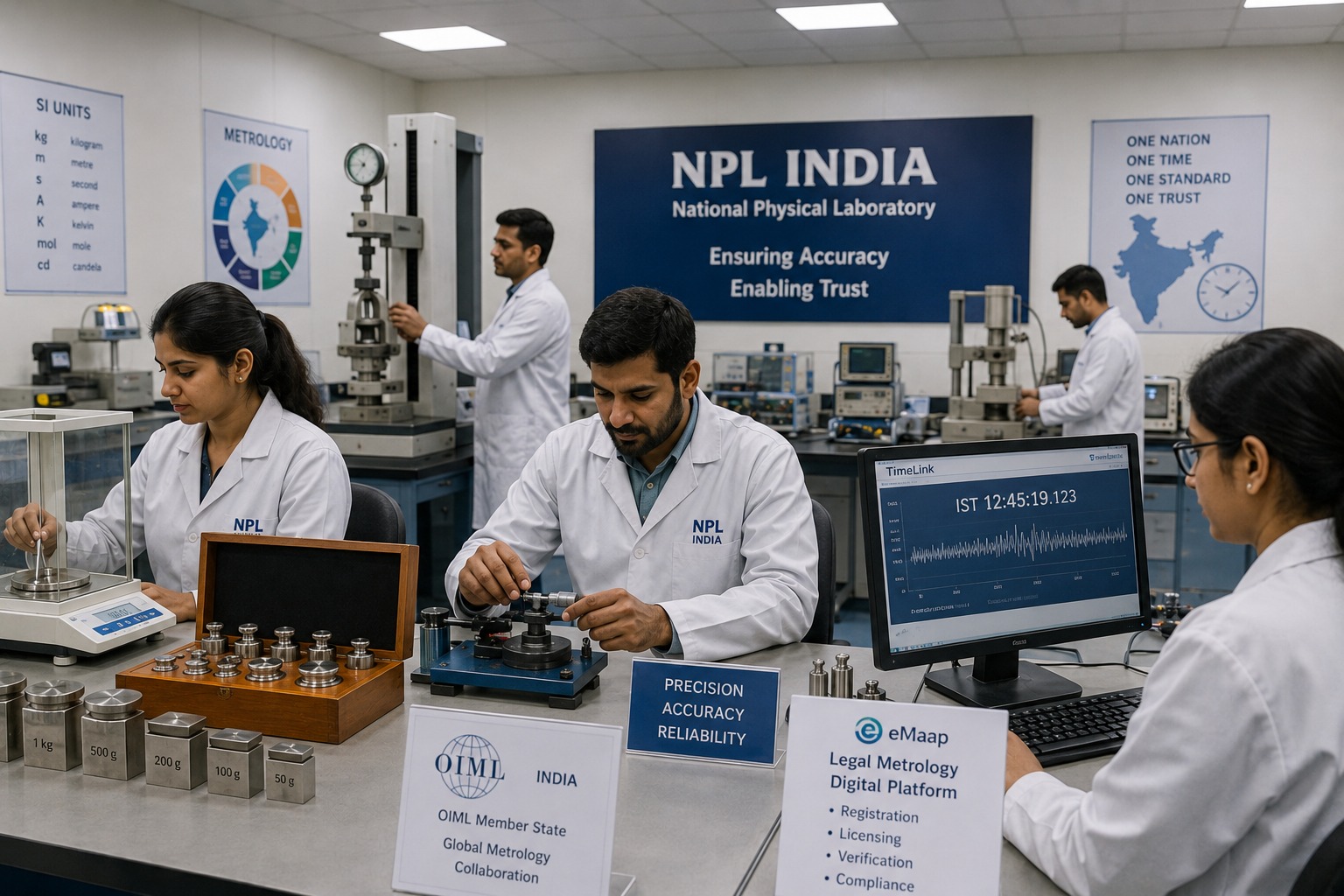
India’s evolving metrology ecosystem is strengthening fair trade, consumer protection, industrial quality, and global competitiveness. The Legal Metrology Act, 2009 anchors a modern regulatory structure that has evolved from ancient systems of weights and measures. Institutions like the National Physical Laboratory and Regional Reference Standard Laboratories support national measurement standards and verification systems. Initiatives like eMaap Portal, One Nation One Time, and authority to issue OIML certification are enhancing transparency, efficiency and consumer satisfaction. They are also supporting ease of trade through India’s integration with global measurement and quality infrastructure.
In modern society, trust often begins with measurement. Whether a consumer buys fuel at a petrol pump, receives electricity bills, purchases packaged food, undergoes a medical test, or makes a digital payment, the expectation remains the same: accuracy, fairness, and transparency. Behind these everyday transactions lies an invisible yet indispensable system that quietly sustains economic order and public confidence — metrology.
Metrology significantly influences everyday life by ensuring accuracy, reliability, and fairness in routine transactions and public services. Legal metrology systems regulate various kinds of weighing and measuring instruments. These include instruments used in petrol pumps, grocery stores, jewellery shops, hospitals, electricity meters, water supply systems, packaged commodities. It ensures consumers receive the correct quantity and value for their purchases and services. These systems help prevent the delivery of lesser quantities, inaccurate billing, and unfair trade practices, thereby strengthening consumer confidence in daily commercial transactions.
Often described simply as the science of measurement, metrology plays a far greater role than many people realize. It forms the foundation of trade, industrial quality, technological innovation, healthcare, scientific research, infrastructure development, and consumer protection. In an increasingly digitized and interconnected economy, reliable measurements are no longer merely technical requirements; they are instruments of governance, economic credibility, and public trust.
India’s metrology ecosystem has undergone a significant transformation over the decades. From ancient systems of weights and measures used in early trade to the modern framework established under the Legal Metrology Act, 2009, the country has steadily evolved towards a comprehensive and globally aligned measurement infrastructure.
Today, India’s legal metrology framework is not only strengthening consumer protection and ease of doing business but also supporting global trade integration, technological modernization, and transparent governance. Recent initiatives such as the eMaap portal, the “One Nation, One Time” programme, and India’s growing international role within global metrology institutions reflect a larger shift towards a digitally enabled, future-ready measurement ecosystem.
At a time when economies increasingly depend on precision, automation, and data-driven systems, India’s evolving metrology landscape has become more relevant than ever before.
Metrology refers to the science of measurement. Legal metrology, meanwhile, concerns the regulation and standardization of measurements used in trade and commerce.
Though the terminology may sound highly technical, its impact is deeply embedded in ordinary life. Every weighing machine in a grocery shop, every fuel dispenser at a petrol station, every electricity meter, medical thermometer, and packaged commodity depends upon accurate measurement systems.
Without standardized measurements, modern economies simply cannot function efficiently. Trade disputes would multiply, industrial production would become unreliable, healthcare systems would suffer inaccuracies, and consumers would lose trust in markets.
Metrology therefore performs two essential functions simultaneously: it ensures scientific accuracy and protects public interest.
Legal metrology systems establish uniform standards for measuring length, weight, volume, time, temperature, electricity, and countless other physical quantities. These standards create a common framework that allows trade, manufacturing, transportation, healthcare, and digital systems to operate seamlessly.
In many ways, measurement is the invisible language of modern civilization.
Most people encounter metrology every day without consciously noticing it.
When consumers purchase one litre of petrol, they trust that the dispensing machine delivers the exact quantity displayed. When packaged food products mention weight, price, or manufacturing details, consumers rely on the accuracy of those declarations. When electricity or water meters record consumption, households expect fair billing.
Legal metrology ensures these expectations are met.
The system regulates weighing instruments, packaged commodities, fuel dispensers, clinical devices, water meters, electricity meters, and even components of digital communication systems. It prevents short weighing, inaccurate billing, misleading packaging, and unfair trade practices.
Its role extends beyond commerce into public safety and welfare. Medical instruments such as thermometers and blood pressure monitors require high precision because inaccurate readings can directly affect diagnosis and treatment. Road safety enforcement systems depend on accurate speed measurement devices. Telecommunications and digital payment systems rely on synchronized timing and precise signal measurements.
In an increasingly technology-driven society, measurement accuracy has become inseparable from governance, economic stability, and public trust.
India’s engagement with standardized measurement systems dates back thousands of years.
Ancient Indian civilization developed sophisticated systems of weights and measures that played a critical role in trade, taxation, jewelry-making, agriculture, and governance. These systems were often based on seeds, grains, body measurements, and mathematical ratios.
Units such as Rati, Masha, Tola, Seer, and Maund formed part of organized commercial systems widely accepted across regions.
The Indus Valley Civilization demonstrated remarkable standardization in urban planning and trade practices, indicating advanced understanding of measurements. Later, during the Maurya Empire, organized systems of weights and measures were institutionalized for administrative and taxation purposes.
Historical ruler Sher Shah Suri further standardized weights and measures and introduced the Rupiya coin, which eventually evolved into the modern rupee.
These early systems reveal that measurement standardization has long been central to India’s economic and administrative history.
India’s modern metrology journey accelerated after independence.
The establishment of National Physical Laboratory in 1947 marked a major institutional milestone. The laboratory became India’s National Measurement Institute and custodian of national standards for measurement units.
Subsequently, the Standards of Weights and Measures Act, 1956 established nationwide uniformity in measurement systems based on the metric system and internationally accepted standards.
India also aligned itself globally by adopting the International System of Units (SI) during 1957–58 and becoming part of the global metrology framework under the International Organization of Legal Metrology (OIML).
Further legislative reforms in 1976 modernized regulation related to inter-state trade, packaged commodities, approval of weighing instruments, and training of legal metrology officials.
However, rapid technological advancement, digitization, globalization, and changing trade practices eventually necessitated a more modern framework. This led to the enactment of the Legal Metrology Act, 2009.
The Legal Metrology Act, 2009 represents the foundation of India’s contemporary metrology ecosystem.
Implemented in 2011, the Act modernized the legal framework governing weights and measures across India. It replaced earlier legislation while incorporating emerging technologies, evolving commercial systems, and stronger consumer protection mechanisms.
The law mandates standardized units of measurement across the country and regulates all weighing and measuring instruments used in commercial transactions.
Its key provisions include:
-
Mandatory verification and stamping of weights and measuring devices
-
Regulation of packaged commodities and mandatory declarations
-
Registration systems for manufacturers, dealers, repairers, and importers
-
Powers for inspections and enforcement
-
Penalties for non-standard or tampered measuring instruments
The Act significantly strengthened transparency in trade and enhanced consumer rights.
Today, consumers purchasing packaged products benefit from mandatory declarations regarding quantity, price, manufacturing details, and expiry information. Similarly, fuel dispensers, electricity meters, medical instruments, and digital systems are all regulated to ensure accuracy and fairness.
As India advances rapidly towards digital transformation, metrology has acquired entirely new dimensions.
Modern digital systems depend heavily on precision timing and accurate measurements. Mobile networks, internet services, artificial intelligence systems, semiconductor manufacturing, online banking, GPS navigation, and IoT devices all require synchronization at extremely high levels of accuracy.
Even millisecond variations can affect telecommunications, financial transactions, cybersecurity systems, and industrial automation.
This growing dependence on precision has expanded the importance of metrology far beyond traditional weighing machines and packaged goods.
The government’s “One Nation, One Time” initiative reflects this shift.
One of the most ambitious initiatives in India’s evolving metrology ecosystem is the “One Nation, One Time” programme.
Implemented through collaboration between the Department of Consumer Affairs, National Physical Laboratory, and Indian Space Research Organisation, the initiative seeks to disseminate Indian Standard Time with extremely high precision across the country.
The objective is to establish a uniform and synchronized national timing infrastructure supporting sectors such as telecommunications, banking, navigation, 5G services, artificial intelligence, scientific research, and power grids.
Importantly, the initiative also aims to reduce dependence on foreign time sources such as GPS systems, thereby strengthening national security and technological sovereignty.
In the digital age, accurate timekeeping has become a strategic national capability.
Another important reform is the introduction of the eMaap portal.
The platform digitizes legal metrology services and integrates systems across states and Union Territories. It provides online registration facilities for manufacturers, importers, dealers, repairers, and producers of packaged commodities.
By simplifying procedures and reducing bureaucratic complexity, the portal improves ease of doing business while enhancing transparency and efficiency.
Such digital governance initiatives represent a broader transition from paper-based regulatory systems towards technology-driven administration.
India’s metrology ecosystem is increasingly gaining international recognition.
As a member of the International Organization of Legal Metrology since 1956, India has steadily expanded its role within global measurement systems.
A major milestone came in 2023 when India became the 13th country authorized to issue internationally accepted OIML approval certificates for weighing and measuring instruments.
This recognition significantly benefits Indian manufacturers. Instruments certified in India can now be exported globally without undergoing additional foreign testing procedures, reducing costs and improving international competitiveness.
It also positions India as a global provider of certification services, strengthening its role within international trade and quality infrastructure systems.
A notable feature of recent reforms has been the attempt to balance consumer protection with ease of doing business.
The Jan Vishwas (Amendment of Provisions) Act, 2023 decriminalized several procedural provisions under the Legal Metrology Act by replacing imprisonment with monetary penalties in selected cases.
Further reforms under the 2026 amendments introduced “improvement notices” allowing businesses—particularly MSMEs—to rectify procedural lapses before penalties are imposed.
This marks an important shift from punitive regulation towards trust-based governance and voluntary compliance.
The approach recognizes that effective regulation should facilitate economic activity while maintaining accountability and consumer protection.
Metrology also contributes significantly towards achieving the Sustainable Development Goals (SDGs).
Accurate measurement systems support fair trade and poverty reduction, strengthen healthcare services, improve energy efficiency, enable industrial innovation, and assist climate monitoring and environmental research.
Reliable measurements are essential for renewable energy integration, scientific assessment of environmental changes, and efficient infrastructure management.
Thus, metrology is not merely a technical discipline; it is an enabling foundation for sustainable development itself.
As India’s economy grows increasingly complex and technology-driven, the importance of trustworthy measurement systems will continue to expand.
E-commerce, digital payments, smart devices, automated manufacturing, AI systems, and interconnected supply chains all depend upon precision, transparency, and standardized verification systems.
Recent reforms requiring country-of-origin disclosures for e-commerce platforms, effective from 2027, further demonstrate how legal metrology is adapting to modern trade realities.
Ultimately, the success of markets depends not only on economic growth but also on consumer confidence. And consumer confidence depends fundamentally on trust.
Metrology creates that trust.
India’s evolving metrology ecosystem reflects a broader national transformation towards transparency, technological modernization, global competitiveness, and consumer-centric governance.
From ancient systems of weights and measures to advanced digital synchronization initiatives, the country’s measurement infrastructure has continuously adapted to changing economic and technological realities.
The Legal Metrology Act, digital governance platforms, globally recognized certification systems, and precision timing initiatives collectively demonstrate how measurement science has become central to modern governance and economic development.
In many ways, metrology represents one of the least visible yet most essential pillars of contemporary society. It quietly safeguards fairness in markets, accuracy in science, reliability in public services, and confidence in everyday transactions.
As India moves towards becoming a major global economic and technological power, its commitment to precise, transparent, and standardized measurement systems will remain indispensable.
Because in the end, progress itself can only be built upon measurements that people trust.
Comments are closed.