
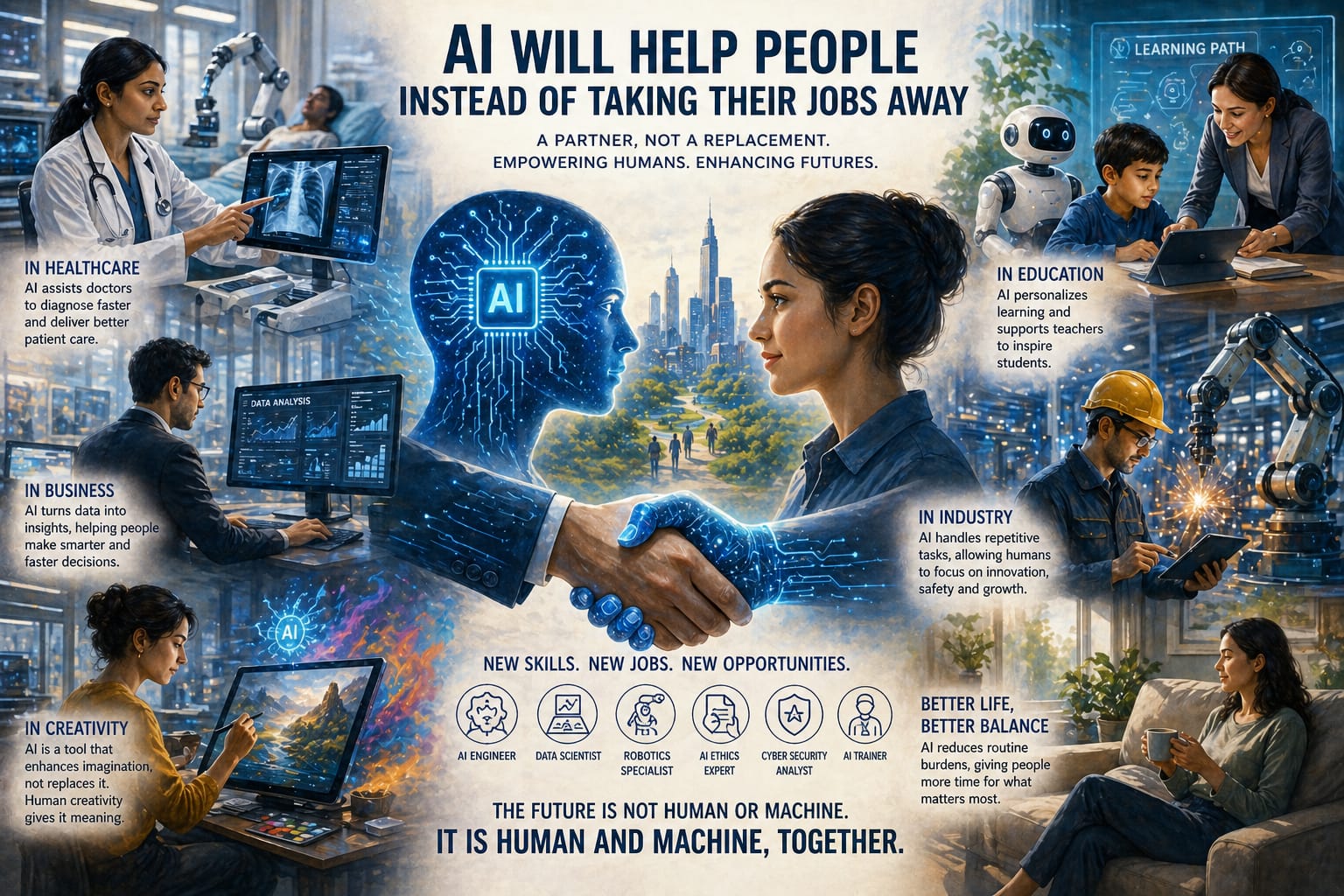

How AI Will Help People Instead of Taking Their Jobs Away

Aryan Singh Vashista

“ Drug abuse cannot be reduced to a law-and-order issue alone. It is deeply connected to social realities, mental health, and lack of opportunity. When effort does not lead to opportunity, vulnerability begins to grow. For many, that vulnerability becomes a pathway to addiction.”

In recent years, artificial intelligence has become one of the most widely discussed technological developments, often accompanied by a sense of uncertainty and fear. A common narrative suggests that AI will replace human workers and lead to widespread job loss. While such concerns are not entirely unfounded, they tend to overlook a broader and more important reality: technological progress has historically reshaped work rather than eliminated it. Artificial intelligence is not an exception to this pattern; rather, it represents the next stage in the long evolution of how humans work, create, and solve problems.

If we look back at earlier technological shifts, a clear pattern emerges. The introduction of machines during the Industrial Revolution raised fears of mass unemployment, yet it ultimately led to increased productivity and the creation of entirely new industries. Similarly, the arrival of computers in the late 20th century sparked concerns about job displacement. Instead, computers transformed workplaces and generated new roles that had never previously existed. Today, professions such as software engineering, digital marketing, and data analysis are integral to the global economy. These examples demonstrate that while technology may change the nature of jobs, it rarely eliminates the need for human contribution.

Artificial intelligence follows the same trajectory. Its primary function is not to replace humans but to assist them by taking over repetitive, time-consuming, and routine tasks. In most workplaces, a significant portion of an employee’s time is spent on activities that require consistency rather than creativity—processing data, managing documentation, or performing basic analysis. By automating these functions, AI allows individuals to redirect their time and energy toward tasks that require critical thinking, innovation, and human interaction. In this sense, AI acts less like a replacement and more like an extension of human capability, enabling people to focus on work that is both more meaningful and more impactful.

The efficiency gains brought by artificial intelligence are particularly evident in fields that rely heavily on data. In healthcare, for instance, AI systems can analyze medical images, patient records, and diagnostic patterns with remarkable speed. This does not diminish the role of doctors; rather, it enhances their ability to make informed decisions. A physician supported by AI can identify potential issues more quickly, reduce the likelihood of error, and dedicate more time to patient care. Similarly, in business environments, AI tools can process vast amounts of information—from market trends to consumer behavior—allowing managers to make strategic decisions based on accurate and timely insights. In such scenarios, AI serves as a powerful analytical assistant, strengthening human judgment rather than replacing it.

Another important dimension of artificial intelligence is its role in generating new forms of employment. Every technological advancement brings with it a shift in the skills that are valued in the workforce. While some traditional roles may evolve or decline, new opportunities inevitably emerge. The rise of AI has already created demand for professionals such as machine learning engineers, AI specialists, data scientists, and cybersecurity experts. Beyond these specialized roles, there is a growing need for individuals who can effectively integrate AI into existing fields, from education and healthcare to finance and creative industries. This indicates that the future of work will not be defined by the absence of jobs, but by the transformation of skills and the emergence of new career paths.

One of the most persistent concerns surrounding AI is its potential impact on creativity. There is a belief that machines capable of generating text, images, or music might replace human creators. However, this perspective misunderstands the nature of creativity itself. Human creativity is deeply rooted in emotion, personal experience, cultural context, and subjective interpretation. While AI can assist in generating ideas or refining outputs, it lacks genuine understanding and lived experience. A piece of writing, a work of art, or a design carries meaning because it reflects the thoughts and emotions of its creator. AI can support this process, offering tools and suggestions, but it cannot replicate the authenticity that defines human expression. Instead of replacing creativity, AI expands its possibilities by enabling individuals to experiment, innovate, and explore new forms of expression.

Beyond productivity and creativity, artificial intelligence also has the potential to improve the overall quality of life. By reducing the burden of repetitive tasks, it allows individuals to manage their time more effectively. This shift can lead to a healthier work-life balance, where people are no longer overwhelmed by routine responsibilities and can instead focus on personal growth, relationships, and well-being. In this way, AI is not just transforming how we work; it is also influencing how we live.

At the same time, it is important to acknowledge that the transition to an AI-driven world will not be without challenges. Certain roles that rely heavily on routine tasks may become less relevant, and individuals in those positions may need to adapt by acquiring new skills. However, this process of adaptation is not new; it has accompanied every major technological change in history. The key difference lies in the speed at which change is occurring, making it essential for individuals, institutions, and governments to prioritize education, training, and skill development. The ability to work alongside AI, rather than compete with it, will become a defining factor in the future workforce.

Ultimately, the question is not whether AI will take jobs, but how humans will choose to use it. Technology, by itself, is neutral—it is shaped by the intentions and decisions of those who develop and implement it. If used responsibly, artificial intelligence can serve as a powerful tool for progress, enhancing productivity, fostering innovation, and creating new opportunities. It can help individuals become more efficient, more creative, and more capable in their respective fields.

The narrative that AI will replace humans oversimplifies a complex reality. What lies ahead is not a future where machines dominate the workforce, but one where humans and machines collaborate in ways that were previously unimaginable. The true potential of artificial intelligence lies not in its ability to perform tasks, but in its capacity to amplify human potential. As history has consistently shown, progress does not eliminate human value; it redefines it.

The future, therefore, is not about humans losing to machines. It is about humans evolving alongside them, learning to harness their capabilities, and ultimately achieving more together than either could alone.

Comments are closed.