


Dr. Reyaz Ahmad
“If talent varies and opportunities differ, resilience remains the defining factor—the ability to continue without immediate validation separates those who succeed from those who withdraw.”
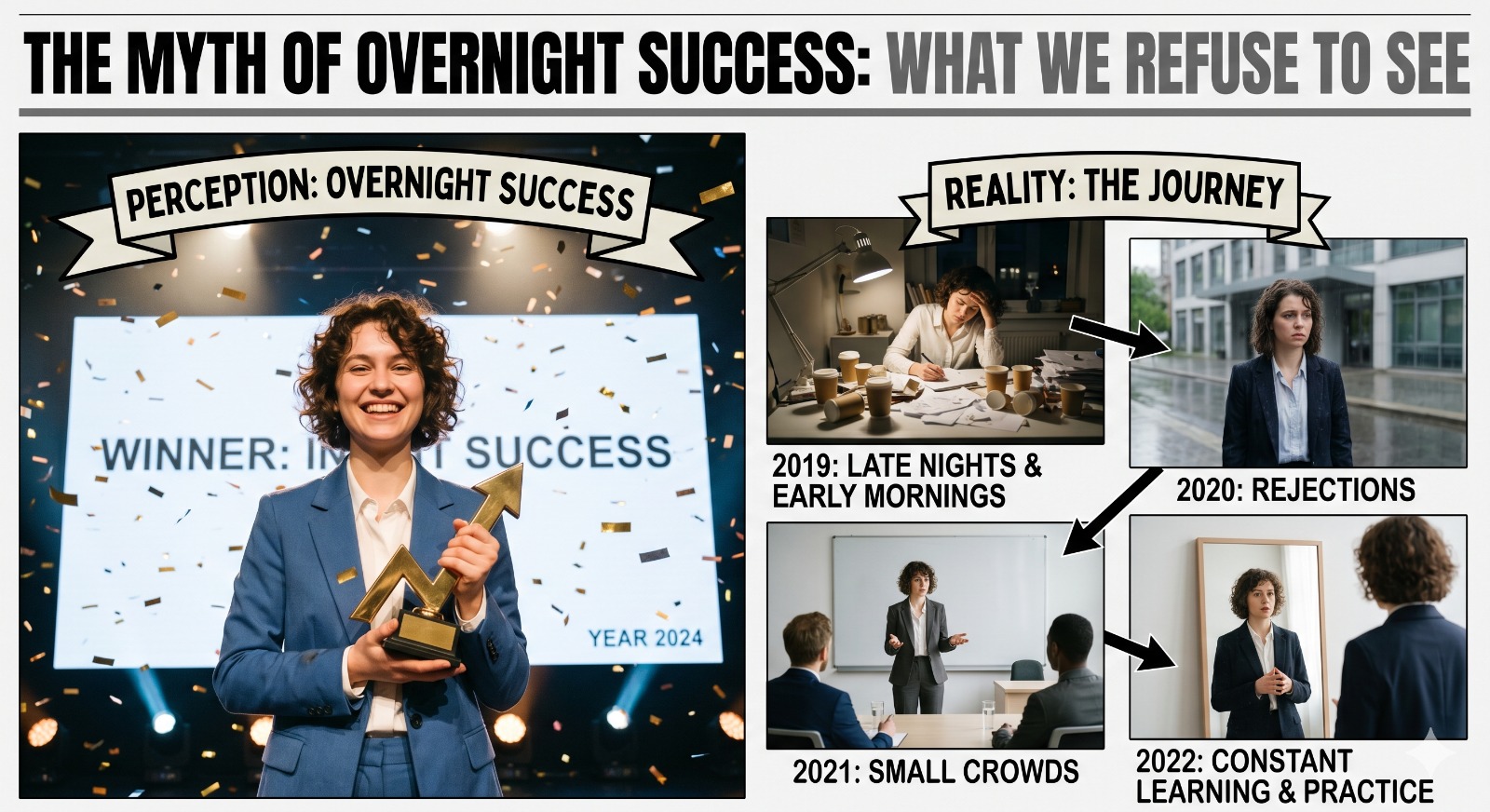
In an age dominated by social media highlights and viral fame, success has been dangerously reduced to a moment—an award, a breakthrough, a sudden rise. We scroll through curated feeds and assume that achievement is instantaneous, almost accidental. But this perception is not just misleading; it is fundamentally flawed. What we often celebrate as “overnight success” is, in reality, only the visible tip of a vast, invisible iceberg of effort, discipline, and persistence.
A widely circulated video captures this truth succinctly: no one sees the hard work and time that goes on behind the scenes—only the outcome. In that simple observation lies a powerful critique of modern culture.
The Illusion of Instant Achievement
Consider the case of a young entrepreneur whose startup suddenly attracts massive investment. Headlines describe a “meteoric rise,” while social media crowns the founder a genius. What remains untold is the decade of failed prototypes, rejected pitches, financial uncertainty, and emotional strain that preceded that moment.
In academia, a student who tops a national examination is often labeled naturally brilliant. Rarely acknowledged are the years of disciplined study, repeated practice, and personal sacrifices behind that success.
The pattern is clear: society glorifies outcomes while ignoring processes.
Behind Every Success: A Hidden Timeline
To understand success accurately, one must shift focus from moments to timelines. Achievement is rarely a single event—it is the cumulative result of sustained effort.
Take a content creator who suddenly “goes viral.” To an outsider, one video appears to change everything. In reality, it is often the product of countless unnoticed attempts—content that failed, strategies that evolved, and skills that were refined over time.
Similarly, a professional praised for a flawless presentation is rarely credited for the hours of preparation, revisions, and past failures that shaped that performance.
This gap between perception and reality creates unrealistic expectations—especially among young individuals who begin to question their progress when immediate results do not appear.
The Cost of Misunderstanding Success
Belief in “overnight success” carries real consequences.
Impatience: When results do not come quickly, individuals are more likely to give up prematurely.
Misplaced comparison: Early efforts are unfairly compared with someone else’s peak achievements.
Devaluation of effort: Hard work loses its perceived importance, weakening the foundation of growth.
These outcomes are not abstract—they are visible in classrooms, workplaces, and creative fields alike.
The Silent Struggles Behind Recognition
Consider a mid-career professional finally promoted after years of consistent effort. Observers may attribute the success to luck or favoritism, overlooking the long history of resilience, learning, and perseverance.
Or take a teacher recognized for innovative classroom practices. What remains unseen is the trial and error, the failures, and the emotional investment required to refine those methods.
In each case, success is not a moment—it is a journey.
The Power of Compounding Effort
Success operates much like compound interest: small, consistent efforts accumulate into significant outcomes over time. The challenge is that these gains are not immediately visible.
A student studying one hour daily may see little change in the short term. Over months and years, however, that consistency leads to mastery. The same principle applies to careers, fitness, and creativity.
Most people do not fail because of lack of ability—they falter because they cannot sustain effort during periods when progress appears slow.
Resilience: The True Differentiator
If talent varies and opportunities differ, resilience remains the defining factor of long-term success. The ability to continue without immediate validation separates those who succeed from those who withdraw.
This resilience is cultivated through mindset. Those who view setbacks as part of the process persist. Those who interpret them as failure often stop.
Competitive examinations offer a clear example: many succeed only after repeated attempts. The difference lies not in intelligence, but in persistence.
A Necessary Reality Check
While hard work is essential, it is not the sole determinant of success. Structural factors—access to education, financial resources, and social networks—play a significant role.
Two individuals may exert equal effort yet achieve different outcomes due to unequal opportunities. Acknowledging this does not diminish effort; it deepens our understanding of success.
Effort is necessary—but not always sufficient.
Redefining Success
To move beyond this flawed narrative, we must redefine success—not as a moment, but as a process.
-
For students: focus on consistent habits, not immediate results.
-
For professionals: prioritize skill development over quick recognition.
-
For entrepreneurs: accept failure as part of innovation.
Comments are closed.