
Climate change drives boar comaback in Kashmir
Officials link surge to rising temperatures

Suhail Khan
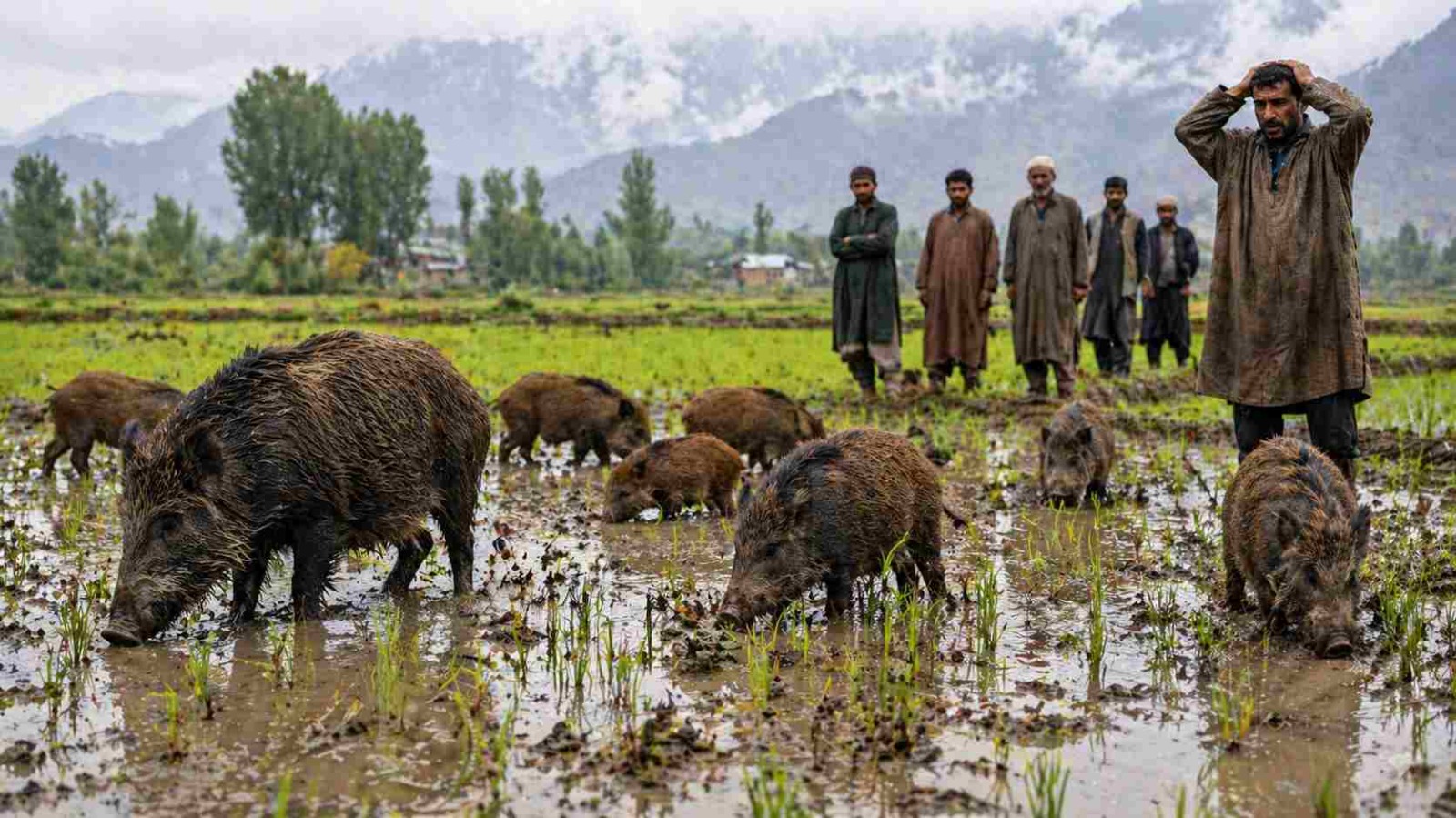
SRINAGAR, APRIL 27: Wild boars, unseen in Kashmir since the mid-1980s, have made a steady comeback over the past few years, with rising sightings in central and north Kashmir sparking panic among farmers and concern among wildlife officials.
The animal, not native to the Valley, has been spotted in several areas including Uri, Lachipora, Limber, Rafiabad, Rajwar and Balpur, besides the upper reaches of Bandipora district. It has also been seen wandering inside the Dachigam National Park and adjoining orchards and crop fields in summer capital Srinagar.
For farmers already reeling from unseasonal rain, the boar has emerged as a fresh threat.
“We had just sown paddy saplings with hard work. Within days, everything is destroyed. Every morning we see our fields ruined,” said Fayaz Khan, a farmer from Zangeer Sopore.
Farmers said freshly sown fields are being repeatedly ravaged, pushing them into financial distress. Some have alleged that despite complaints, no concrete steps have been taken by the administration.
“We are already late this season. Now this has become another disaster for us,” a group of farmers said.
Locals claim the boars were first spotted three years ago, but this year their numbers have grown sharply, with over a hundred now roaming fields and orchards. In a Muslim-majority region where the animal is culturally unacceptable, the menace has caused particular unease.
Some farmers, meanwhile, said they are now constantly guarding their fields at night. But if the destruction continues, they warned, they may have to abandon farming this year.
“If there is no crop this year, how will we feed our families?” a farmer said.
Speaking to Kashmir Convener, Senior wildlife officer Intisar Suhail ruled out large-scale culling or translocation, linking the population surge to climate change over the last two decades.
“The boar is not indigenous to Kashmir. It was introduced here during the Maharaja’s time, about 80-90 years ago. For the last 20-25 years, the climate has changed, so the population has revived,” Suhail said.
He said the animal’s high breeding rate — two litters per year, with 7-9 offspring per pair — as a key driver. “Its population has boosted suddenly,” he said.
But culling, he added bluntly, “is not a solution. Translocation is also not a solution. They are in hundreds and thousands. You cannot cull hundreds and thousands. That is a big project. There are laws in place. This has to be a decision at a higher level.”
Instead, the department is promoting community-level nurseries and temporary power fences. “Wherever we get information, we go there and do awareness. We had suggested to the agriculture department to provide subsidy for temporary power fences,” Suhail said.
He admitted wild boars have started venturing near towns due to “population spillover,” but said the problem is unlikely to disappear entirely. “If heavy snowfall or a harsh winter comes, the population will naturally be under control. But this problem is not going to vanish altogether. We have to learn to tackle it in a coordinated manner.”
Dr Raja Muzaffar Bhat, Chairman of the J&K RTI Movement, has appealed to Forest and Wildlife Minister Javed Rana and Chief Wildlife Warden Sarvesh Rai for urgent intervention.
“These wild animals attack paddy crop at night and eat up all the grains. For the last one week this has been happening. This problem has frustrated paddy farmers and needs to be addressed at the highest level,” Bhat said.
Manzoor Ahmad an environment expert and researcher with the wildlife department warned that the rapid rise of a non-native species could be suppressing other animals. “There is clear evidence of suppression of other animals and their habitat. It is possible that wild boars are suppressing the Hangul’s habitat because they are prolific breeders,” he said.
A regional wildlife officer told Kashmir Convener that a comprehensive study on the resurfacing of the animal is underway. He said the department has no census data yet, but is aware of the damages.
“With their growing population, they are moving out of their habitat in search of more food,” he added.
Comments are closed.