
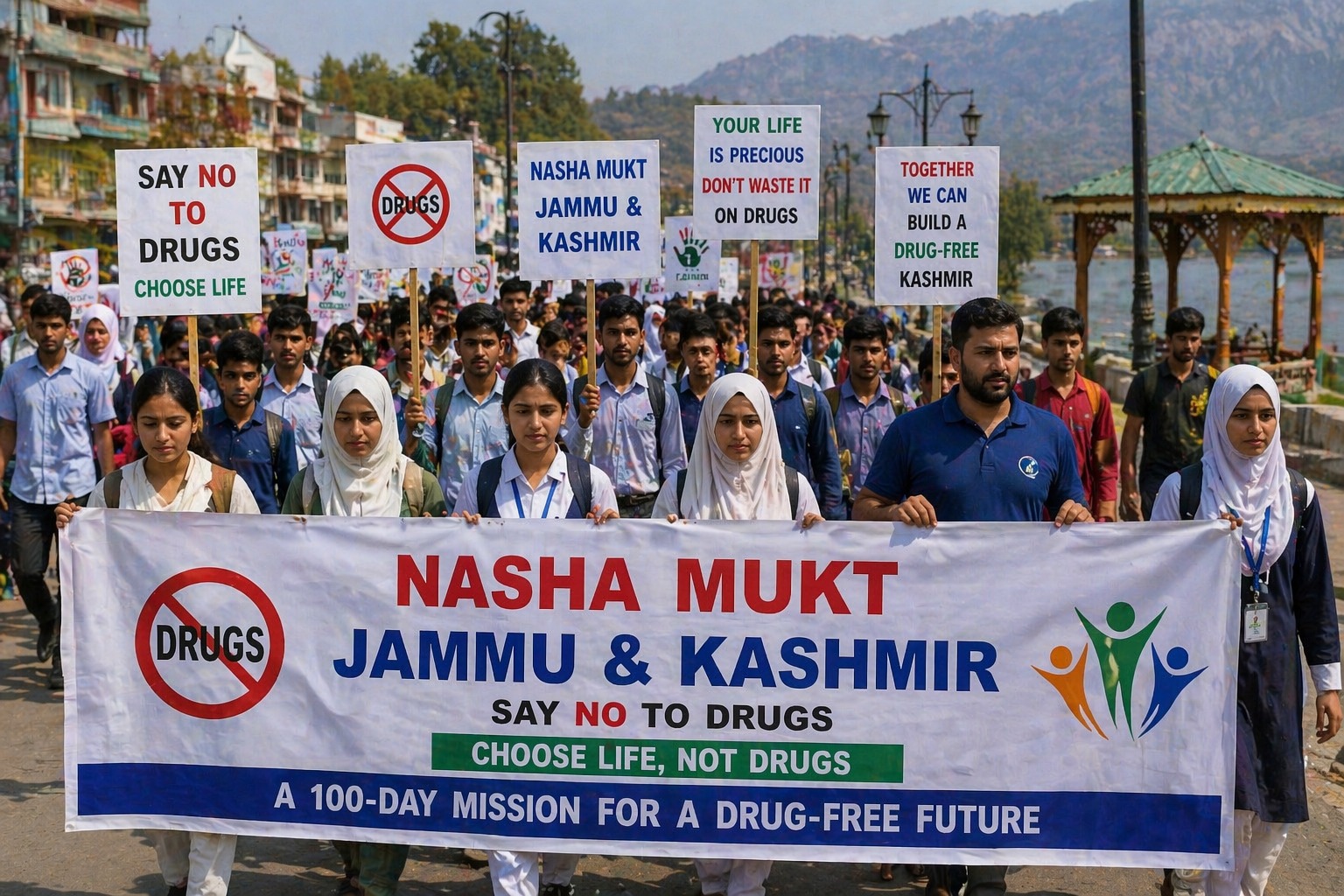
Nasha Mukt Jammu & Kashmir: A 100-Day Mission That Must Reach Every Doorstep
A Collective Call to Protect Our Youth, Families, and Future


AR Matahanji
“Drug abuse in Jammu & Kashmir is not a distant or abstract crisis—it is a deeply human tragedy unfolding quietly within homes and communities. Behind every case lies a story of fear, silence, and struggle that rarely reaches public attention. Addressing it requires not just enforcement, but empathy and collective responsibility.”
At a time when Jammu & Kashmir stands at a delicate yet hopeful crossroads—marked by aspirations of peace, development, and renewed opportunity—an insidious crisis continues to grow quietly within its social fabric. It does not announce itself with the immediacy of conflict or the visibility of political unrest. Instead, it creeps into homes, unsettles families, and gradually erodes the promise of a generation. Drug abuse, once considered a marginal issue, has today evolved into a widespread social challenge that demands urgent, sustained, and collective action.
The tragedy of addiction is not merely statistical; it is deeply human. Behind every case lies a story that rarely reaches public discourse—a mother waiting late into the night, gripped by fear; a father struggling silently to pull his child back from the brink; a young life, once filled with ambition, slipping into cycles of dependency and despair. Drug abuse does not remain confined to the individual. It fractures families, burdens communities, and threatens the long-term stability of society itself.
It is in this context that the 100-Day Nasha Mukt Jammu & Kashmir Campaign, launched under the leadership of Manoj Sinha, assumes profound significance. More than a policy initiative, it represents an attempt to confront a crisis that is as emotional as it is structural—one that requires not just enforcement, but empathy; not just awareness, but participation.
A Campaign Beyond Administration
The strength of the 100-day campaign lies in its recognition that drug abuse cannot be addressed through isolated institutional efforts alone. Law enforcement, while essential, can only act at the surface level. The roots of addiction lie deeper—in social pressures, psychological vulnerability, economic uncertainty, and the absence of supportive ecosystems.
By framing the initiative as a time-bound mission, the administration has introduced both urgency and accountability. Yet its real ambition extends beyond timelines. The campaign seeks to evolve into a mass movement—one that mobilizes communities, empowers families, and encourages individuals to take ownership of the issue.
This is a crucial shift. For too long, drug abuse has remained shrouded in silence, stigma, and denial. Families often hesitate to seek help, fearing social judgment. Young individuals struggling with addiction remain trapped between shame and helplessness. In such an environment, the problem not only persists—it multiplies.
Breaking this silence is perhaps the most important first step, and the campaign, in its design, acknowledges this truth.
Leadership and the Politics of Responsibility
Public policy, especially in socially sensitive domains, often reflects the priorities of leadership. The launch of this campaign signals a clear political acknowledgment that the drug menace is not a peripheral concern but a central challenge to societal well-being.
Leadership, however, must go beyond announcements. It must create systems that sustain engagement, ensure accountability, and foster collaboration across institutions. The 100-day framework, if implemented effectively, has the potential to do precisely that—by aligning administrative machinery, community stakeholders, and civil society under a shared objective.
Yet, it is equally important to recognise that such initiatives must be continuously evaluated. The success of the campaign will not be measured solely by the number of awareness drives conducted or enforcement actions taken, but by deeper indicators: Are families coming forward? Are youth accessing rehabilitation services without fear? Are communities actively participating in prevention efforts?
These are the questions that will define whether the campaign becomes a milestone or merely a moment.
The Media as a Catalyst for Change
In the fight against drug abuse, information is as critical as intervention. The role of media—print, electronic, and digital—has been pivotal in bringing the issue into public consciousness.
Through consistent coverage, investigative reporting, and human-interest stories, media platforms have helped dismantle the culture of silence surrounding addiction. They have highlighted both the dangers of drug abuse and the possibilities of recovery, offering narratives that are as cautionary as they are hopeful.
Importantly, responsible journalism has also bridged the gap between policy and people. By reporting on government initiatives, grassroots efforts, and rehabilitation success stories, the media has created a space for dialogue and participation.
However, the media’s role must continue to evolve. Sensationalism can distort realities, while underreporting can invisibilise suffering. What is needed is sustained, nuanced, and empathetic coverage—one that informs without stigmatizing, and mobilizes without exaggerating.
Understanding the Spread: A Social Reality
Drug addiction does not discriminate. It cuts across geography, class, and education. From urban centers to remote villages, from affluent households to economically vulnerable communities, its reach is widespread.
What often begins as experimentation—driven by curiosity, peer influence, or escapism—gradually transforms into dependency. The consequences are multifaceted: deteriorating mental and physical health, strained relationships, financial distress, and eventual social isolation.
Yet, one of the most damaging aspects of this crisis is the silence that surrounds it. Families conceal struggles to avoid societal judgment. Individuals hesitate to seek help due to stigma. This collective silence creates an environment where addiction thrives unchecked.
Addressing this requires a shift in societal attitudes—from judgment to understanding, from exclusion to support.
Taking the Campaign to the Grassroots
For the 100-day campaign to achieve meaningful impact, it must transcend institutional boundaries and reach the grassroots. Awareness cannot remain confined to official events or urban centers; it must enter homes, schools, and neighborhoods.
Door-to-door awareness initiatives can play a transformative role in this regard. By engaging directly with families, such efforts can educate people about early warning signs of addiction, available counseling services, rehabilitation options, and helpline resources. Early intervention, facilitated by informed communities, can prevent cases from escalating into severe dependency.
Equally important is the formation of community-based anti-drug committees at the village and ward levels. These committees, comprising local leaders, teachers, youth representatives, religious figures, and healthcare professionals, can serve as localized support systems. Their presence fosters a sense of collective responsibility and ensures that the issue remains visible within communities.
Youth: From Vulnerability to Leadership
Young people are often seen as the most vulnerable group in the context of drug abuse. While this is true, it is only one side of the story. Youth are not just at risk—they are also the most powerful agents of change.
Transforming youth from passive beneficiaries into active participants is essential. Initiatives such as sports tournaments, cultural programs, awareness rallies, and debate competitions can provide constructive outlets for energy and creativity. Youth clubs and peer-led campaigns can further amplify the message, making it more relatable and impactful.
When young individuals take ownership of the movement, the narrative shifts—from prevention imposed from above to change driven from within.
The Role of Families and Communities
The family remains the first line of defense against addiction. Open communication, emotional support, and early recognition of behavioral changes can significantly reduce vulnerability.
Parents, however, often struggle to identify warning signs or initiate conversations about drug use. Awareness programs tailored for families can bridge this gap, equipping them with the knowledge and confidence needed to act.
Women, particularly mothers, often play a critical role in this context. Their ability to detect subtle changes in behavior makes them key stakeholders in prevention efforts. Women-led awareness initiatives and self-help groups can strengthen community resilience against drug abuse.
Religious and community leaders also hold significant influence. By addressing the issue during gatherings and promoting messages of compassion and rehabilitation, they can help reshape societal attitudes.
Education Systems as Prevention Spaces
Schools and colleges are not just centers of learning; they are critical spaces for early intervention. Integrating awareness programs, counseling services, and life skills education into educational institutions can create a protective environment for students.
Declaring campuses as drug-free zones is a step in the right direction, but it must be supported by continuous engagement. Workshops, peer counseling, and mentorship programs can help students navigate challenges and resist negative influences.
Rehabilitation: The Missing Link
While prevention and enforcement are essential, rehabilitation remains the cornerstone of any effective anti-drug strategy. Addiction is not merely a behavioral issue; it is a complex health condition that requires medical, psychological, and social support.
Expanding access to rehabilitation centers, strengthening counseling services, and integrating skill development programs are crucial steps. Recovery must be viewed not as an end, but as a process—one that requires sustained support and societal acceptance.
Equally important is the need to eliminate stigma. Individuals seeking help must feel supported, not judged. Communities must shift from exclusion to inclusion, recognizing that recovery benefits not just individuals, but society as a whole.
Technology and Outreach
In an increasingly digital world, social media platforms offer powerful tools for awareness and engagement. Campaigns that leverage these platforms can reach wider audiences, particularly youth, and create interactive spaces for dialogue.
However, digital outreach must complement, not replace, on-ground efforts. The effectiveness of the campaign will depend on its ability to balance both.
A Shared Responsibility
The fight against drug abuse cannot be won by any single entity. It requires coordinated efforts across government agencies, law enforcement, healthcare systems, educational institutions, media, civil society, and families.
Each stakeholder has a distinct role, but their efforts must converge towards a common goal. The 100-day campaign provides a framework for such convergence, but its success will depend on sustained collaboration beyond the initial phase.
From Campaign to Movement
The true measure of the 100-Day Nasha Mukt Jammu & Kashmir Campaign will not lie in its duration, but in its legacy. If it succeeds in transforming awareness into action, silence into dialogue, and vulnerability into resilience, it can evolve into a long-term movement.
Encouragingly, early signs suggest growing momentum. Communities are beginning to engage, families are opening up, and youth are stepping forward. These are not small achievements—they are the building blocks of social change.
Yet, the journey ahead remains long. Sustaining momentum beyond 100 days will require institutional commitment, community ownership, and continuous innovation.
A Call to Conscience
At its core, the fight against drug abuse is not just a policy challenge; it is a moral imperative. It calls upon society to protect its most vulnerable, to support those in need, and to create environments where individuals can thrive without fear or dependency.
A drug-free Jammu & Kashmir is not an abstract ideal. It is a tangible goal—one that can be achieved through collective effort, compassionate action, and unwavering commitment.
The vision is simple yet powerful: every home free from the shadow of addiction, every young person empowered to pursue their dreams, every community united in purpose.
This is not the responsibility of the government alone. It belongs to each of us.
Because every life saved from addiction is not just an individual victory—it is a family restored, a dream revived, and a future secured. And in that truth lies the urgency of now.
Comments are closed.