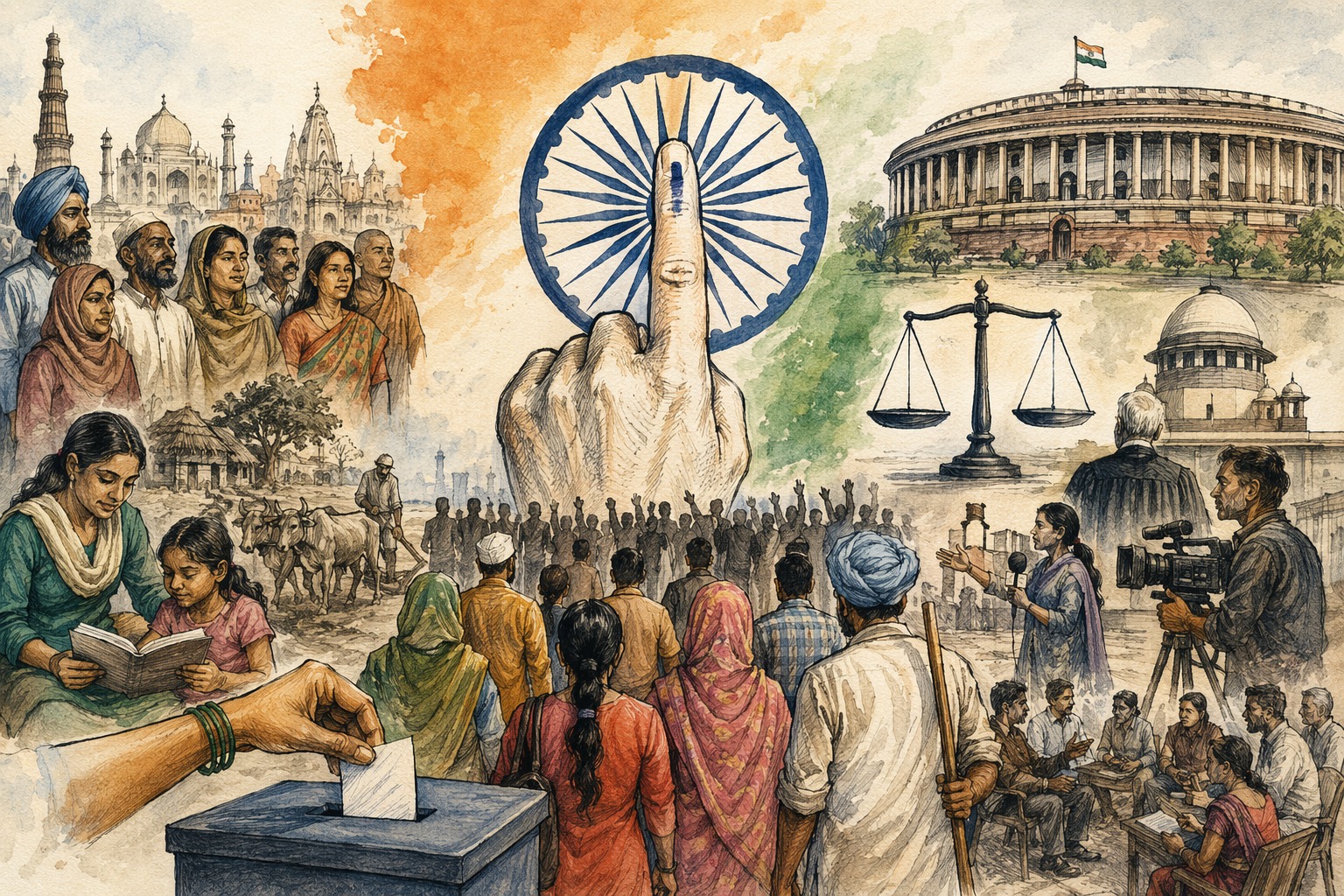

From People to Power: The Enduring Beauty of India’s Democracy

Dar Muqeet Gull


“India’s strength is often described through its geography or history, but its true foundation lies in its people. Not as passive inhabitants, but as active participants shaping the nation’s destiny.”

India’s strength is often described through its vast geography, its ancient civilisation, or its unmatched cultural diversity. Yet, none of these alone explains the resilience and vitality of the nation. The true foundation of India lies in its people—not merely as inhabitants of a territory, but as active participants in shaping its destiny. In India, citizenship is not a passive identity; it is a responsibility, a right, and a power. The story of Indian democracy is, therefore, not the story of governments or institutions alone, but the story of millions of ordinary individuals who collectively sustain an extraordinary system.

India is not just a democratic country in theory—it is democracy in motion. From the snow-laden landscapes of Kashmir to the southern tip of Kanyakumari, a single unifying idea binds the nation together: that every voice matters. This belief is not symbolic; it is institutionalised, practiced, and reaffirmed through continuous participation. It is what transforms a population into a people, and a people into a democratic force.

At the heart of this system lies the principle of universal adult franchise, one of the most radical and empowering features of Indian democracy. Every citizen above the age of 18 has the right to vote, regardless of caste, class, gender, religion, or education. This simple yet profound idea ensures that power is not inherited, bought, or imposed—it is earned through the consent of the governed. In a country marked by deep social and economic inequalities, the equal value of each vote becomes a powerful equaliser. A farmer in a remote village, a daily wage labourer in a bustling town, and a corporate executive in a metropolitan city—all stand on equal footing when they step into a polling booth. This is democracy in its purest form: the dignity of choice.

The strength of this system is further reinforced by the framework of the Constitution of India, a document that serves as the moral and legal backbone of the nation. It guarantees justice—social, economic, and political; liberty of thought, expression, belief, faith, and worship; equality of status and opportunity; and the promotion of fraternity. These are not abstract ideals but guiding principles that shape governance and public life. The Constitution ensures that no individual, no matter how powerful, stands above the law. It transforms authority into accountability and power into responsibility.

One of the defining characteristics of Indian democracy is its secular nature. India does not privilege any one religion over another. Instead, it creates a framework where all faiths are respected and protected. Citizens are free to practice, preach, and propagate their religion without fear or coercion. This commitment to religious freedom is not merely a legal provision—it is a social contract that allows diversity to coexist peacefully. In a nation where multiple religions, languages, and cultures intersect, secularism becomes the thread that weaves unity out of diversity.

Education plays a crucial role in sustaining this democratic fabric. The Right to Education Act is not just about schooling; it is about empowerment. An educated citizen is more aware, more engaged, and better equipped to participate in democratic processes. Education nurtures critical thinking, encourages questioning, and builds a sense of responsibility. It ensures that democracy is not reduced to periodic voting, but becomes a continuous process of informed participation.

Indian democracy also stands out for its openness. It does not confine participation to voting alone; it extends the opportunity to lead. Any citizen who meets the constitutional criteria can contest elections. This transforms democracy from a spectator sport into an inclusive arena where anyone can aspire to represent the people. The presence of multiple political parties further enriches this process. Each party brings its own ideology, vision, and priorities, offering citizens a genuine choice. This diversity of political thought ensures that democracy remains dynamic, responsive, and representative.

Regular elections are the lifeblood of this system. Every five years, citizens are given the opportunity to evaluate their leaders and decide the future course of governance. This periodic accountability is what distinguishes democracy from other forms of government. Power is not permanent; it is conditional. Governments exist by the will of the people, and they can be changed by the same will. This creates a system where leaders must remain responsive, transparent, and answerable.

The role of institutions in safeguarding this process cannot be overstated. The Election Commission of India ensures that elections are conducted in a free and fair manner, maintaining the integrity of the democratic process. The judiciary acts as a guardian of the Constitution, protecting the rights of citizens and ensuring that laws are applied fairly. A free press plays the role of a watchdog, bringing issues to light, questioning authority, and keeping the public informed. Civil society, too, contributes by mobilising communities, advocating for rights, and fostering participation. Together, these institutions create a system of checks and balances that prevents the concentration of power and promotes accountability.

However, the beauty of Indian democracy does not lie in its perfection. Like any system of such scale and diversity, it faces challenges. Issues such as social inequality, political polarisation, misinformation, and economic disparity continue to test its resilience. Yet, what makes Indian democracy remarkable is its capacity to evolve. It is not static; it learns, adapts, and reforms. The very fact that these challenges are debated openly is a testament to the strength of democratic values.

Participation remains the cornerstone of this evolution. Democracy is not sustained by institutions alone; it is sustained by people who engage, question, and contribute. Every vote cast, every opinion expressed, every debate held—these are the building blocks of a living democracy. When citizens remain aware and active, democracy thrives. When they withdraw, it weakens.

In India, the act of voting is more than a civic duty; it is a declaration of belonging. It is a reminder that power ultimately rests with the people. It is what transforms governance from a distant authority into a collective enterprise. The journey from people to power is not a one-time event; it is an ongoing process that defines the very essence of the nation.

As India continues to grow and evolve, the responsibility of its citizens becomes even more significant. Democracy demands awareness, participation, and vigilance. It requires individuals to look beyond personal interests and consider the larger good. It calls for engagement not just during elections, but in everyday life—through dialogue, community involvement, and a commitment to justice and equality.

India stands today as one of the world’s largest and most vibrant democracies, not because it is free from flaws, but because it refuses to be defined by them. Its strength lies in its people—in their ability to dream, to dissent, to decide, and to drive change. It is a system where the governed are also the governors, where authority flows from the ground up, and where the future is shaped collectively.

In the final analysis, the beauty of India’s democracy lies in its simplicity and its depth. It lies in the idea that every individual matters, that every voice counts, and that every action contributes to the larger narrative of the nation. It is a system built not in corridors of power, but in the everyday lives of its citizens.

India’s democracy is not built by leaders alone—it is built by its people. And as long as its citizens continue to participate, to question, and to believe in the power of their voice, the journey from people to power will remain not just a possibility, but a reality.

Comments are closed.