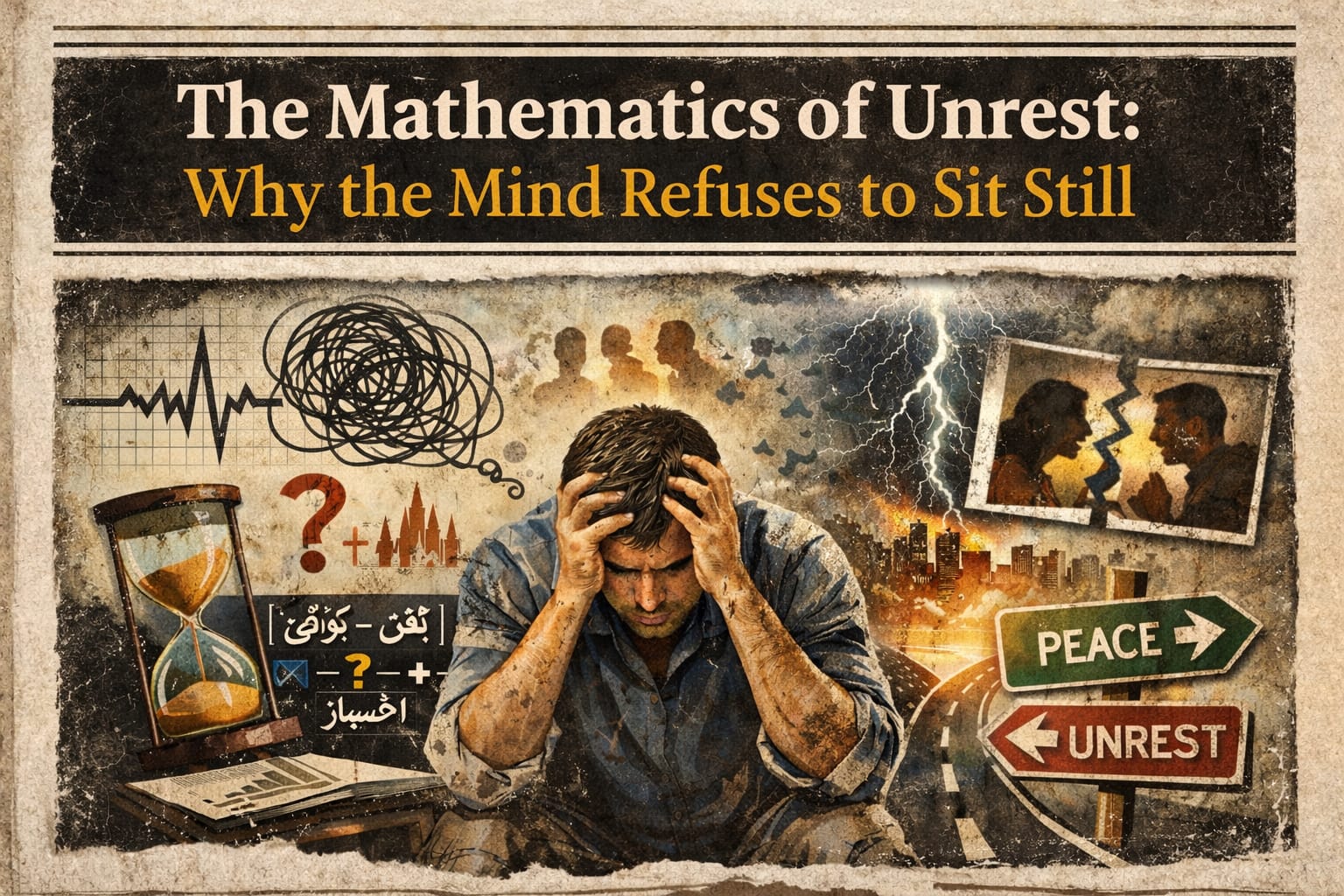

The Mathematics of Unrest: Why the Mind Refuses to Sit Still

Dr. Reyaz Ahmad

“Rumination is not problem-solving; it is amplification. What repeats without resolution grows louder, even if reality itself has not changed.”

You do not need advanced training in mathematics to understand human restlessness. All you need is the memory of a night when your body was exhausted but your thoughts refused to slow down—when your mind kept revisiting a conversation, rehearsing tomorrow’s uncertainties, or circling the same unresolved question. That inability to feel settled is not random. Beneath it lies a subtle internal logic, an invisible arithmetic the mind performs continuously.

Human beings are constantly comparing what they expected with what actually occurred. When life unfolds roughly as imagined, the mind remains steady. But when reality sharply diverges from expectation—when respect is replaced by dismissal, stability by disruption, clarity by confusion—an internal disturbance begins. That gap between what “should have been” and what “is” becomes the seed of unrest. The larger this gap grows, the stronger the emotional turbulence that follows. Disappointment, frustration, and even anger are often nothing more than signals that something did not align with our internal forecast.

Yet misalignment alone does not fully explain why unrest deepens. What intensifies it is uncertainty. A difficulty with a clear solution is manageable; a difficulty without a visible end is far more distressing. When outcomes remain unknown, the mind struggles because it prefers completion over ambiguity. It seeks resolution, predictability, and closure. When none is available, it compensates by rehearsing possibilities—often negative ones. Thoughts begin to circle not because the individual enjoys worry, but because the brain is attempting to close an open loop. Without answers, it keeps calculating.

Another powerful variable in this internal equation is the sense of control. Even serious hardships feel lighter when a person believes action can influence the outcome. A structured plan, a defined pathway, or a tangible next step provides psychological stability. In contrast, when effort appears ineffective and events seem entirely outside one’s influence, distress transforms into helplessness. Two individuals may face identical circumstances, yet the one who perceives some degree of agency often copes more calmly than the one who feels powerless. The severity of the situation matters less than the perceived ability to respond to it.

Complicating matters further is the mind’s tendency to amplify its own signals. A single worry can evolve into a cascade of repetitive thoughts. When a concern repeats without producing progress, it becomes rumination—a mental echo chamber where the original issue grows louder and more intrusive. This feedback loop does not solve problems; it magnifies them. What began as a manageable concern can feel overwhelming simply because it has been replayed countless times. The amplification happens internally, even if the external reality remains unchanged.

Time also plays a destabilizing role. Modern life often requires waiting—waiting for results, decisions, approvals, or responses. The human mind, however, prefers immediate feedback. In the absence of timely answers, imagination fills the gap. Because the brain evolved to detect threats, it frequently predicts unfavorable outcomes. Delayed clarity therefore breeds emotional volatility: moments of optimism quickly replaced by fear, brief calm interrupted by doubt. Such fluctuations are not signs of fragility but natural responses to prolonged ambiguity.

Daily life introduces yet another element: accumulated stress. Small pressures—deadlines, financial responsibilities, misunderstandings, fatigue—rarely seem catastrophic on their own. But like drops of water filling a container, they gather silently. When the container is nearly full, even a minor additional stressor can trigger disproportionate emotional reaction. Occasionally, a sudden shock—a harsh remark, unexpected loss, or unsettling news—causes an abrupt internal shift. Unrest can appear sudden, yet often it has been quietly building beneath the surface.

Perhaps the most profound source of unrest, however, lies within. Internal conflict generates a unique form of turbulence. Human beings often hold competing desires at the same time. One part longs for achievement while another craves rest. One seeks independence while another yearns for approval. One wishes to forgive while another demands justice. When these opposing forces pull simultaneously, the mind becomes divided. External circumstances may be manageable, but unresolved internal contradictions create persistent agitation. No external solution can fully settle a struggle that is fundamentally internal.

When viewed through this lens, unrest is not merely “overthinking” or personal weakness. It is the mind signaling that something requires adjustment—an expectation that needs revision, an uncertainty that demands clarity, a sphere of control that must be reclaimed, a repetitive thought pattern that needs interruption, or an internal conflict that calls for deliberate choice. Understanding these dynamics shifts the conversation from self-criticism to self-inquiry.

Peace rarely arrives by accident. It tends to emerge when expectations become more realistic, when uncertainty is faced rather than feared, when even small areas of control are reclaimed, and when inner contradictions are acknowledged with honesty. The mind seeks coherence, predictability, and resolution. When it cannot anticipate what lies ahead, cannot influence outcomes, and cannot reconcile its own divisions, it resists rest.

In that sense, the mathematics of unrest is simple: when prediction collapses, control diminishes, and resolution remains distant, the mind continues calculating—again and again—until balance is restored.

Author can be mailed at reyaz.ahmad@hu.ac.ae

Comments are closed.