

S Ahmad
India today stands at a defining demographic juncture. With one of the youngest populations in the world, the country possesses a rare opportunity to transform its human capital into a powerful engine of economic growth. However, this potential can only be realised if the workforce is equipped with the right skills, aligned with the demands of a rapidly evolving global economy. The Economic Survey 2025–26 and the Union Budget 2026–27 together present a clear and strategic vision: India’s growth story will be driven not merely by numbers, but by the quality, adaptability, and productivity of its workforce.
Recent labour market indicators suggest a steady recovery and growing participation. The Labour Force Participation Rate has stabilised at 55.9%, with a noticeable increase in women’s participation and a decline in unemployment across rural and urban regions. Yet, beneath this encouraging trend lies a structural challenge—bridging the gap between available jobs and employable skills. This gap is not just an economic concern; it is a social one, influencing income mobility, regional disparities, and long-term development outcomes.
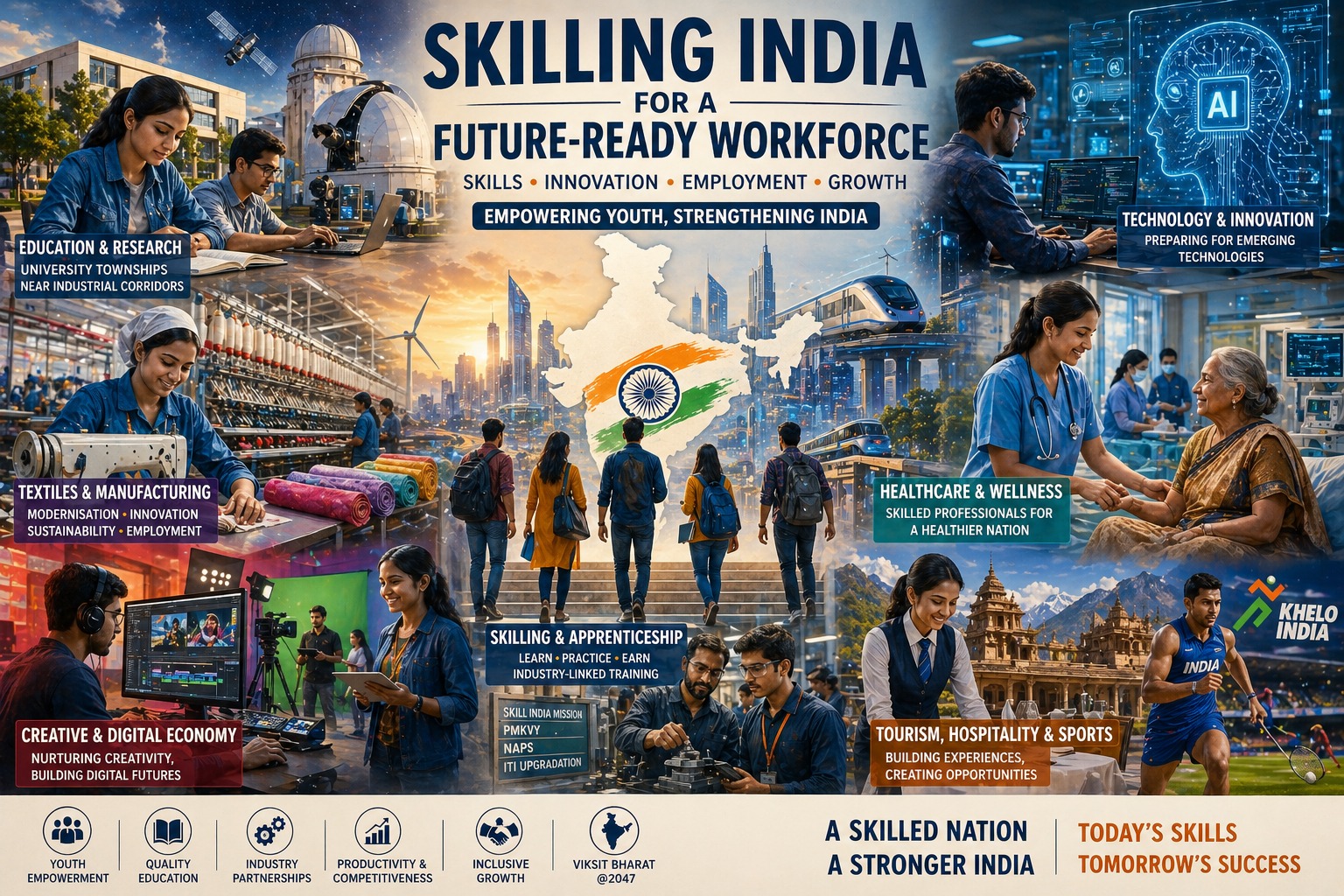
Recognising this, the Union Budget 2026–27 places skill development at the centre of policy design, not as a standalone initiative but as a cross-sectoral priority embedded across education, industry, healthcare, tourism, creative sectors, and rural livelihoods. The emphasis is clear: skilling must move beyond certification to become deeply integrated with industry demand, technological change, and real employment opportunities.
The education sector reflects this shift most visibly. With an allocation of ₹1.39 lakh crore, the focus is not only on expanding access but on reshaping the structure of learning itself. The creation of university townships near industrial corridors signals a move toward aligning academia with economic geography. These townships are envisioned as integrated ecosystems where education, research, skill training, and industry coexist, enabling students to transition more seamlessly into the workforce. Simultaneously, the proposal to establish girls’ hostels in every district addresses a critical but often overlooked barrier—access and retention of women in higher education, particularly in STEM fields.
India’s push toward advanced scientific capacity is equally significant. Investments in telescope infrastructure, including facilities such as the National Large Solar Telescope and Himalayan Chandra Telescope, indicate that skilling is no longer confined to traditional sectors. It now extends to high-end research domains like astrophysics and space science, preparing India for leadership in knowledge-intensive industries.
The textile and apparel sector, one of India’s largest employers, is undergoing a transformation that combines tradition with innovation. With over 45 million jobs supported by the sector, the focus on modernisation through schemes like the National Fibre Scheme, Samarth 2.0, and Mega Textile Parks is aimed at enhancing both productivity and global competitiveness. The emphasis on man-made fibres and new-age sustainable materials reflects a forward-looking approach, while continued support for handloom and handicrafts ensures that traditional livelihoods are not left behind in the process of industrial transition.
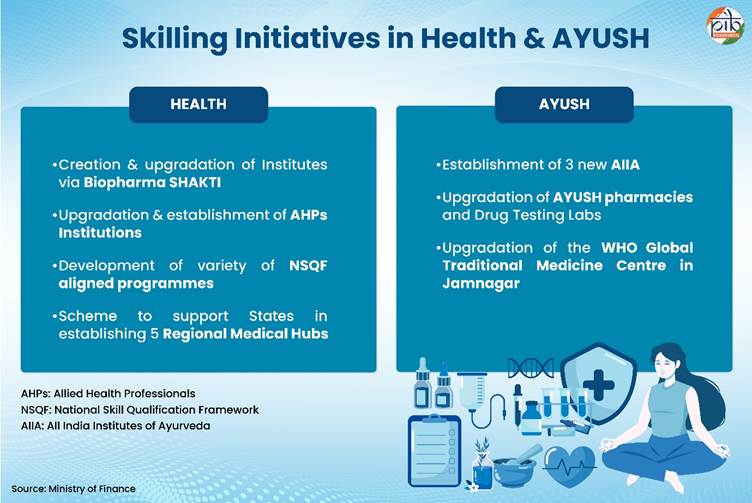
Healthcare, another critical pillar, is witnessing a parallel expansion of skill capacity. With rising demand driven by demographic changes and global healthcare needs, the government’s plan to add 100,000 allied health professionals and train 1.5 lakh caregivers highlights the emergence of a structured “care economy.” This is not just about addressing domestic needs but also positioning India as a global hub for healthcare services and medical tourism. The integration of training, infrastructure, and regulatory strengthening under initiatives like Biopharma SHAKTI further underscores the ambition to build a comprehensive healthcare ecosystem.
Equally noteworthy is the growing recognition of non-traditional sectors as engines of employment. The so-called “Orange Economy,” encompassing media, entertainment, and digital content, is projected to expand significantly in the coming years. The introduction of AVGC Content Creator Labs in thousands of schools and colleges represents an early-stage intervention aimed at nurturing creativity and digital skills. This initiative acknowledges a fundamental shift in the nature of work—where creativity, storytelling, and digital production are becoming as important as technical expertise.
Tourism and hospitality, long recognised for their employment potential, are also being strengthened through institutional reforms. The transformation of the National Council for Hotel Management into a more integrated National Institute of Hospitality reflects an effort to bridge the gap between academic training and industry requirements. Similarly, initiatives like upskilling tourist guides and creating digital knowledge grids for heritage sites demonstrate how technology can enhance both employment and cultural preservation.
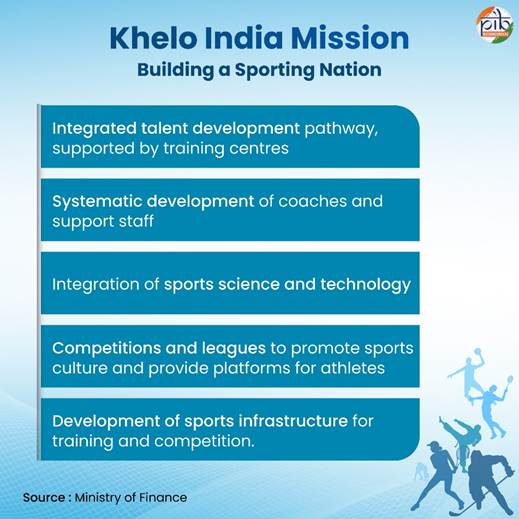
Sports, too, are being reimagined as a structured sector for employment and skill development. With increased budgetary allocation and the launch of the Khelo India Mission, the focus extends beyond athletic excellence to include coaching, sports science, infrastructure, and management. This holistic approach recognises that sports ecosystems can generate diverse employment opportunities while contributing to national identity and global presence.
At the core of this transformation lies a robust institutional framework built over the past decade. Programmes such as the Skill India Mission, Pradhan Mantri Kaushal Vikas Yojana (PMKVY), National Apprenticeship Promotion Scheme (NAPS), and the Craftsmen Training Scheme have created a large-scale skilling infrastructure across the country. The evolution of PMKVY into a demand-driven, industry-aligned programme, with over 27 lakh candidates trained under its latest phase, reflects a shift toward outcome-based learning.
The apprenticeship ecosystem, strengthened through NAPS, embodies the principle of “earn while you learn,” linking training directly with industry experience. Meanwhile, the expansion and modernisation of Industrial Training Institutes under initiatives like PM–SETU signal a renewed focus on long-term vocational education. The hub-and-spoke model, combined with industry partnerships, aims to ensure that training remains relevant to real-world requirements.
Despite these advances, the challenge lies in execution and scale. Skilling is not merely about training individuals; it is about creating an ecosystem where skills translate into livelihoods. This requires continuous alignment with market demand, strong industry participation, and mechanisms to measure outcomes effectively. It also requires addressing regional disparities, ensuring that opportunities reach rural and marginalised communities, and integrating informal workers into formal skill frameworks.
Ultimately, India’s demographic advantage is not guaranteed to yield economic dividends on its own. It must be actively converted into productive capacity through sustained investment in human capital. The vision outlined in recent policy frameworks suggests a clear understanding of this reality. By embedding skilling across sectors, leveraging technology, and strengthening institutional capacity, India is laying the foundation for a workforce that is not only large but capable, adaptable, and future-ready.
As the country moves toward its long-term goal of becoming a developed nation by 2047, the success of this journey will depend significantly on how effectively it equips its people to participate in and drive economic transformation. Skilling, therefore, is not just a policy priority—it is the bridge between potential and progress, between demographic strength and sustainable growth.
Comments are closed.