


When seeing is no longer believing how AI is changing the way we see reality

Ankush Shrama

Ankush Sharma


There was a time when information was limited. If we wanted to know something, we depended largely on newspapers, television, radio, books or simply on people around us. Information travelled, but it travelled at a certain pace.

Then came the internet, and gradually, social media changed the way we received and shared information. The late 1990s saw the emergence of social networking platforms such as SixDegrees, while Facebook arrived in 2004 and soon became a part of everyday communication.

Suddenly, information was no longer limited to what a newspaper printed the next morning or what a television channel broadcast at a particular hour. Anyone with a phone and an internet connection could share a photograph, write about an event, record a video or tell the world what they had witnessed.

For a long time, however, there was something we took for granted: what we were seeing was generally created by a real person, at a real place, at a real time. A photograph was a photograph. A video was a recording of something that had happened. It could certainly be misleading, edited or taken out of context, but creating something completely new that looked real required considerable skill.

Then artificial intelligence began changing that equation.

AI itself is not new. Its development goes back decades. But November 2022 became a major turning point for ordinary users when OpenAI released ChatGPT to the public. For many people, this was their first direct experience of having a conversation with a machine that could understand a question and generate a human-like response.

And that was only the beginning.

What started with asking AI to write, explain or answer something has rapidly moved far beyond text. Today, generative AI can create images from a simple description, modify existing photographs, imitate styles, generate voices and produce increasingly realistic videos. A photograph can be turned into a completely different scene. A person can be made to appear to say or do something they never actually said or did.

In other words, technology has not simply made information faster. It has begun changing the very nature of what we see as evidence.

And that brings us to an uncomfortable question: when almost anything can be created to look real, how do we know what is actually real?

Nepal: The real disaster behind the false visuals.

On the morning of August 26, 2026, Nepal witnessed a devastating flash-flood disaster after a massive ice and rock avalanche in the Himalayan region sent an enormous surge of water and debris into the river systems. The flooding affected settlements across several districts along the Trishuli River and caused widespread destruction of roads, bridges, homes and other infrastructure.

The scale of the disaster was enormous. Lives were lost, people went missing and thousands were left stranded or displaced. The flooding also affected areas connected to the Nepal–China border, disrupting an important route for trade and tourism. The disaster was followed closely by neighbouring India as well, with many Indians reported missing or stranded.

But while the real disaster was unfolding on the ground, another version of Nepal’s tragedy was taking shape online. Videos and images began appearing on social media some genuine, some old or unrelated, and some entirely generated using artificial intelligence.
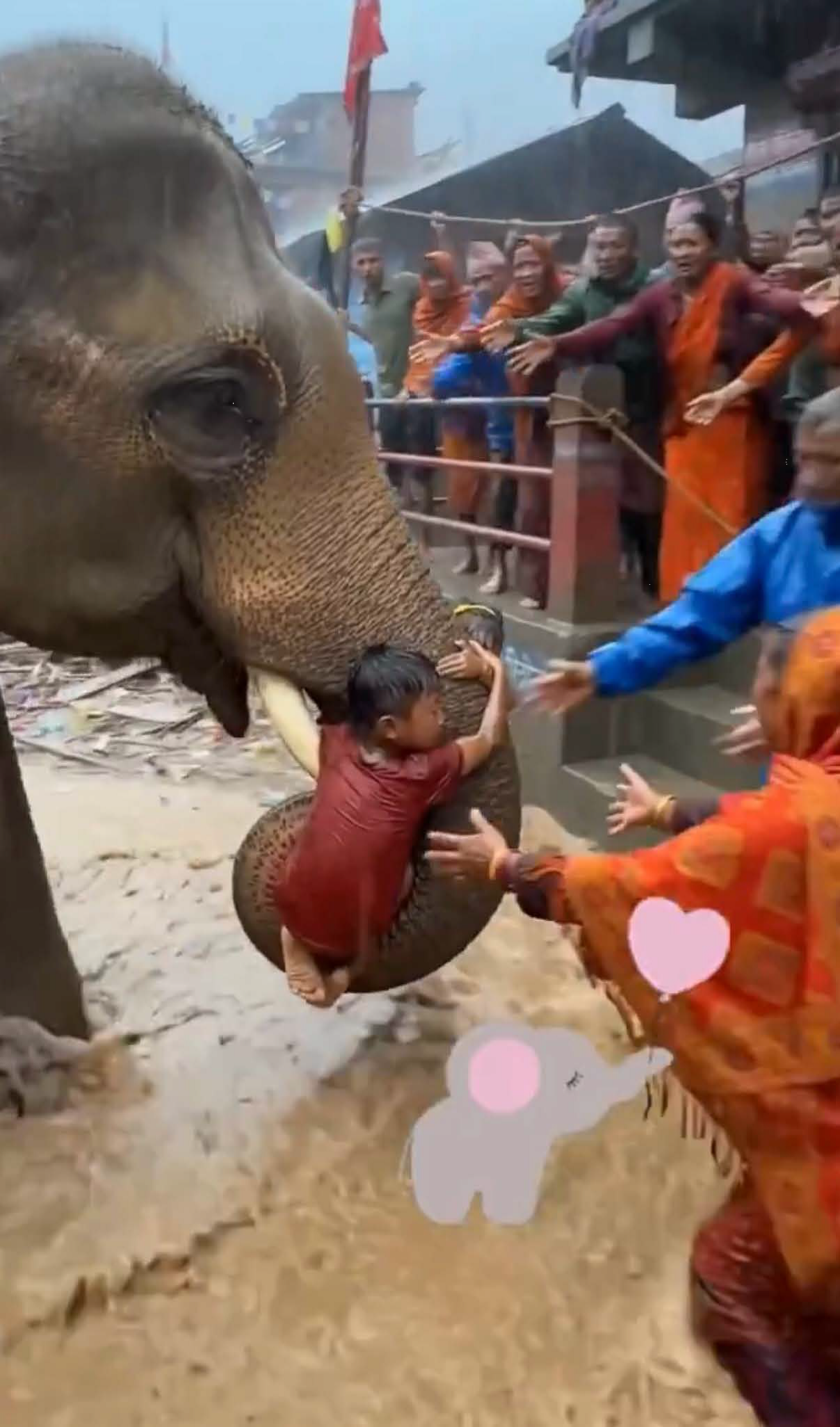
AI-generated elephant rescue video falsely shared as footage from the Nepal floods

One such video that caught the attention of thousands on social media shows an elephant appearing to rescue children during a flood. In the video, the elephant can be seen moving through the water and seemingly lifting a child with its trunk, while people around it try to help. At first glance, the scene looks emotional and completely believable. It is the kind of video that can make people stop scrolling, watch it, and immediately share it with others.

The problem is that the video is AI-generated, yet many people watching it have accepted it as a real incident and shared it as footage from the recent floods in Nepal. With social media allowing a single video to reach thousands of people within minutes, repeated sharing can make a false story appear increasingly convincing. For someone who does not regularly verify the source, date or origin of a video, seeing the same footage again and again can easily create the impression that it must be true.

And this is where AI-generated content becomes different from the misinformation we have been used to. Earlier, a misleading photograph or an old video could be traced back to a real event. Now, an entirely fictional scene can be created from scratch and made to look like something that actually happened.

The elephant rescue video is only one example of how easily AI-generated content can be mistaken for reality. But this is not an isolated incident. Across social media, similar videos and images are appearing every day, showing events that never actually happened. Some are created purely for entertainment, while others are shared as real news and become misleading before anyone stops to question them.

Another recent example shows just how convincing these AI-generated visuals can become.
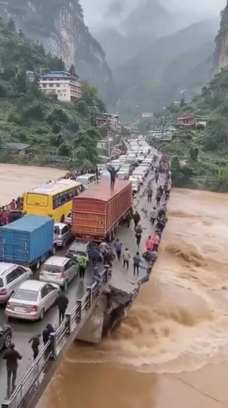
AI-generated-video-falsely-shared-as-scenes-of-a-bridge-collapsing-during-the-Nepal-floods
AI-generated video falsely shared as scenes of a bridge collapsing during the Nepal floods

Another video that spread rapidly on social media showed a horrifying scene of a flooded bridge. Cars and buses could be seen stuck in a massive traffic jam, while people were trying to move away from the rising water. As the bridge appeared to break apart, some people seemed to fall into the water and disappear.

For someone watching it casually on a phone, the video looked like real footage of a disaster. There was nothing about it that immediately felt like a computer-generated scene. It had the noise, the movement and the chaos that we normally associate with real flood videos.

But the video was not real. It was created using AI and was shared online as if it showed the situation in Nepal.

What makes such videos worrying is not only their ability to fool people, but the speed at which they travel. One person watches it, believes it and shares it. Another person sees it from a different account and assumes it must be genuine because so many others are sharing it too.

And this becomes even more concerning when we think about people who are not very familiar with technology. An elderly person who has grown up trusting photographs and videos as evidence may not know what signs to look for in an AI-generated video. The same can be true for children who are still learning how to judge information online.

These two videos may seem like just two misleading posts in the endless stream of content on social media. But they point towards a much bigger problem: if AI can create scenes that never happened and make them look convincing, how capable are we of telling reality from fabrication?

What Does Research Tell Us?

The two videos from Nepal raise a much larger question: if AI-generated content can look convincing enough to be shared as real, how good are ordinary people at actually identifying what is fake?

Research over the past few years suggests that the answer is not particularly reassuring.

Can we really tell a deepfake from reality?

A large body of research suggests that the problem is not simply that people are careless online. We may genuinely struggle to tell what is real.

In December 2024, Alexander Diel and his colleagues published a systematic review and meta-analysis in Computers in Human Behavior Reports, bringing together 56 studies involving more than 86,000 participants. The researchers examined how well people could distinguish AI-generated deepfakes from genuine content.

The findings were striking. Overall, people performed only around chance level when trying to detect deepfakes. For videos, the average detection accuracy was about 57 per cent.

That means that simply watching a video carefully does not necessarily tell us whether it is real. Our eyes, which we have traditionally trusted as a source of evidence, may no longer be enough.

Why do realistic AI visuals make false information more believable?

The problem becomes even more serious when AI does not simply create a fake scene, but creates a visual that appears to prove a false story.

A peer-reviewed study by Sean Guo, Yiwen Zhong and Xiaoqing Hu, published in the Harvard Kennedy School Misinformation Review in November 2025, examined how realistic AI-generated images affect people’s belief in false headlines.

The researchers found that when AI-generated images looked realistic and appeared to provide strong visual evidence for a claim, people were more likely to believe the false information.

In simple terms, the image can become more than decoration. It can act like “proof” in the viewer’s mind even when the event shown in the image never happened.

And India is already seeing this

And this is not a problem that exists only somewhere else in the world. Researchers have already been studying how generative AI is entering India’s information ecosystem.

In research conducted in Uttar Pradesh, Kiran Garimella of Rutgers University and Simon Chauchard studied around two million messages from non-personal WhatsApp groups, collected from nearly 500 participating users. Their findings were published in Nature in June 2024.

The researchers found that generative-AI content was still a relatively small part of the viral material they examined fewer than two dozen of 1,858 highly viral messages contained AI-generated content. But the examples they found were revealing: AI was already being used to create convincing images and videos around politics, religion, infrastructure and other emotionally sensitive subjects.

The researchers also pointed to a bigger concern. As AI-generated content becomes more realistic, it may become increasingly difficult for ordinary users to distinguish what is genuine from what has been manufactured.

The Human Factor

The technology may be artificial, but the reaction it creates in us is very real. A shocking video can create fear, an emotional one can create sympathy, and a politically charged video can create anger. In many cases, we react to what we see before we stop to question whether it is genuine.

This becomes particularly important for people who may not be equally familiar with the rapidly changing digital world. Children are growing up in an environment where a photograph or video appearing on a screen is no longer necessarily evidence that something actually happened. For older users who may have less experience with AI-generated or manipulated content, identifying such material can also be challenging.

But this should not become a question of simply blaming a particular age group. The real issue is digital literacy the ability to question, verify and understand the information we encounter online. Research has shown that even short digital-literacy interventions can improve people’s ability to distinguish genuine information from misinformation.

There is, however, an even deeper problem. If people become aware that AI can manufacture almost anything, they may begin to doubt genuine content as well. A real photograph can be called AI-generated. A genuine video can be dismissed as a deepfake. The danger, therefore, is not only that we may believe something that never happened, but that we may stop believing things that actually did.

How Can We Protect Ourselves?

So, what can we actually do in a world where seeing is no longer enough?

The answer is not to stop believing everything we see. It is to become more careful about what we accept as evidence.

Before sharing a shocking photograph or video, we can start with a few simple questions: Who posted it? When was it recorded? Where did it originally come from? Is the same event being reported by credible news organisations? Can the original image or video be found?

We should also pay attention to the context. A familiar-looking location does not necessarily mean that the footage is recent, and an emotional caption does not make a video authentic. Reverse-image searches, checking the original source and comparing information across reliable sources can help establish whether something is genuine.

Most importantly, we should learn to pause when a piece of content immediately makes us angry, frightened or overwhelmed. Those are precisely the moments when we are most likely to react before we verify.

Technology will continue to improve, and AI-generated content will become increasingly difficult to distinguish from reality. Detection tools and platform labels can certainly help, but they cannot replace human judgement. The first line of defence is still the person holding the phone.

The Bigger Danger: When Real Looks Fake

Perhaps the most worrying consequence of the AI era is not that fake content will become easier to create. It is that the existence of convincing fake content could make us suspicious of everything even the truth.

Imagine a genuine video of a disaster being dismissed as AI-generated. Imagine an authentic photograph being rejected simply because someone claims it has been created by artificial intelligence. As synthetic media becomes more common, denying real evidence may become easier than proving it.

This creates a new kind of information crisis. In the past, the challenge was often to convince people that something false was not true. In the future, we may also have to convince people that something true is actually real.

When almost anything can be made to look real, the question is no longer simply what we see. The question is whether we know how to verify what we see.

conclusion:

AI has given us extraordinary new ways to create, communicate and imagine. But the same technology has also made the boundary between reality and fabrication harder to see.

We cannot turn the clock back, nor can we expect technology to stop evolving. What we can change is the way we consume information. In the age of AI, perhaps the most important skill is no longer simply knowing how to see but knowing when to pause, question and verify.

Because when seeing is no longer believing, verification becomes our new way of finding the truth.


Author is the Broadcast Executive at Doordarshan Jammu

Comments are closed.