


Muqeet Mubashir
Kashmir has long been known for its rich cultural heritage, strong family values and deep attachment to faith. For generations, Islam has not only shaped the spiritual lives of Kashmiris but has also influenced their social conduct, traditions and way of life. Among these traditions, Modesty in dress and behaviour has always held a special place.
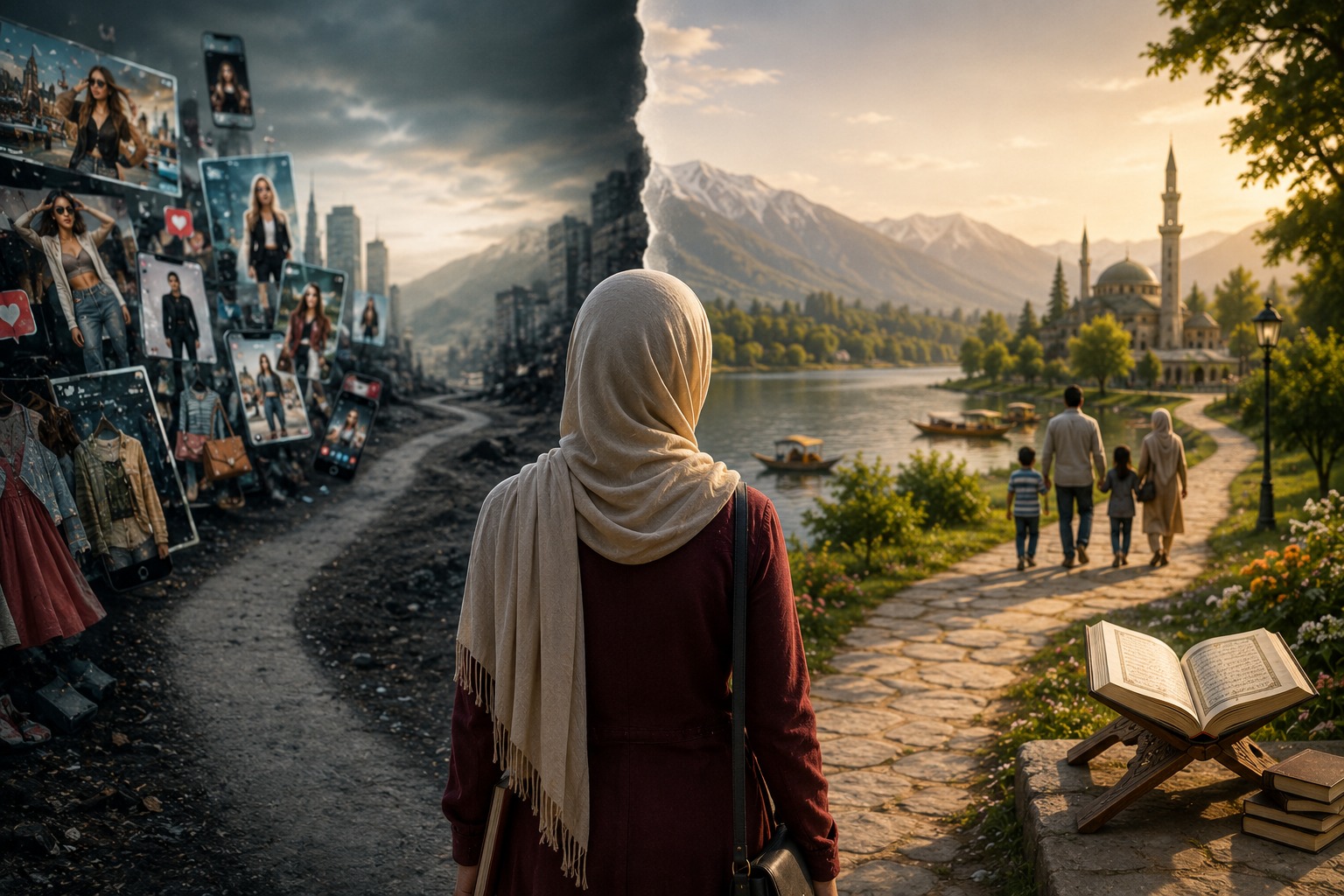
Today, however, many people across the Valley are witnessing a gradual but noticeable cultural shift. The influence of social media, entertainment platforms, celebrity culture and global fashion trends are reshaping the way many young people think, dress and present themselves. While change is a natural part of every society, an important question arises: Are we embracing progress or are we slowly losing touch with the values that once defined us?
A few decades ago, modest dressing was not considered unusual in Kashmir. It was simply part of everyday life. Women, young girls, men and boys generally dressed in a manner that reflected simplicity and respectability. Clothing was not viewed as a tool for attracting attention but as a means of comfort, dignity and self-respect.
Today, the situation appears different. Through smartphones and social media platforms, young people get exposed to thousands of images, videos, and fashion trends every day. Influencers and celebrities often become role models. New styles are adopted within days, sometimes without any reflection on whether they align with local culture, family values or religious teachings.
This change is particularly visible in clothing trends. What was once considered inappropriate or inconsistent with the values of Kashmiri society is increasingly becoming normalized.
The concern here is not about fashion itself. Islam does not oppose cleanliness, beauty or presentable dressing. The concern is about the growing tendency to measure modernity by how closely one imitates trends that originate elsewhere, regardless of whether those trends are compatible with one’s own beliefs.
Islam provides clear guidance on modesty.
The Almighty Allah in Surah An-Noor of the Holy Quran says:
وَقُل لِّلْمُؤْمِنَاتِ يَغْضُضْنَ مِنْ
أَبْصَارِهِنَّ وَيَحْفَظْنَ فُرُوجَهُنَّ وَلَا يُبْدِينَ زِينَتَهُنَّ إِلَّا
مَا ظَهَرَ مِنْهَا
“And tell the believing women to lower their gaze and guard their chastity and not display their adornment except what ordinarily appears thereof…” (Surah An-Noor, 24:31)
In another verse of Surah Al-Ahzaab, Allah says:
يَـٰٓأَيُّهَا ٱلنَّبِىُّ قُل لِّأَزْوَٰجِكَ
وَبَنَاتِكَ وَنِسَآءِ ٱلْمُؤْمِنِينَ يُدْنِينَ عَلَيْهِنَّ مِن
جَلَـٰبِيبِهِنَّ ذَٰلِكَ أَدْنَىٰٓ أَن يُعْرَفْنَ فَلَا يُؤْذَيْنَ
“O Prophet! Ask your wives, daughters and believing women to draw their cloaks ( loose outer garments) over their bodies. In this way, it is more likely that they will be recognized as virtuous and not be harassed/ abused…” (Surah Al-Ahzaab, 33:59)
These verses are often misunderstood as restrictions. In reality, they are presented within Islam as guidelines meant to preserve dignity, respect and moral values. It is important to note that the Quran first instructs believing men to lower their gaze and maintain modest conduct before addressing women. Modesty in Islam is therefore not a responsibility placed on one gender alone; it is a value expected from society as a whole.
While the responsibility of modest conduct rests upon both genders, Islamic teachings give particular attention to women’s modesty because of the value and dignity that Islam attaches to their status in society. Modesty does not mean that a woman must abandon education, employment, ambition or participation in society. Nor does it mean that every woman must wear a particular style of clothing. Rather, it means dressing in a manner that reflects dignity and avoids unnecessary exposure of the body. Clothing that is extremely tight, transparent, or designed primarily to emphasize physical appearance may be fashionable according to certain trends, but many Islamic scholars argue that it does not fulfil the spirit of modesty encouraged by Islam.
Unfortunately, many parents have also become silent spectators to this change. Parents who once guided their children about right and wrong now often hesitate to discuss modesty out of fear that they may appear old-fashioned. Some parents assume that schools, society or religious institutions will handle the responsibility. As a result, many young people learn more about fashion, relationships and lifestyle choices from social media than from their own families.
Parents must ask themselves an honest question: If they do not teach their children about the values they claim to cherish, who will? Social media algorithms are not designed to preserve culture, strengthen faith or promote moral responsibility. Their purpose is to maximize attention and engagement.
Another important aspect of this discussion is the growing tendency to equate westernization with progress. There is nothing wrong with learning from other societies. The Muslim world has historically benefited from knowledge, science, technology and intellectual exchange. However, learning from others is very different from blindly imitating them.
One may adopt modern education, technological advancement, professional excellence and scientific thinking without abandoning religious principles. The challenge arises when external trends become more influential than faith, culture and personal conviction.
Allama Iqbal beautifully expressed this concern. He repeatedly warned Muslims against losing their identity through imitation. One of his most famous couplets states:
خودی کو کر بلند اتنا کہ ہر تقدیر سے پہلے
خدا بندے سے خود پوچھے بتا تیری رضا کیا ہے
Allama Iqbal’s message was clear. A strong society is not the one that blindly follows every trend that comes from outside. A strong society is the one that understands its own identity, values and purpose. True confidence comes from knowing who we are, not from copying others.
Unfortunately, many young people today are growing up in an environment where social media has become a teacher, guide and role model. Fashion influencers, celebrities and content creators often define what is considered modern, attractive or acceptable. Within seconds, a trend emerging in another part of the world reaches the screens of Kashmiri youth.
The result is a gradual shift in thinking. Many people begin to believe that modest dressing is backward, while revealing or body-emphasizing clothing is a symbol of confidence and progress.
Yet very few stop to ask a simple question: Who decides these standards? Why should a Muslim society accept every cultural trend without examining whether it aligns with its religious values?
Whenever concerns about modesty are raised, some people respond by saying that clothing is a personal choice. Indeed, every individual has the freedom to make choices. However, for a believing Muslim, every choice is also connected to accountability before Almighty Allah. Islam is not merely a religion confined to mosques or religious occasions. It provides guidance for everyday life, including how one conducts oneself in public.
The question therefore is not whether people have the freedom to choose. The real question is whether those choices are being guided by faith or by constantly changing social trends.
At the same time, there is a need for honesty within families and communities. Many parents express concern about the changing behavior of young people, yet they often avoid difficult conversations. Some parents provide every material comfort but hesitate to discuss faith, morality and personal conduct. Children are taught how to succeed in examinations, but not always how to navigate the moral challenges of modern life.
If parents do not explain the wisdom behind Islamic teachings, children may eventually view those teachings as outdated restrictions rather than valuable guidance. Faith cannot survive through inheritance alone; it must be understood, discussed and practiced.
Another consequence of unchecked westernization is the gradual weakening of cultural identity. Kashmir has always been unique. Its traditions, customs, language and values have distinguished it from many other places. However, when a society begins to imitate everything it sees online, it risks losing the characteristics that once made it special.
This does not mean rejecting modernity or isolating oneself from the world. Islam never opposed knowledge, learning or progress. The Muslim civilization once led the world in engineering, science, medicine, mathematics, architecture and philosophy. The problem arises when modernity is mistaken for imitation and when religious values are sacrificed in the name of fashion or acceptance.
The younger generation deserves guidance rather than condemnation. They are growing up in an age unlike any previous generation. Every day they face pressures from social media, advertising, entertainment platforms and peer groups. It is therefore the responsibility of parents, teachers, scholars and community leaders to provide positive direction.
Instead of merely criticizing young people, society must help them understand why modesty matters. Islam does not promote modesty to suppress individuality or limit potential. Rather, it encourages a balance where dignity, self-respect and character remain more important than physical appearance.
As Kashmir continues to change, it must decide what kind of future it wishes to build. Will it be a future shaped entirely by external influences and temporary trends or one guided by faith, values and cultural confidence?
The answer will not be found on social media platforms. It will be found in homes where parents take their responsibilities seriously, in educational institutions that promote character alongside academic success and in communities that understand the difference between progress and imitation.
The Holy Quran reminds us in Surah Al-Hajj:
ذَٰلِكَ وَمَن يُعَظِّمْ شَعَائِرَ اللَّهِ
فَإِنَّهَا مِن تَقْوَى الْقُلُوبِ
“And whoever honors the symbols of Allah; indeed, it is from the piety of hearts.” (Surah Al-Hajj, 22:32)
Ultimately, the discussion about clothing is part of a larger discussion about identity. It is about whether a society remains connected to the principles it claims to cherish. Fashion trends will come and go. Social media trends will rise and disappear. What remains is the character of the people and the values they choose to pass on to future generations.
Kashmir has preserved its spiritual and cultural heritage through centuries of change. The challenge before today’s generation is not whether they can engage with the modern world or not. The challenge is whether they can do so while remaining faithful to the moral and religious foundations that have long defined their society.
For if a community loses confidence in its own values, it may eventually find itself following every trend, yet standing firmly for nothing. And that is a price far greater than any society can afford.
Comments are closed.