
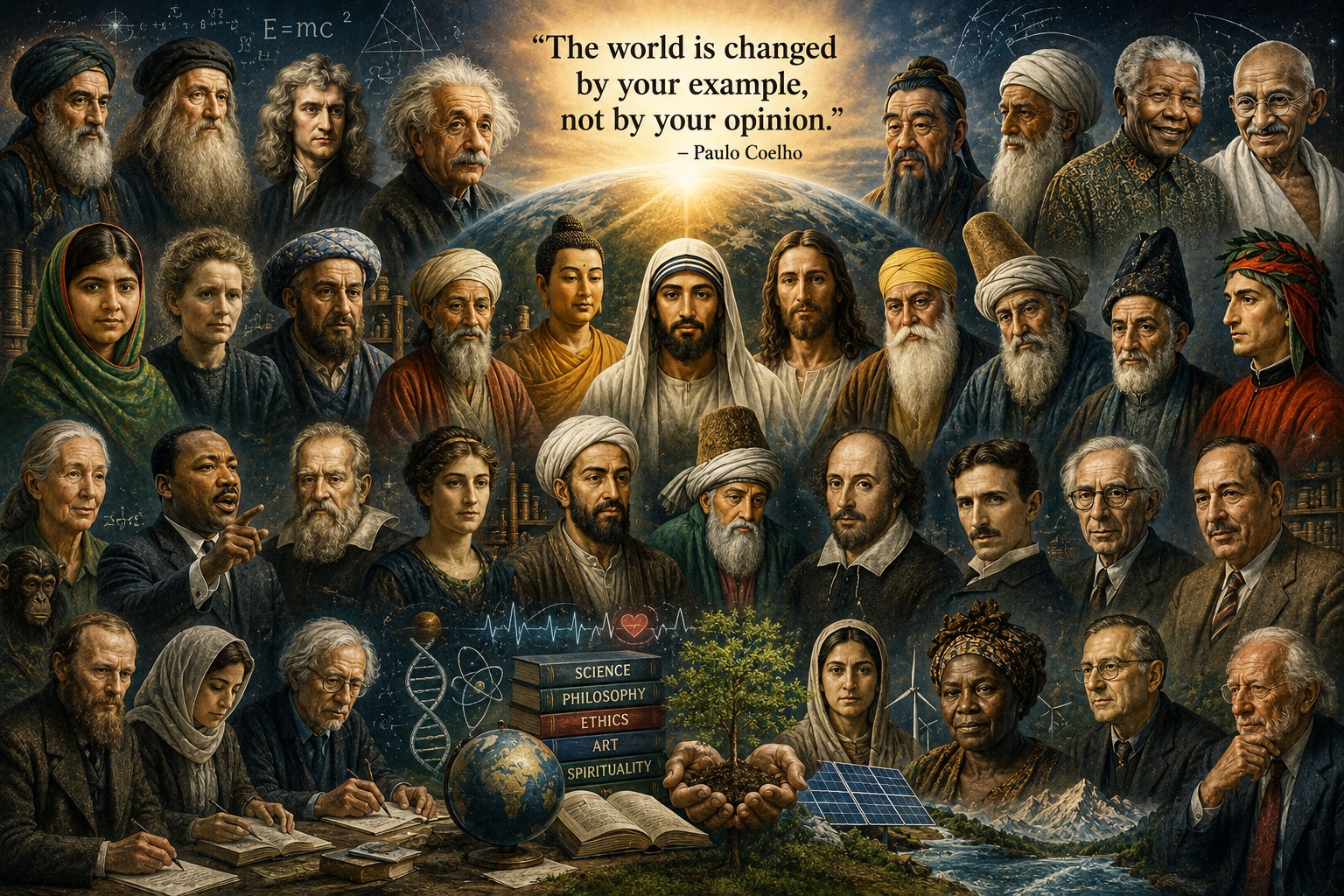

Universal Visionaries: Genius, Wisdom, Consciousness, and the Future of Human Civilization

Shabeer Ahmad Lone


“Artificial intelligence, biotechnology, climate instability, and digital acceleration have expanded humanity’s power without guaranteeing moral maturity. The defining challenge of our age is not creating more knowledge, but cultivating the wisdom to use it.”

Human history is commonly narrated through wars, empires, dynasties, revolutions, technologies, and economies. Yet beneath these visible movements lies another, quieter history: the history of consciousness itself. Civilizations are ultimately transformed not merely by armies, institutions, or markets, but by individuals and communities whose imagination, moral courage, spiritual depth, intellectual originality, artistic sensitivity, ecological awareness, or ethical vision reshape humanity’s understanding of itself and the world.

Across centuries and continents, such visionaries have appeared in astonishingly diverse forms: prophets, philosophers, scientists, poets, mystics, reformers, artists, educators, physicians, inventors, healers, environmental guardians, musicians, psychologists, storytellers, and moral revolutionaries.

Others remained unnamed within oral traditions, indigenous cultures, villages, monasteries, forests, deserts, and forgotten archives. Yet despite differences of language, geography, religion, and historical context, they share one defining characteristic: they expand the horizon of human possibility. They teach humanity not merely how to survive, but how to think more deeply, feel more compassionately, live more wisely, and perceive more truthfully.

         The moral and spiritual architecture of civilization itself was profoundly shaped by prophetic and sacred visionaries whose influence transcended time and geography. Prophet Moses (A.S) articulated moral law and collective ethical responsibility within ancient civilization.

Prophet Jesus Christ (A.S) transformed compassion, forgiveness, mercy, and spiritual love into enduring civilizational ideals. Prophet Hazrat Muhammad ﷺ united spirituality, ethics, law, social justice, intellectual inquiry, and communal transformation into one of history’s most influential moral and civilizational syntheses.

Guru Nanak Dev Ji challenged hierarchy and emphasized equality, humility, devotion, honest labor, and universal human dignity. These figures were not merely founders of religious traditions; they reshaped humanity’s moral imagination and redefined the meaning of justice, responsibility, compassion, and transcendence.

Modern civilization, however, often reduces genius to measurable intelligence, productivity, fame, innovation, or technical mastery. Such reduction reflects broader tendencies within industrial modernity itself, which frequently values efficiency more than wisdom and information more than understanding. Yet contemporary scholarship increasingly challenges this narrow conception.

Researchers in psychology, philosophy, neuroscience, creativity studies, ethics, and contemplative traditions now argue that the most transformative forms of genius involve not isolated intelligence alone, but the integration of imagination, emotional depth, resilience, ethical responsibility, contemplative awareness, interdisciplinary synthesis, ecological sensitivity, and civilizational consciousness.

Intelligence may solve problems within existing systems; wisdom questions the assumptions upon which those systems are built. Creativity may generate innovation; moral imagination determines whether innovation serves human flourishing or collective destruction.

         The twenty-first century illustrates this paradox with painful clarity. Humanity has developed extraordinary scientific and technological capabilities capable of curing disease, connecting continents, exploring space, and extending knowledge beyond previous imagination.

Yet the same intelligence has also produced mechanized warfare, ecological devastation, nuclear annihilation, digital addiction, surveillance systems, algorithmic manipulation, and technologies capable of intensifying loneliness, anxiety, and existential fragmentation.

Humanity possesses unprecedented information while simultaneously experiencing crises of meaning, belonging, empathy, and spiritual coherence. The deepest crisis of modern civilization is therefore not merely technological, political, or economic; it is civilizational and existential. Humanity’s power has expanded faster than its wisdom.

         Universal visionaries become especially important in such moments because they perceive interconnectedness where fragmented societies perceive separation. They resist the narrowing tendencies of hyper-specialization and remind humanity that reality itself is relational, layered, and profoundly interconnected.

Leonardo da Vinci embodied this integrative spirit by refusing to separate art from science, anatomy from aesthetics, or observation from wonder. Ibn Sina united medicine, philosophy, psychology, and metaphysics within a holistic intellectual vision.

Rabindranath Tagore sought harmony between education, ecology, spirituality, creativity, and human freedom. Albert Einstein perceived scientific inquiry itself as a form of cosmic wonder, while Jagadish Chandra Bose dissolved rigid boundaries between biology, physics, and plant consciousness long before ecological interconnectedness became globally recognized.

         Long before modernity, universal visionaries had already begun reshaping humanity’s ethical and philosophical imagination. Confucius envisioned civilization as moral cultivation rooted in dignity, harmony, and relational responsibility. Mencius deepened this vision by emphasizing compassion and innate human goodness.

Zhu Xi shaped Neo-Confucian civilization through a synthesis of ethics, education, and metaphysical reflection. Socrates transformed questioning into a discipline of moral self-examination. Plato explored justice, beauty, and transcendence as foundations of civilized life, while Aristotle sought synthesis between ethics, politics, metaphysics, and empirical inquiry.

 Laozi articulated harmony with the natural order in ways that resonate deeply within an ecologically fractured age. Buddha placed suffering, mindfulness, compassion, and liberation at the center of human transformation, while Nagarjuna revolutionized metaphysical thought through profound explorations of emptiness and interdependence.

Adi Shankara articulated nondual philosophy with extraordinary metaphysical sophistication, while Patanjali systematized contemplative discipline and the science of consciousness itself.

         Within the Islamic intellectual tradition, some of history’s most remarkable universal visionaries emerged through extraordinary syntheses of revelation, science, philosophy, spirituality, aesthetics, and civilizational reflection. Al-Kindi initiated one of the earliest major dialogues between Greek philosophy and Islamic thought.

Al-Farabi envisioned the virtuous city as an ethical and intellectual community rooted in wisdom. Ibn Rushd defended rational inquiry and profoundly influenced both Islamic and European intellectual history. Ibn Khaldun pioneered civilizational sociology centuries before the emergence of modern social sciences, exploring solidarity, education, economics, power, and the cyclical rise and decline of societies with astonishing analytical depth. Al-Biruni combined astronomy, geography, anthropology, comparative religion, and mathematics with rare intellectual humility and intercultural curiosity. Ibn al-Haytham transformed optics and experimental methodology in ways that shaped modern scientific inquiry itself.

Muhammad ibn Musa al-Khwarizmi revolutionized mathematics through algebra and algorithmic thinking, foundations upon which contemporary computational civilization still rests.

         The contemplative and spiritual dimensions of human transformation were illuminated by figures whose influence transcended institutional religion itself. Al-Ghazali sought reconciliation between reason and spiritual purification after recognizing the limitations of purely formal knowledge.

Ibn Arabi articulated one of history’s most expansive metaphysical visions of unity, imagination, mercy, and divine interconnectedness. Jalal ad-Din Muhammad Rumi transformed mystical longing into universal poetry of love and transcendence.

Mulla Sadra developed a profound metaphysics of existence, consciousness, and becoming that integrated philosophy, mysticism, and revelation into a unified intellectual vision. Shah Waliullah Dehlawi sought renewal through synthesis rather than fragmentation, while Bediuzzaman Said Nursi confronted the crises of modernity by harmonizing faith, reason, and scientific awareness.

In the contemporary period, Seyyed Hossein Nasr has profoundly critiqued ecological and spiritual alienation within modern civilization, while Syed Muhammad Naquib al-Attas explored the crisis of knowledge, secularization, and ethical disintegration in modern education.

         The poetic and aesthetic imagination of humanity often expressed truths inaccessible to abstract systems alone. Muhammad Iqbal sought to awaken creativity, selfhood, spiritual dignity, and civilizational renewal within colonized and fragmented societies. Kalidasa united beauty, nature, metaphysics, and emotional refinement within classical literature.

Saadi Shirazi articulated human solidarity with timeless clarity, while Hafez transformed love and longing into enduring lyrical illumination. Omar Khayyam embodied the tension between scientific inquiry and existential reflection. Amir Khusrau fused cultures, languages, and musical traditions into a remarkable Indo-Persian synthesis.

Matsuo Basho transformed silence, impermanence, and simplicity into contemplative art. Mirza Ghalib explored metaphysical longing and existential fragility within collapsing worlds. Faiz Ahmed Faiz united revolutionary hope with lyrical humanism, while Mahmoud Darwish transformed exile into universal meditations on memory, identity, and belonging.

         Universal visionaries also emerged through artistic imagination capable of revealing hidden dimensions of human existence. Michelangelo transformed sculpture and painting into spiritual drama. William Shakespeare explored ambition, betrayal, love, madness, and power with psychological depth still unsurpassed centuries later.

 Dante Alighieri transformed spiritual cosmology into literary architecture. Johann Wolfgang von Goethe integrated literature, science, philosophy, and aesthetics into a unified vision of human flourishing. Fyodor Dostoevsky descended fearlessly into the moral contradictions of modern consciousness. Toni Morrison restored dignity and historical memory to voices erased by oppression. Vincent van Gogh transformed suffering and solitude into luminous emotional expression.

         Music, too, became a universal language of transcendence and civilizational memory. Johann Sebastian Bach transformed mathematical order into spiritual harmony, while Ludwig van Beethoven turned deafness, struggle, and emotional intensity into monumental artistic resilience.

         Scientific revolutions were likewise shaped by minds whose influence transcended narrow specialization. Galileo Galilei transformed humanity’s cosmic self-understanding through scientific courage. Isaac Newton reshaped humanity’s understanding of motion and cosmic order.

Charles Darwin altered humanity’s understanding of life and evolution. Marie Curie combined scientific brilliance with extraordinary perseverance under conditions of exclusion. Nikola Tesla imagined technological futures far beyond his era.

Alan Turing laid the foundations of modern computing while confronting profound personal persecution. Stephen Hawking expanded public understanding of cosmology and black holes, while Carl Sagan united science with wonder, humility, and planetary consciousness. Abdus Salam, Ahmed Zewail, and Aziz Sancar embodied the continuing global contribution of Muslim scientific thought to contemporary knowledge.

         Political and ethical transformation often emerged through figures who united moral courage with visionary leadership. Mahatma Gandhi transformed nonviolence into a civilizational ethic. Martin Luther King Jr. integrated prophetic spirituality with democratic justice and nonviolent resistance. Nelson Mandela transformed imprisonment into reconciliation rather than vengeance.

Desmond Tutu embodied forgiveness and restorative justice. Vaclav Havel explored the moral power of truth against ideological domination. Frantz Fanon exposed the psychological violence of colonialism, while Edward Said transformed understandings of culture, representation, and intellectual responsibility.

         The ecological imagination of humanity was profoundly deepened by figures who challenged exploitative relationships with nature. Henry David Thoreau linked simplicity, conscience, and nature into a philosophy of ethical living. Rachel Carson exposed ecological destruction caused by industrial modernity.

 Thomas Berry envisioned humanity as part of a sacred planetary community, while Wangari Maathai united ecology, democracy, women’s empowerment, and social justice within one transformative vision.

The educational and psychological imagination of humanity was similarly transformed by visionaries who understood learning and healing as pathways toward liberation. Maria Montessori recognized the creative dignity of children. Paulo Freire emphasized critical consciousness against oppressive systems.

John Dewey linked democracy with reflective inquiry. Carl Jung explored myth, symbolism, dreams, and the collective unconscious as dimensions of human transformation, while Viktor Frankl transformed suffering into a philosophy of meaning and spiritual resilience emerging from the horrors of concentration camps.

         The critique of industrial civilization and dehumanizing forms of progress was deepened by thinkers such as Ivan Illich, who challenged institutionalized systems of modernity, and E. F. Schumacher, who emphasized humane economics, sustainability, and “small is beautiful” as alternatives to mechanistic development.

         Women universal visionaries also transformed civilization in ways long neglected by patriarchal histories. Hypatia symbolized intellectual courage against intolerance. Simone Weil united suffering, spirituality, labor, and ethics with rare depth.

Hannah Arendt profoundly analyzed totalitarianism, evil, and political responsibility. Annemarie Schimmel built enduring bridges between civilizations through her profound engagement with Islamic spirituality, poetry, and mysticism.

         Yet one of the deepest truths about universal visionaries is that many remain unnamed. Entire civilizations have been sustained by indigenous elders, mothers, healers, craftsmen, oral storytellers, spiritual caretakers, and marginalized communities whose wisdom rarely entered official history.

Contemporary scholarship increasingly recognizes that human transformation is not shaped only by isolated “great individuals,” but also by collective ethical memory, communal resilience, intercultural dialogue, inherited traditions of care, and civilizations learning from one another across generations.

         The future of humanity may therefore depend less upon producing more information than upon cultivating wiser forms of consciousness capable of integrating knowledge with responsibility, creativity with compassion, technological advancement with ethical restraint, and progress with ecological balance.

Artificial intelligence, biotechnology, climate instability, ecological collapse, and digital acceleration have intensified humanity’s power without guaranteeing corresponding moral maturity. The central challenge of the future is therefore not merely technological advancement, but the cultivation of wisdom capable of guiding civilization humanely.

         Universal visionaries matter because they remind humanity that the deepest transformations begin invisibly-in consciousness, imagination, moral courage, contemplative awareness, ecological sensitivity, and the capacity to perceive interconnectedness where fragmented societies perceive division. They reveal that civilization is not ultimately sustained by power alone, but by truth, beauty, compassion, wonder, justice, humility, ecological harmony, and the enduring human search for meaning.


Author is a teacher, Writer, Researcher and  Member ICPR,MAAS. He can be mailed at shabirahmed.lone003@gmail.com

Comments are closed.