

Dr. Azham Ilyass
“Without mathematics, there would be no precise drug dosing, no reliable diagnostic testing, no advanced medical imaging, no evidence-based medicine, and no effective public health planning. The stethoscope may symbolize medicine, but mathematics remains one of its most indispensable foundations.”
When people think of healthcare, they usually imagine doctors diagnosing illnesses, nurses caring for patients, surgeons performing complex operations, or advanced machines scanning the human body. Rarely does anyone think of mathematics. Yet behind every prescription, medical test, hospital operation, and public health policy lies an invisible force that makes modern healthcare possible: mathematics.
Often regarded as a subject confined to classrooms and textbooks, mathematics is in reality one of the most powerful tools in medicine. It silently guides decisions that save lives every day. From calculating the correct dosage of medicines to predicting disease outbreaks, from interpreting laboratory reports to creating sophisticated medical images, mathematics has become an indispensable partner in healthcare.
In many ways, modern medicine would be unimaginable without mathematical thinking.
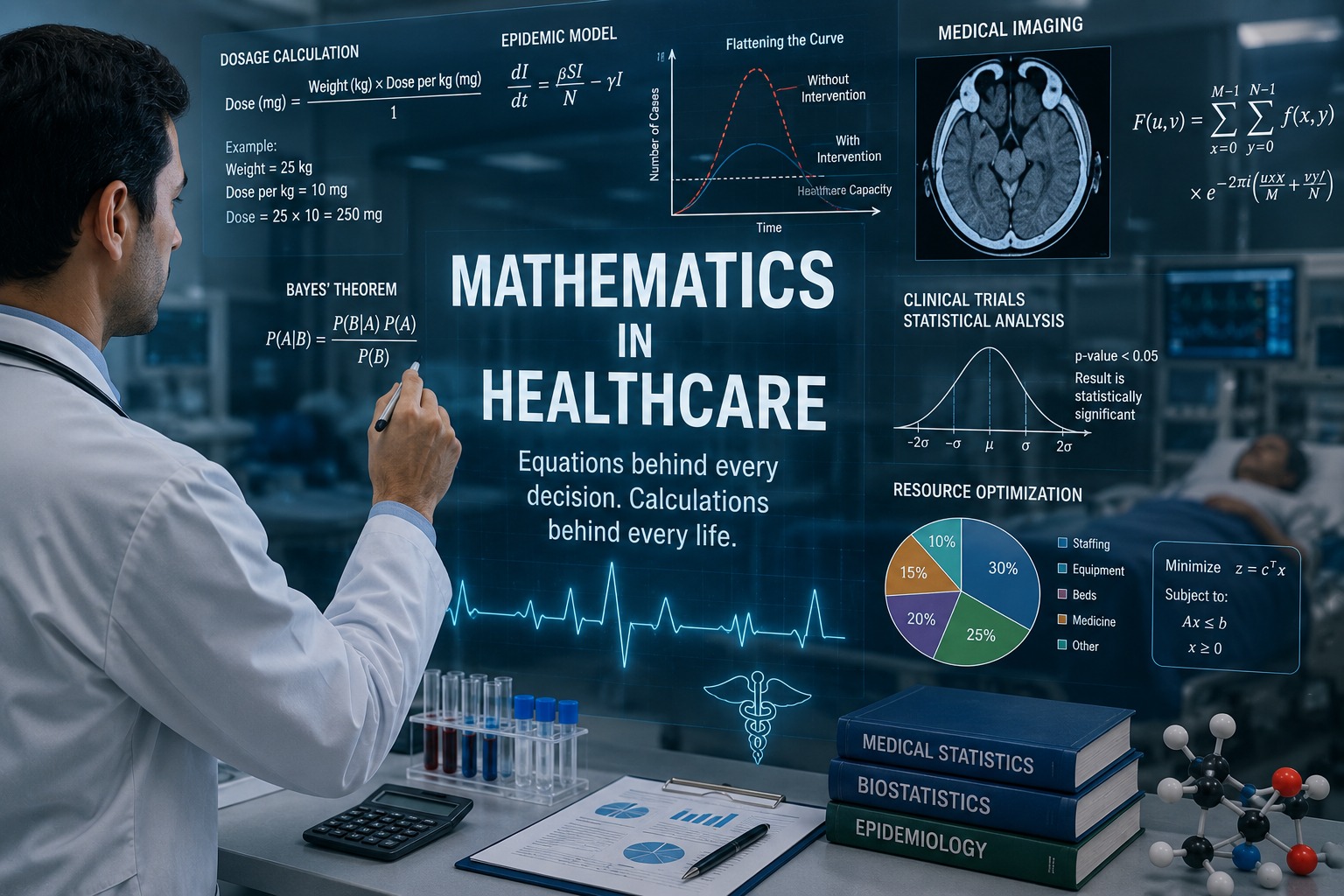
Consider a routine visit to a doctor. A child arrives with a fever and requires medication. The physician prescribes a drug based on the child’s weight rather than age alone. A standard recommendation may be 10 milligrams of medicine per kilogram of body weight. What appears to be a simple prescription is actually a mathematical calculation involving ratios, proportions, and unit conversions.
If the calculation is incorrect, the consequences can be serious. An insufficient dose may fail to treat the illness, while an excessive dose may cause harmful side effects. Every day, healthcare professionals perform thousands of such calculations to ensure patient safety. Whether administering intravenous fluids, determining insulin doses for diabetic patients, or calculating chemotherapy regimens for cancer treatment, mathematics serves as a crucial safeguard against medical errors.
The role of mathematics becomes even more significant in diagnostic medicine.
Imagine a patient receiving a positive test result for a rare disease. Most people assume that a positive result automatically means they have the disease. However, medical reality is more complicated. Diagnostic tests are never perfect. Some healthy individuals may receive positive results, while some affected individuals may test negative.
To interpret these results accurately, medical professionals rely on probability theory and statistical reasoning. One of the most influential mathematical concepts used in medical diagnosis is Bayes’ theorem, which helps determine the actual likelihood of a disease after considering factors such as disease prevalence and test accuracy.
This statistical approach prevents unnecessary panic, reduces misdiagnosis, and helps doctors make informed decisions. In an era where medical testing has become increasingly sophisticated, mathematical probability has become essential for translating laboratory data into meaningful clinical judgments.
The COVID-19 pandemic demonstrated to the world how deeply mathematics is intertwined with public health.
During the pandemic, terms such as “exponential growth,” “flattening the curve,” and “reproduction number” became part of everyday conversation. Behind these concepts were mathematical models developed by epidemiologists and statisticians to understand how the virus spread through populations.
Using differential equations and predictive modelling, scientists estimated infection rates, hospitalization needs, and mortality patterns. Governments relied on these mathematical projections when deciding whether to impose lockdowns, close schools, restrict travel, or expand healthcare infrastructure.
Vaccination campaigns also depended heavily on mathematical calculations. Public health experts used herd immunity models to determine the percentage of the population that needed immunity to significantly reduce disease transmission. These calculations guided vaccination targets and helped policymakers allocate resources efficiently.
Without mathematical modelling, managing a global pandemic would have been far more difficult and potentially far more devastating.
Medical imaging provides another remarkable example of mathematics at work.
Today, technologies such as X-rays, CT scans, MRI scans, ultrasound imaging, and PET scans allow doctors to see inside the human body without performing surgery. However, these machines do not simply produce images directly. Instead, they collect vast amounts of raw numerical data.
Mathematical algorithms then transform this information into detailed visual images that physicians can interpret. CT scanners, for example, solve complex inverse problems to reconstruct three-dimensional representations of organs and tissues from multiple measurements taken at different angles.
Similarly, MRI technology relies on advanced mathematical techniques such as Fourier transforms to convert signals generated by the body’s tissues into clear diagnostic images. Without these sophisticated calculations, modern medical imaging would be impossible.
In fact, every scan that helps detect a tumour, identify a fracture, or diagnose a stroke represents a triumph of mathematical science as much as medical expertise.
Mathematics also plays a vital role in medical research and pharmaceutical development.
Before a new drug reaches patients, it must undergo rigorous clinical trials involving thousands of participants. Researchers use statistical methods to determine whether a treatment genuinely works or whether the observed benefits occurred merely by chance.
Statistical analysis helps identify side effects, compare treatment outcomes, and assess safety profiles. Without these methods, healthcare systems would struggle to distinguish effective therapies from ineffective or potentially harmful ones.
Evidence-based medicine, now considered the gold standard of healthcare practice, is fundamentally built upon statistical reasoning. Every guideline recommending a particular treatment, screening programme, or preventive measure is supported by mathematical analysis of scientific data.
Beyond patient care and research, mathematics contributes significantly to the efficient functioning of healthcare systems themselves.
Hospitals face constant challenges involving resource allocation, staffing, scheduling, and patient flow. Mathematical models help administrators determine how many beds are needed, how operating theatres should be scheduled, and how emergency departments can manage patient surges.
Techniques such as queuing theory help reduce waiting times in clinics and hospitals. Linear programming assists in optimizing nurse schedules and resource distribution. Predictive analytics allows healthcare institutions to anticipate seasonal increases in patient demand and prepare accordingly.
These applications may not be visible to patients, but they directly influence the quality, efficiency, and accessibility of healthcare services.
The growing integration of artificial intelligence into medicine further highlights the importance of mathematics.
Machine learning algorithms are increasingly being used to detect diseases from medical images, predict patient outcomes, identify high-risk individuals, and support clinical decision-making. These technologies rely heavily on mathematical principles including probability, optimization, linear algebra, and statistical inference.
As healthcare becomes more data-driven, mathematical literacy will become even more essential for future medical professionals.
The significance of mathematics in healthcare extends beyond hospitals and laboratories. It empowers public health officials to understand disease patterns, helps governments allocate healthcare resources, supports researchers in discovering new treatments, and enables clinicians to make evidence-based decisions.
Most importantly, it saves lives.
Yet despite its profound impact, mathematics often remains invisible to the public. Patients see doctors and medicines, but rarely the calculations, algorithms, and statistical models working behind the scenes. The success of modern healthcare depends not only on medical knowledge and technological innovation but also on centuries of mathematical discoveries accumulated across generations.
The next time you receive a prescription, undergo a blood test, review a scan report, or benefit from a vaccination programme, remember that mathematics is quietly at work. It measures, predicts, analyses, and guides countless decisions that influence health outcomes every day.
In this sense, mathematics is more than a scientific discipline. It is an unseen healer—an indispensable partner in medicine that continuously contributes to longer lives, better treatments, and healthier societies.
The stethoscope may symbolize medicine, but mathematics remains one of its most powerful and indispensable foundations.
Comments are closed.