
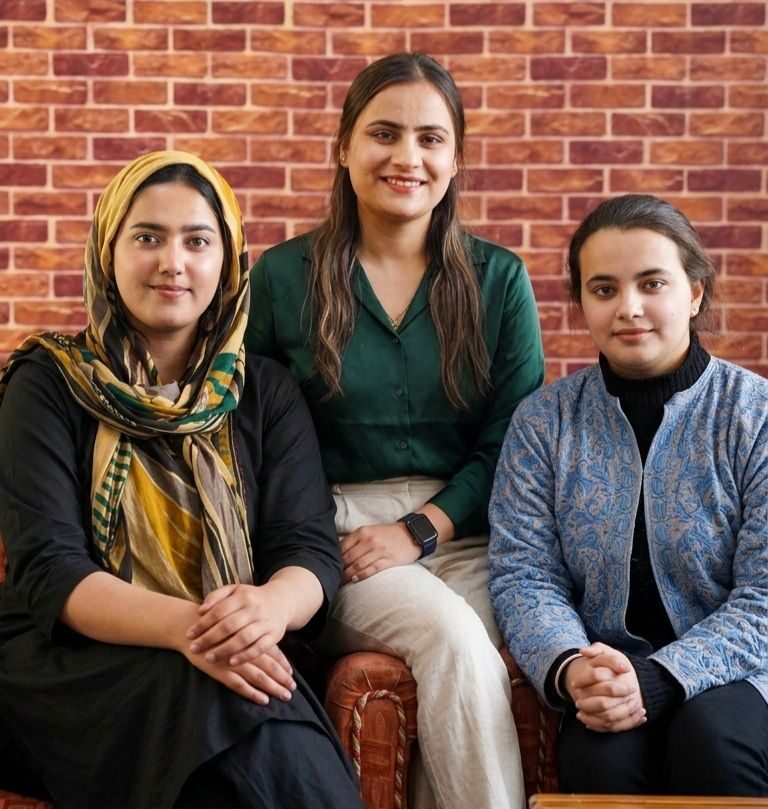
The Girls Behind Baramulla’s New Radio Voice
On 89.6 FM, three young women are taking conversations beyond songs and into everyday life

Suhail Khan
Srinagar, June 6: For as long as anyone in Kashmir can remember, radio has been a pacifier. Ghazals, old film songs, the occasional romantic request — all designed to soothe, never stir. The sound of a valley trying to forget itself.
But tune into 89.6 FM in Baramulla these days, and you will notice the difference. The songs haven’t vanished entirely. Sandwiched between them are conversations that would have been unthinkable a decade ago a farmer talking about government crop schemes, a young woman describing how she enrolled in college against family opposition, a counsellor explaining what to do if someone you know is addicted to heroin.
Behind this quiet revolution are three young female Radio Jockeys — RJ Harleen, RJ Furqana and RJ Meenakshi — who walked into an Army-run community radio station as amateurs and have since turned it into an unlikely platform for public service broadcasting.
“I knew nothing about radio when I started two years ago. Nothing,” Furqana told Kashmir Convener from the station’s modest studio. “But this platform — run by the Army — gave me room to learn, to stumble, to rise. Today, I speak with district achievers, with mothers, with students. My mic is no longer just mine. It belongs to anyone who has a story but no stage.”
Meenakshi, who joined around the same time, sees radio as an underutilised tool. “Radio is not about speaking. It is about connecting — with a farmer in a far-off hamlet, with a girl told to stay home, with a family hiding its son’s addiction. That mission brought me here.”
‘Radio must do more than entertain’
Both women are acutely aware of the space they occupy. A community radio station run by the Indian Army in Kashmir is, by definition, political. But their programming deliberately sidesteps the usual polarities. Instead, they have chosen to focus on issues that affect daily life — issues that official discourse often ignores.
“We consciously decided that radio must do more than entertain,” Meenakshi said. “We brought in health awareness, government schemes, women’s issues, education, career guidance. Gradually, people stopped tuning in only for songs. They started listening for information.”
Furqana pointed to tangible outcomes. “We’ve had listeners call to say a programme helped them make a life decision — whether to pursue a course, seek mental health support, or report a social problem. When your content saves someone from misinformation or despair, you know radio is far from dead.”
The station has covered drug abuse — a growing crisis in Kashmir that receives far less attention than it deserves — as well as girl child education, environmental degradation, and financial literacy. “The feedback comes directly — ‘Your show changed how I think’,” Meenakshi said. “That is our real metric.”
Neither woman pretends the journey has been easy. In a society where a girl stepping out still invites scrutiny, standing behind a microphone — particularly one bearing the Army’s insignia — required considerable courage.
“Challenges are part of the process,” Meenakshi said. “If there are no challenges, how will you learn? In Kashmir, a girl finding her own space has never been easy. But when you stay focused on your goal, opportunities begin to build themselves.”
Furqana recalled moments when stepping out of her comfort zone felt impossible. “But Radio Baramulla gave me a safe, encouraging environment. Over time, I realised — when girls are given trust and opportunity, they don’t just perform. They transform.”
Station manager RJ Harleen, who also anchors shows told Kashmir Convener the station was established under the Army’s Sadbhavna (goodwill) operations in 2023, with recruitment beginning that December. “From 2024, our radio station was on-air. This is for people like me — for whom voice, radio, media is love. For those who want to change the world with their words, who want to bring change in society. I thank the Indian Army especially that they gave us such opportunities.”
‘We are not letting the craze of radio die’
Harleen, who worked as a ground reporter for 4.5 years before moving to radio, described the challenges of being a woman in Kashmir’s male-dominated media landscape. “When you have to take a bite, you have to go to all the males, pick up the mic, you might get hurt. But if you have decided to do this, nothing is tough.”
On the relevance of radio in the digital age, she said: “Radio has become digital. We have an app, discussion forums, reels, podcasts. Anyone can write their opinions, feedback and grievances without hesitation. We are not letting the craze of radio die in Kashmir.”
Harleen recalled starting a cultural series that drew emails even from foreign historians. “When you represent something, there is a lot of responsibility. I always try to make my content — 10 seconds, 40 seconds, 1 minute — beneficial for someone.”
On backlash, she was matter-of-fact. “When a girl speaks, you can see backlash in the comment section. But that doesn’t mean an outspoken woman is defined by it. When I started, there was 50-60 per cent negativity. Now only 1-2 per cent is left. That is how you make the change. Your work will speak.”
‘Break the door and come out’
Rj Harleen, in a message, said, “Don’t think your life is in these four walls. There is a world outside. Do come out. Break the door and come out. No one made my way. I came out and grabbed the opportunities. Then the opportunities came after me. This life is yours, not anyone else’s.”
RJ Furqana said . “Believe in yourself. Do not let fear or society’s limits define your dreams. If I could go from knowing nothing to hosting a radio show, so can you.”
RJ Meenakshi smiled. “Dream big. But also have the courage to work for those dreams. Don’t wait for permission to shine — create your own opportunity.”
Outside the studio, the Pir Panjal ranges stand indifferent, as they have for millennia. But inside 89.6 FM, three female RJs are quietly proving that the most revolutionary sound in Kashmir today is not a stone hitting a shield or a slogan shouted through a loudspeaker.
It is a girl speaking clearly, without apology, on her own terms.
And that, perhaps, is the most political thing of all.
Comments are closed.