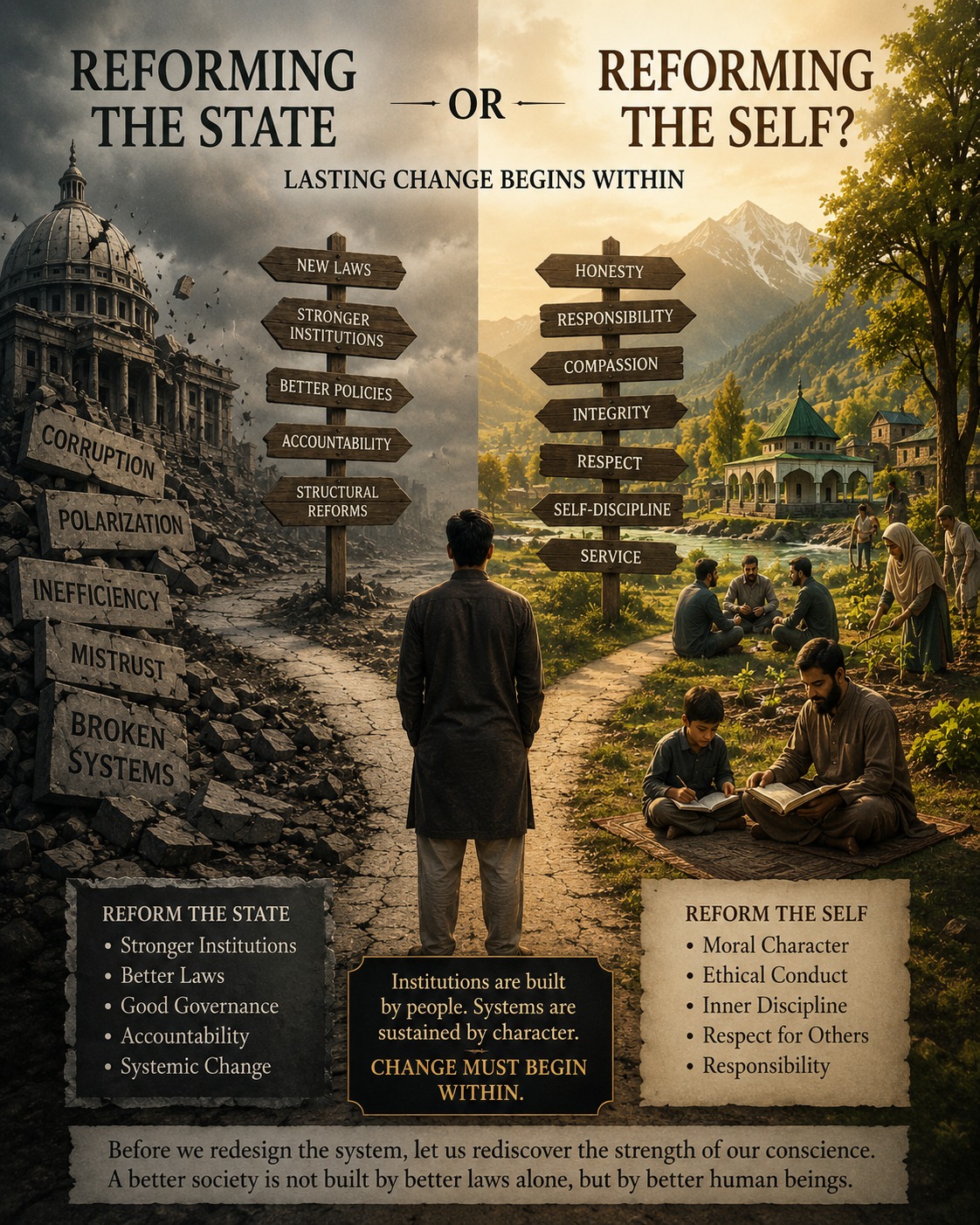


Reforming the State or Reforming the Self?

Shokin


“A society that internalizes honesty, responsibility and mutual respect can sustain institutions even during political turbulence. A society driven by personal gain will find that no structural reform can permanently resolve instability.”

In times of political uncertainty, public debate tends to revolve around one central theme: reform the system.

Strengthen institutions. Improve governance mechanisms. Enforce stricter laws. Enhance accountability. Replace leaders. Amend procedures.

The assumption behind these calls is understandable better structures will produce better outcomes.

Yet history, philosophy, and experience suggest a more difficult possibility: perhaps political reform fails when it begins only with institutions and neglects the moral foundations that sustain them.

This is not a new insight. It is, in fact, one of the oldest political reflections across civilizations.

The Greek philosopher Aristotle argued that the purpose of political life was not merely order, but the cultivation of virtue. A constitution, he believed, could not compensate for citizens lacking ethical discipline. Political systems presuppose moral character.

In China, Confucius taught that governance rooted in virtue produces lasting harmony, whereas governance rooted only in punishment creates temporary compliance. Fear may control behavior, but it cannot produce integrity.

Centuries later, the great historian Ibn Khaldun observed that civilizations rise when social cohesion and moral discipline are strong, and decline when luxury and ethical erosion weaken collective responsibility. Political collapse, in his analysis, begins internally long before it becomes visible externally.

Even within the spiritual tradition that has shaped much of Kashmir’s intellectual and moral heritage, the Qur’an offers a profound reflection: “Indeed, Allah does not change the condition of a people until they change what is within themselves” (13:11). Change, in this vision, begins not with systems but with conscience.

Across traditions, the message converges: institutions do not create character. They amplify it.

This insight carries particular weight in the Indian context. Our constitutional framework is one of the most carefully designed in the world. Our legal structures are extensive. Our democratic institutions are elaborate. Yet public dissatisfaction often persists  corruption, mistrust, polarization, inefficiency.

If the system alone were sufficient, these issues would have long disappeared.

The uncomfortable truth is that institutions are operated by human beings. Laws are implemented by officials. Policies are shaped by leaders. Elections are decided by voters.

When ethical restraint weakens, systems strain under pressure. When public trust erodes, even well-crafted institutions struggle to function effectively.

For a region like Kashmir rich in intellectual history, spiritual depth, and cultural refinement this philosophical question is not abstract. It touches daily life.

We often ask: What reforms are needed? Which administrative structures must change? What political arrangement will finally produce stability?

These are important questions.

But perhaps an equally important one remains unasked: What kind of citizens are we cultivating?

A society that internalizes honesty, responsibility, and mutual respect can sustain institutions even during political turbulence. A society that treats public life as a space for personal gain or factional loyalty will find that no structural reform can permanently resolve instability.

This is not an argument against institutional reform. On the contrary, institutions matter deeply. Rule of law, transparency, and accountability are essential pillars of modern governance.

But the order of causation matters.

If morality depends on institutions, it collapses when institutions weaken. If morality is internalized practiced even when unobserved institutions become stronger as a natural consequence.

The philosopher’s insight is simple yet demanding: political order is downstream from moral order.

In Kashmir’s history, periods of cultural flourishing were not defined solely by political arrangements, but by intellectual vitality and ethical seriousness. Scholars, poets, jurists, and spiritual figures shaped society not through power, but through character. Political authority followed moral influence.

Today, in a fast-moving and polarized environment, the temptation is to seek quick structural solutions. But enduring reform rarely arrives through legal amendment alone. It emerges when citizens exercise integrity even in small, unseen decisions. When leaders act responsibly even when unpressured. When public debate is guided by reason rather than resentment.

Perhaps the most radical reform is not institutional but ethical.

Before redesigning systems, we may need to ask whether we possess the moral depth required to sustain them.

Political reform may begin in legislatures and courts. But lasting stability begins in homes, schools, communities and within the individual conscience.

For a society seeking durable peace and stability, the question is not only how to reform the state.

It is whether we are prepared to reform ourselves.


Author has done Bachelors in Business Administration and can be reached at habeelsuhail23@gmail.com

Comments are closed.