


Mohammad Muslim
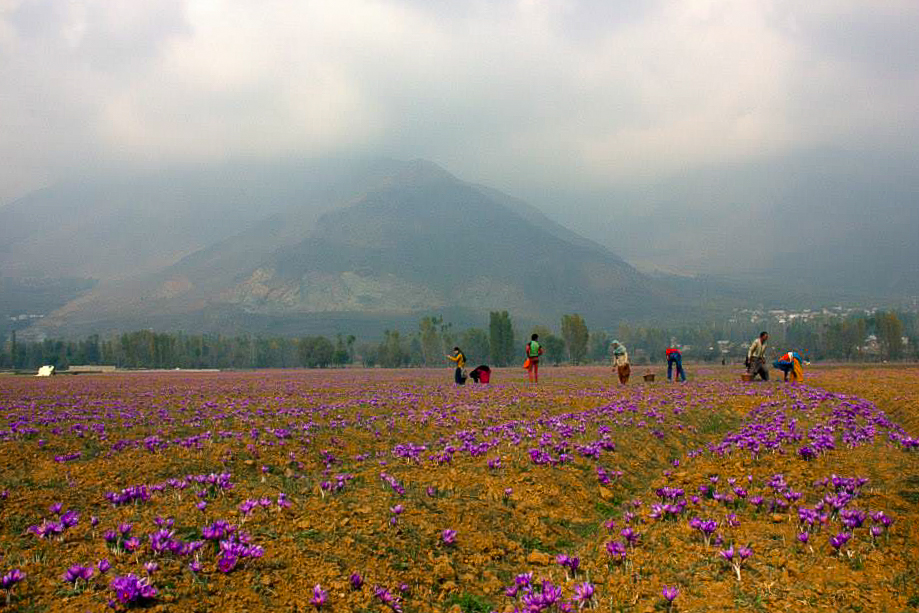
For tourists, saffron is one of the wonders of autumn in Kashmir; endless purple fields, fragrance of the spice in the air, and Saffron Festival in Pampore each year attracting people to witness the harvest and drink the world-renowned kahwa infused with fresh strands of Kashmiri saffron.
Each year, in October, a miraculous change takes place in the karewas of Pampore which has been attracting visitors and merchants from south Kashmir for hundreds of years. Overnight, the plateau that was just recently brown turns purple with thousands of crocus flowers blooming. In each of those flowers there are three tiny crimson threads – saffron, the most expensive spice in the world and what makes Pampore “The Saffron Town” in Kashmir. However, this year, the harvest season fast approaches, but saffron growers are looking at their fields with more fear than pride.
The saffron harvest is unique among all the agricultural processes in Kashmir valley. The whole process takes place within 2-3 weeks and timing is crucial in this race against time. Flowers have to be harvested early in the morning before the sun withers them and the crimson stigmas have to be separated from the flower by hand on the same day. Sorting centers in Pampore’s core belt, such as Dussu, Chandhara, Khonibal and Letapora – usually conducted through the nights at the peak of their blooming period, with entire families laboring under floodlights because the flowers have no patience to wait.
It is precisely for the above reasons that the spice is sold at such incredibly high prices. In fact, around 150,000 hand-plucked flowers are needed to produce only one kilogram of dried saffron strands. The cost of hiring temporary laborers who harvest saffron has gone up tremendously in the past few years as the harvest of saffron directly competes with the harvesting seasons of apples and walnuts, requiring the very same laborers.
The biggest problem that growers face during the harvesting season is not in the markets but in the field itself. In the past year, the producers of saffron in Pampore, Pulwama and Budgam districts have reported that there have been incidents where porcupines have been making their way into corms and destroying the bulbs before they get a chance to flower. There have been numerous complaints from different villages about fields that have been destroyed overnight. This issue has been acknowledged by the Legislative Assembly who have put together an action plan which includes the departments of agriculture, revenue and wildlife. The encroachment by monkeys in Wahab Sahib is another front in the same struggle, where farmers are provided with firecrackers until a permanent solution is found for their habitat.
On top of the problem of damage by wildlife is a problem that is even more persistent and insidious: the weather. For the growth of saffron corms, there is an essential sequence of events where it needs the cold of winter along with the protection of the snow to survive the dormancy period and then bloom again next fall. This sequence has recently become less predictable; late snow falls and early melting leave the saffron corms vulnerable to the cold penetrating too deeply for its tolerance range.
For those families earning their livelihood from the saffron harvest, the upcoming months mean much more than entertainment and fun – a sign that there is no glamour and glory without patience, hard work and resilience in the cultivation of “red gold”.
Comments are closed.