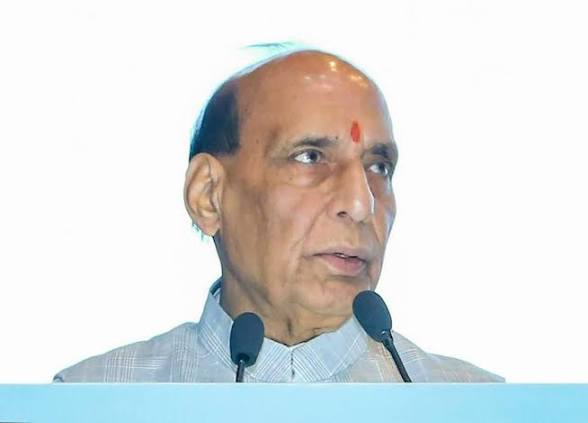
New Delhi, July 18: Defence Minister Rajnath Singh on Saturday said Operation Sindoor demonstrated India’s world-class defence preparedness and highlighted the success of the government’s sustained push for self-reliance in defence under the guiding principles of ‘Nation First’ and ‘Forces First’.
Addressing an event in New Delhi, the Defence Minister described Operation Sindoor as a testament to the courage of the Indian Armed Forces and the country’s evolving technological capabilities. He said the operation reflected the government’s policy of zero tolerance against terrorism and showcased India’s ability to strike terrorists and their supporters wherever necessary.
Singh said advanced indigenous defence systems, including the Akash Teer, Akash missile system and BrahMos, played a crucial role during the operation, underscoring the success of the government’s efforts to strengthen domestic defence manufacturing over the past 12 years.
Highlighting the progress made towards defence self-reliance, the Minister said annual defence production has increased from around ₹40,000 crore in 2014 to a record ₹1.78 lakh crore in 2025-26, while defence exports have grown from ₹686 crore in 2013-14 to over ₹38,000 crore.
He said the government aims to cross ₹2 lakh crore in defence production this year, raise it to ₹3 lakh crore by 2029, and increase defence exports to ₹50,000 crore within the same period.
Singh announced that another Positive Indigenisation List would soon be notified to further accelerate indigenous manufacturing. So far, the Armed Forces have issued five positive indigenisation lists covering 509 items, while Defence Public Sector Undertakings have notified five additional lists comprising 5,012 items.
The Defence Minister said the government has fundamentally shifted India’s defence policy from import dependence to indigenous production by creating a robust defence industrial ecosystem capable of meeting both domestic and international demand.
He highlighted reforms aimed at simplifying defence exports, including the Defence EXIM Portal, online approvals, Open General Export Licence, Green Channel policy and self-certification mechanisms.
Referring to the defence industrial corridors in Uttar Pradesh and Tamil Nadu, Singh said investment proposals worth ₹70,000 crore have been received, with nearly ₹10,000 crore already invested, creating new employment opportunities and strengthening India’s manufacturing base.
He added that 75 per cent of the defence modernisation budget has been earmarked for procurement from Indian industry and said a new Defence Acquisition Procedure (DAP) would be unveiled this year to further promote indigenous manufacturing.
On defence innovation, the Minister said procurement worth over ₹2,400 crore has been approved from startups and MSMEs, while projects valued at more than ₹1,500 crore have been sanctioned for emerging technologies.
He said 676 startups and innovators are currently engaged through the Innovations for Defence Excellence (iDEX) initiative, with 551 contracts signed by March 2026. The number of defence startups has grown from only a few dozen in 2018 to more than 2,000 today, working in areas such as drones, artificial intelligence, cybersecurity, robotics and quantum technologies.
Singh also noted that India’s defence ecosystem now includes Defence Public Sector Undertakings, private industry, over 17,000 MSMEs and thousands of supply units, supported by DRDO’s expanding collaboration with industry, academia and innovators.
He said India is increasingly emerging as a reliable global security partner, expanding defence diplomacy beyond strategic cooperation to include technology partnerships, industrial collaboration and participation in global supply chains.
Concluding his address, the defence minister said the government’s vision is to build a strong, self-reliant and developed India where soldiers are equipped with indigenous weapons, scientists have greater opportunities, youth drive innovation and domestic industries compete globally, enabling India to emerge as a modern defence power by 2047.


Comments are closed.