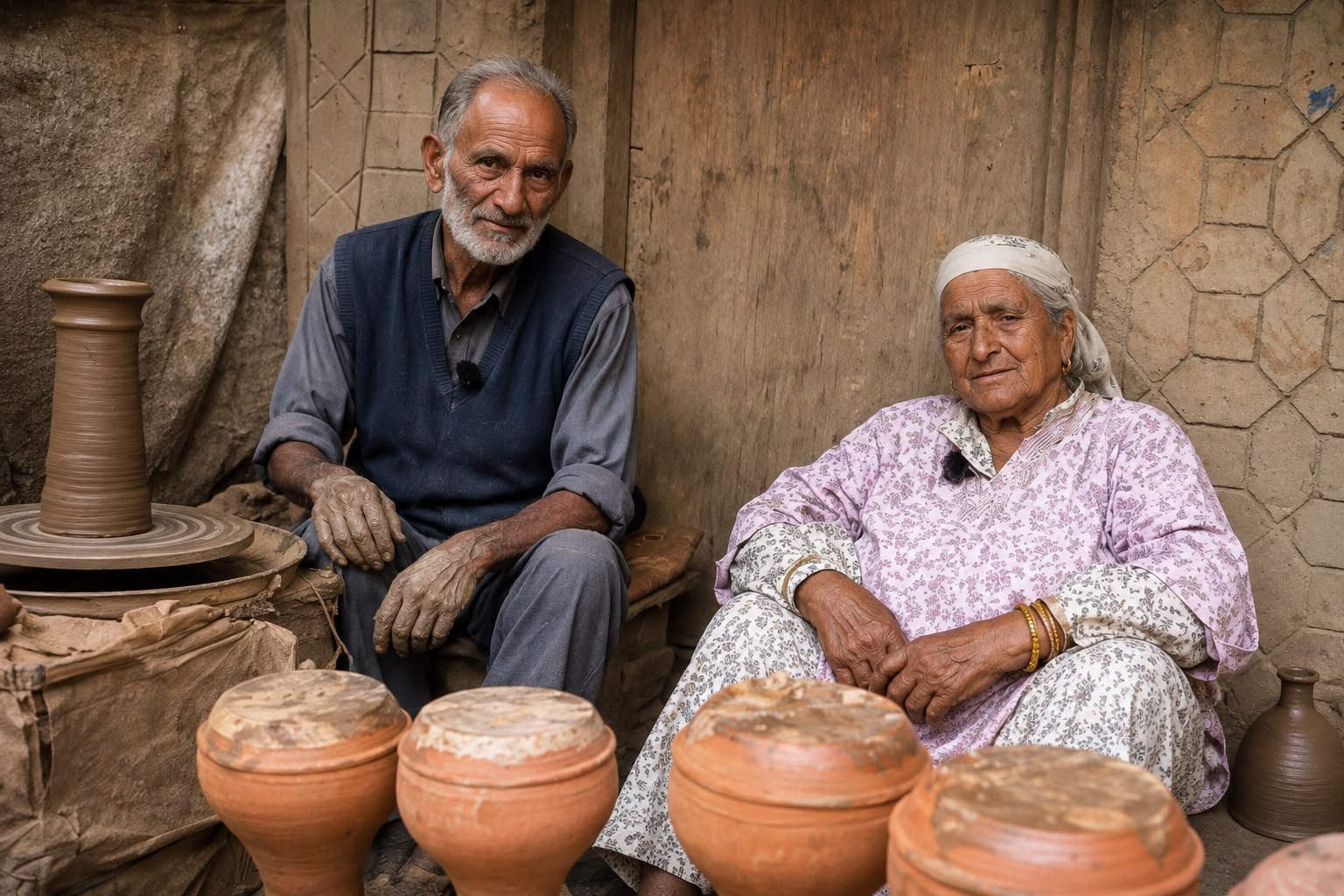
Baramulla, Aug 20: In an age of microwaves and non-stick cookware, a clay pot still finds its way out of a small workshop in north Kashmir’s Baramulla district — carried, quite literally, on the shoulders of an 80-year-old woman.
For half a century, Muhammad Ramzan Kumar has moulded clay with his hands. His wife has walked it to villages, sold it on trust, and returned with money — often months later. Together, they have kept alive a craft that once echoed through every Kashmiri household but is now fighting for breath.
“People have moved to modern things. Stainless steel, plastic — everything is available,” Ramzan told Kashmir Convener. “But clay pottery is a legacy. It has a connection with every Kashmiri.”
The couple, both in their 80s, have been in the trade since they married. Ghulam recalls a time when pottery was at its peak — when earthenware was not just utilitarian but essential, especially tumaknari, the ceremonial pots used in Kashmiri weddings.
“I make the pots. My wife sells them,” he said. “It was never just about money. It is about keeping something alive that our ancestors gave us.”
His wife, who has undergone two surgeries over the years, still makes the rounds. “Since my marriage, I have been doing this. Every day, I go from village to village,” she said. “People buy from us. They pay after months sometimes. But we give them on trust — (umeed se.”)
The business, however, is shrinking. Ramzan admitted that very few families are left in the trade. “Bahut kam log ab is business mein hain. Most have shut down or switched to other lines. Demand is less. Or maybe people have become modernised. But pottery itself is an example of our culture,” he said.
Yet, Ramzan and his wife remain undeterred. “At this age, I feel proud that I have contributed something to our traditional culture,” he said. “It is not about surviving. It is about keeping alive something that people have emotions connected to.”
For many in Baramulla district, the couple’s work brings back memories of a different time. “My grandmother used to cook only in clay pots. The food had a taste you cannot get from steel,” said Abdul Majeed, a resident of nearby Delina village, while purchasing a small handi . “When I see Ramzan uncle still working at this age, I feel a sense of loss. We are watching our culture slip away.”
Another customer, Shakeela Bano, “I come to them because I trust their work. These pots are pure. There is no machine-made feel. They are made with love and years of skill.”
Notably, Baramulla, historically known as the “Gateway of Kashmir” , has long been a centre of cultural heritage, but its crafts are fading. As the district works on modernisation plans , the human story of its artisans often gets left behind, however the couple’s perseverance is not just a personal story of survival. It reflects a larger cultural shift in Kashmir, where traditional crafts are being edged out by industrial alternatives. Once a backbone of the rural economy, pottery is now confined to a handful of artisans, many of whom have moved on.


Comments are closed.