Beyond Books and Lectures: What Students Really Need from University Teachers Today
In an age of artificial intelligence and unlimited access to information, the real value of a university professor lies in developing critical thinking, character, confidence and the skills students need to navigate an increasingly complex world.
Education has always been one of the most important instruments of social and economic progress. Universities, in particular, have traditionally played a central role in shaping individuals, developing knowledge and preparing future generations to contribute meaningfully to society. However, the nature of education is changing rapidly, and so are the expectations placed on those responsible for delivering it.
Walk into a university classroom today and the difference from a decade or two ago becomes immediately apparent. Students are no longer entirely dependent on teachers, textbooks or library resources to access information. With a smartphone or computer, they can search for almost any concept within seconds, watch explanatory videos, attend online lectures and even use artificial intelligence tools to simplify complicated subjects. Information that once required considerable time and effort to obtain is now available at the touch of a button.
This development raises an important question: if students can access information independently, what should they expect from their university teachers?
The answer lies in recognising that teaching has never been merely about transferring information. Its deeper purpose is to develop understanding, encourage independent thinking, build confidence and prepare individuals to deal with real-life challenges. A teacher’s responsibility, therefore, extends far beyond explaining a subject or completing the prescribed syllabus.
In the contemporary university environment, particularly in a diverse and internationally connected country such as the United Arab Emirates, professors must increasingly combine academic expertise with effective communication, ethical leadership, mentorship, technological awareness and an understanding of students’ individual needs.
The modern university teacher must not compete with technology in providing information. Instead, the teacher must help students understand, evaluate and apply that information meaningfully.
Clarity in teaching: Making learning understandable
One of the most important qualities of an effective university teacher is the ability to communicate complicated ideas in a simple and understandable manner. Academic knowledge alone does not automatically make someone an effective teacher. A professor may possess excellent subject expertise, but if students cannot understand the concepts being explained, the purpose of teaching remains unfulfilled.
Students learn more effectively when lectures are organised, instructions are clear and expectations are communicated in advance. They should understand what they are expected to learn, how their performance will be assessed and what standards they need to meet.
A good teacher does not assume that every student has understood a topic simply because it has been explained. Instead, the teacher regularly checks understanding, encourages questions and provides practical examples to connect theoretical concepts with everyday experiences.
This is particularly important in multicultural university environments such as those in the UAE, where students come from different educational systems, linguistic backgrounds and cultural settings.
Clarity in teaching is not a sign of simplifying academic standards. Rather, it is the ability to make complex knowledge accessible without compromising its depth. When students understand what is expected of them, they are more confident, independent and willing to participate in the learning process.
Kindness with discipline: The importance of balanced authority
Another important aspect of effective teaching is the ability to maintain a balance between friendliness and discipline. A university classroom should be welcoming and respectful, but it must also have clearly defined expectations.
Being approachable does not mean compromising professional standards. Similarly, maintaining discipline does not require a teacher to become unnecessarily strict or intimidating.
Students need an environment in which they feel comfortable expressing their opinions, asking questions and acknowledging their difficulties. At the same time, they must understand the importance of attendance, punctuality, assignment deadlines, academic participation and mutual respect.
This balance creates what may be described as kind firmness. A teacher can be understanding towards a student’s genuine difficulties while remaining consistent about academic responsibilities.
Such an approach also helps establish a positive classroom culture. Students are more likely to participate actively when they know that their opinions will be respected and their mistakes will be treated as opportunities to learn rather than reasons for embarrassment.
A teacher’s influence is not limited to the knowledge communicated during lectures. Students also remember how they were treated, whether their concerns were heard and whether they were encouraged during difficult moments.
Respectful behaviour builds trust, and trust creates the conditions necessary for meaningful learning.
Assessment should measure understanding, not memorisation
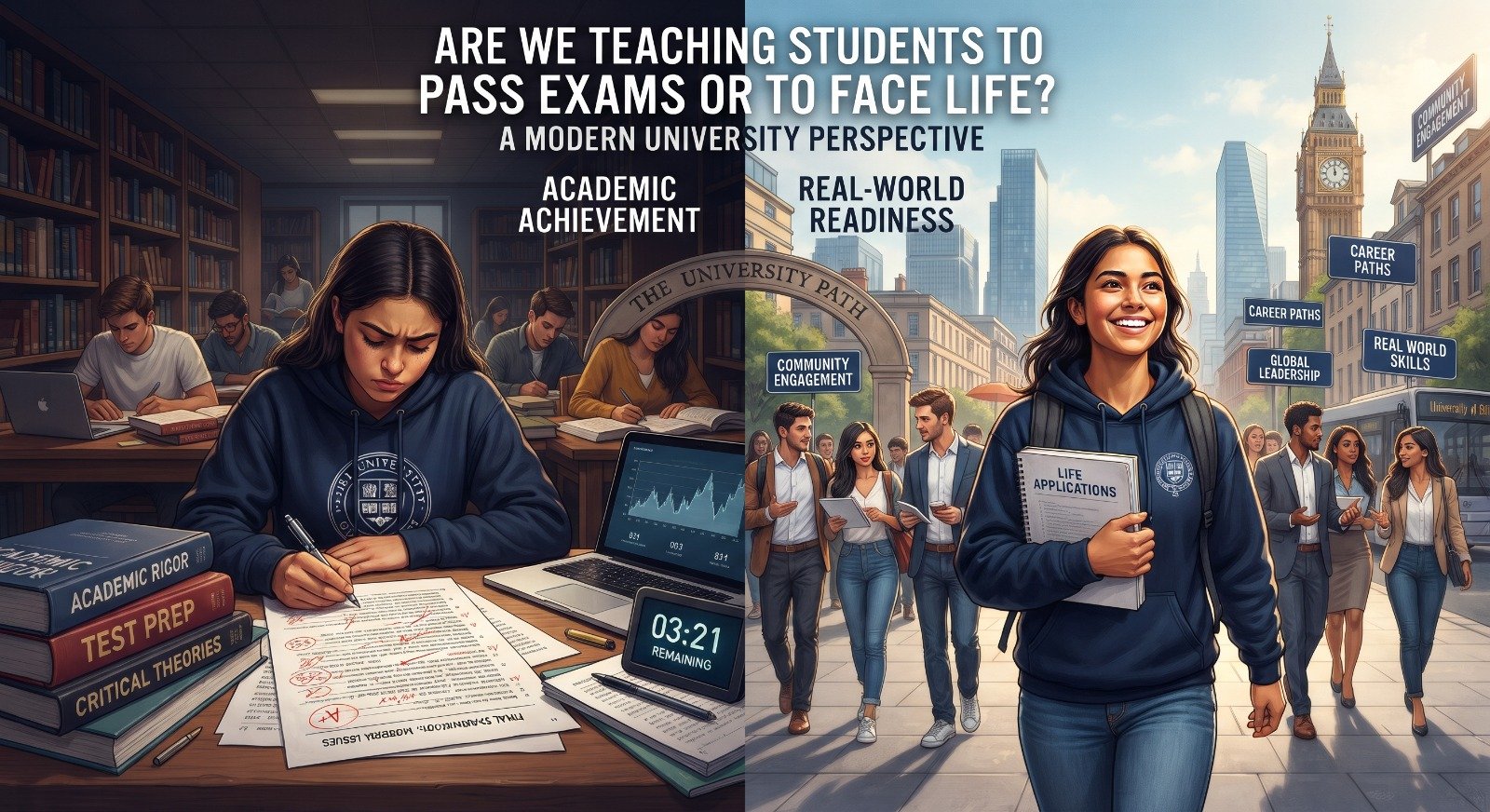
Assessment is another area in which university teaching needs to evolve. Traditionally, academic performance has often been measured through examinations that place considerable emphasis on recalling information and reproducing learned material.
Although examinations remain an important component of education, they cannot always provide a complete picture of a student’s understanding, analytical ability or practical competence.
In an era when information can be accessed instantly and artificial intelligence can generate answers to many conventional questions, universities must pay greater attention to what students can actually understand, analyse and apply.
A modern professor should therefore design assessments that encourage reasoning, interpretation, problem-solving and independent thinking.
Case studies, presentations, research assignments, group projects and practical exercises can complement conventional examinations. Oral discussions and short individual explanations can also help teachers establish whether students genuinely understand the work they submit.
Equally important is transparency in grading. Students should be informed about assessment criteria through clear rubrics so that they understand how their performance will be evaluated.
Academic integrity must also become an essential part of this process. Instead of treating plagiarism and unauthorised assistance merely as disciplinary issues, teachers should explain why honesty, originality and proper acknowledgement of sources matter in academic and professional life.
The objective of assessment should not simply be to identify who has secured the highest marks. It should be to determine what students have learned and how effectively they can use that learning.
Feedback: Helping students improve rather than merely judging them
Marks and grades indicate performance, but they do not necessarily explain how a student can improve. This is where constructive feedback becomes particularly important.
Students need to know not only where they have made mistakes but also why those mistakes occurred and what they can do differently in the future.
Effective feedback should be timely, specific and practical. Telling a student that an assignment is weak provides little guidance. Explaining which arguments lack clarity, where evidence is insufficient and how the structure can be improved gives the student a meaningful direction.
Feedback should also be a two-way process. Teachers must pay attention to students’ responses, identify areas where several learners are facing similar difficulties and modify their teaching strategies accordingly.
For example, if a significant number of students perform poorly in a particular topic, the teacher should consider whether the subject needs to be explained differently or whether additional learning resources are required.
Modern teaching also offers opportunities to use simple assessment data, classroom participation and quiz results to identify learning gaps.
The underlying principle is straightforward: teaching should not end when a lecture is completed or an examination is conducted. It should continue through observation, feedback and improvement.
Inclusion: Recognising that every student learns differently
University classrooms are increasingly diverse. In the UAE, students often represent different nationalities, languages, cultures and educational backgrounds. Even within the same classroom, their levels of confidence, communication abilities and academic preparedness may vary considerably.
An effective teacher must recognise these differences without allowing them to become barriers to learning.
Some students may be comfortable expressing their views in front of others, while some may need encouragement before participating. Others may require additional explanations, accessible learning materials or more time to understand difficult concepts.
The responsibility of a teacher is to create an environment in which every student has a fair opportunity to participate and progress.
This does not mean lowering academic expectations or compromising standards. Rather, inclusion involves removing unnecessary obstacles that prevent students from demonstrating their abilities.
Teachers must also remain conscious of unconscious biases, avoid labelling students and respect different accents, communication styles and cultural perspectives.
A truly inclusive classroom is one in which students feel that their backgrounds are respected and their contributions are valued.
When students feel accepted, they are more likely to develop confidence, participate in discussions and engage meaningfully with their studies.
Artificial intelligence: A challenge as well as an opportunity
Perhaps no development has generated as much discussion in contemporary education as artificial intelligence.
AI-powered tools can explain difficult concepts, generate summaries, assist with writing, solve mathematical problems and provide personalised learning support. These capabilities offer enormous opportunities for students and teachers alike.
However, they also raise serious questions about academic integrity, independent thinking and the future of conventional assessment.
Universities cannot afford to ignore these developments. Nor would it be practical to assume that simply prohibiting AI tools will prevent students from using them.
The more constructive approach is to teach responsible and ethical AI use.
Students should understand when the use of AI is acceptable, when it is prohibited and how they should acknowledge its assistance. They must also learn that AI-generated information can be inaccurate, incomplete or misleading and should therefore be independently verified.
More importantly, teachers should design learning activities that require students to demonstrate their own understanding. Assignments involving personal reflection, local case studies, classroom discussions, practical applications and oral presentations can make it easier to evaluate genuine learning.
Technology should support education, not replace the intellectual effort that education is intended to develop.
A university professor’s greatest responsibility in the AI era is perhaps to help students become critical users of technology rather than passive consumers of machine-generated information.
Connecting education with employment and everyday life
A university degree remains an important qualification, but employers increasingly expect graduates to demonstrate abilities that extend beyond academic knowledge.
Communication, teamwork, adaptability, problem-solving, analytical thinking and professional conduct have become essential qualities across many sectors.
Universities must therefore ensure that classroom learning is connected with practical realities.
Teachers can achieve this by incorporating real-world examples, case studies, group activities, research projects and problem-solving exercises into their courses. Where appropriate, they can also connect academic concepts with developments in the UAE’s economy, public institutions, business environment and wider society.
For example, students studying mathematics should be encouraged to understand how mathematical reasoning is applied in finance, technology, engineering, data analysis and everyday decision-making. Similarly, students in other disciplines should be given opportunities to explore how theoretical knowledge can address practical problems.
Such approaches help students understand the relevance of what they are studying and develop confidence in applying their knowledge outside the classroom.
The objective of higher education should not be limited to producing graduates who possess certificates. It should be to prepare individuals who can think independently, work responsibly, communicate effectively and adapt to changing professional requirements.
Professional ethics: Teaching through personal example
A university teacher’s responsibility does not end when the lecture concludes. Professional conduct, fairness and ethical behaviour are equally important aspects of academic life.
Students observe how their teachers communicate, respond to disagreements, handle responsibilities and treat individuals with different opinions. These everyday interactions often influence their understanding of professional values more deeply than formal lectures on ethics.
A responsible professor should communicate respectfully, respond to student concerns appropriately, maintain confidentiality, follow institutional policies and apply academic rules consistently.
Fairness is particularly important in assessment and student interactions. Personal preferences, cultural differences or individual relationships should never influence academic judgement.
Teachers must also recognise the authority that comes with their position and use it responsibly. Their role should be to guide and encourage students, not to discourage them through unnecessary criticism or unequal treatment.
Universities build their reputation not only through research publications, rankings and infrastructure but also through the quality and professionalism of their academic staff.
The university of tomorrow needs better teachers, not merely more technology
The rapid transformation of higher education presents both opportunities and responsibilities. Universities are investing in digital platforms, modern infrastructure, online resources and technology-enabled classrooms. These developments are important, but technology alone cannot guarantee better education.
A well-equipped classroom does not automatically produce meaningful learning. Similarly, access to advanced digital tools does not necessarily develop independent thinkers or responsible professionals.
The human element remains central to education.
A good teacher recognises when a student needs encouragement, when a concept requires a different explanation and when a learner needs to be challenged to think beyond familiar ideas. These aspects of teaching require judgement, empathy, experience and a genuine commitment to student development.
Universities must therefore invest not only in technological infrastructure but also in the continuous professional development of their faculty members. Teachers should be encouraged to update their subject knowledge, explore new teaching methodologies, understand emerging technologies and reflect on their classroom practices.
Institutions should also recognise and reward effective teaching alongside research and other academic contributions. Teaching excellence deserves to be treated as a central measure of institutional quality rather than a secondary responsibility.
Conclusion: Educating minds and preparing human beings
The role of a university professor has never been more demanding or more significant. Students today have access to an extraordinary amount of information, but access to information alone does not guarantee wisdom, understanding or the ability to make sound decisions.
What they need are teachers who can guide them through that information, help them distinguish reliable knowledge from misinformation, encourage them to question assumptions and prepare them to face challenges with confidence and integrity.
The modern university teacher must be academically competent, a clear communicator, approachable yet disciplined, fair in assessment, constructive in feedback, inclusive in approach and responsible in the use of technology. Above all, the teacher must remain committed to the intellectual and personal development of students.
The ultimate purpose of higher education is not simply to produce individuals who know more. It is to develop people who can think better, act responsibly, work effectively with others and contribute positively to society.
Google can provide information, and artificial intelligence can generate answers, but neither can independently replace the human responsibility of mentoring, encouraging and shaping young minds through meaningful relationships and personal example.
The true measure of a university teacher is therefore not merely how much knowledge is delivered in a classroom, but how much confidence, curiosity, independent thinking and capability students carry with them when they leave it.
Author is Faculty of Mathematics, Department of General Education, HUC, Ajman, UAE. He can be mailed at reyaz56@gmail.com


Comments are closed.