
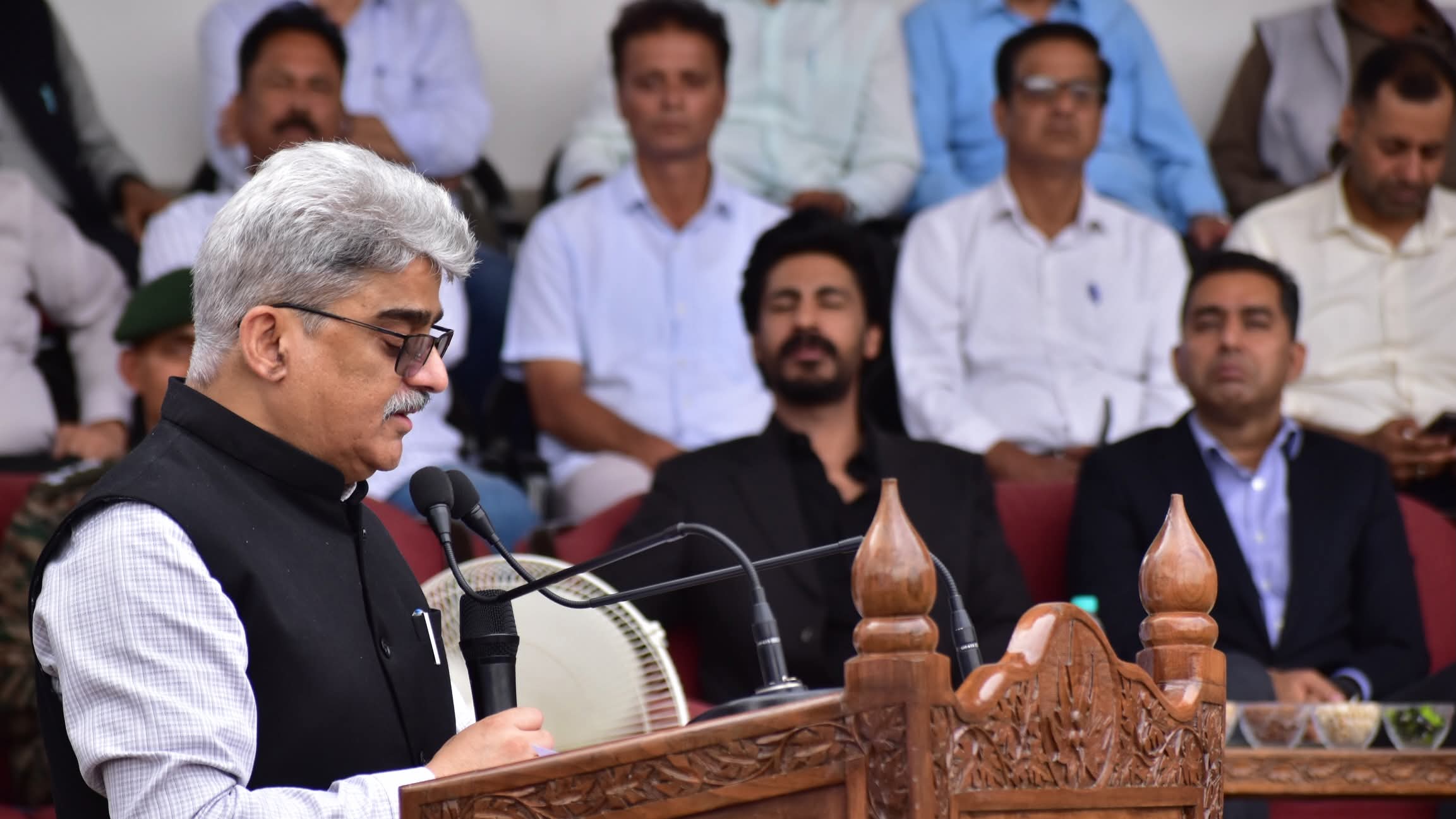

Srinagar, August 20: Chief Secretary Atal Dulloo on Thursday reviewed various renewable energy initiatives and emerging green-energy policies in Jammu and Kashmir, directing departments to ensure coordinated and time-bound implementation of projects aimed at expanding solar, hydro, wind and biomass-based energy generation.
The review meeting of the Science and Technology Department was attended by Commissioner Secretary, Science & Technology; Director, CSIR-IIIM Jammu; DG Budget; MD, PDCL; CEO, JAKEDA; CEO, CITaG and other concerned officers.
Dulloo directed the Power Development Department, Revenue, Finance and Agriculture departments to maintain close coordination and complete identified initiatives within stipulated timelines. He also called for completion of a district-wise biomass survey and immediate identification of government land for a centralised Green Land Bank, including through the digital land bank created by the Forest Department.
The Chief Secretary said Jammu and Kashmir’s solar, water, wind and biomass potential should be converted into viable projects through milestone-based implementation with clear responsibilities.
The meeting reviewed floating solar projects, small hydropower, solarisation of government buildings, wind-resource assessment, smart metering, battery energy storage systems and compressed bio-gas production.
Under the Pradhan Mantri Surya Sarovar Yojana, JAKEDA has identified five reservoirs for floating solar projects, with a combined potential of 83.51 MW. Manasbal Lake in Ganderbal, with an identified potential of 34.06 MW, and Mansar Lake in Samba, with 31.9 MW, were assessed as feasible sites. The assessment follows a 100 kW floating solar pilot project at Dal Lake.
In the small hydropower sector, seven projects with a combined capacity of 35.25 MW are operational, while a 3 MW project is nearing completion. DPRs have been prepared for 76 projects of up to 2 MW, totalling 118 MW, and 56 projects in the 2-10 MW category, with a cumulative capacity of 331 MW.
The meeting also noted that eight of the 15 DPRs approved nationally under the Model Solar Village component of PM Surya Ghar: Muft Bijli Yojana have been sanctioned for J&K, involving Central Financial Assistance of ₹7.99 crore.
CITaG presented the proposed Integrated Renewable Energy Policy, which targets 500 MW of ground-mounted solar, 150 MW of battery energy storage and 50 MW of wind capacity by 2030, rising to 2,000 MW solar, 1,200 MW BESS and 300 MW wind capacity by 2040.
The proposed Compressed Bio-Gas Policy targets at least six major CBG plants by March 2030, with combined production capacity of 32 tonnes per day. The plants would use municipal wet waste, livestock manure, orchard waste and agricultural residue, with the initiative expected to generate more than 700 direct jobs.
Comments are closed.