

S Ahmad
India’s manufacturing sector is steadily emerging as a central pillar of its long-term economic transformation. Currently contributing around 16–17 percent to GDP and employing over 27 million people, manufacturing is expected to play a decisive role as the country moves toward its ambitious goal of becoming a $30–35 trillion economy by 2047.
Achieving this scale requires more than incremental growth; it demands a structural shift in how industrial activity is organized, supported, and sustained. In recent years, India’s policy approach has evolved in this direction, placing strong emphasis on the development of integrated manufacturing hubs that combine infrastructure, logistics, regulatory support, and institutional coordination into unified industrial ecosystems.
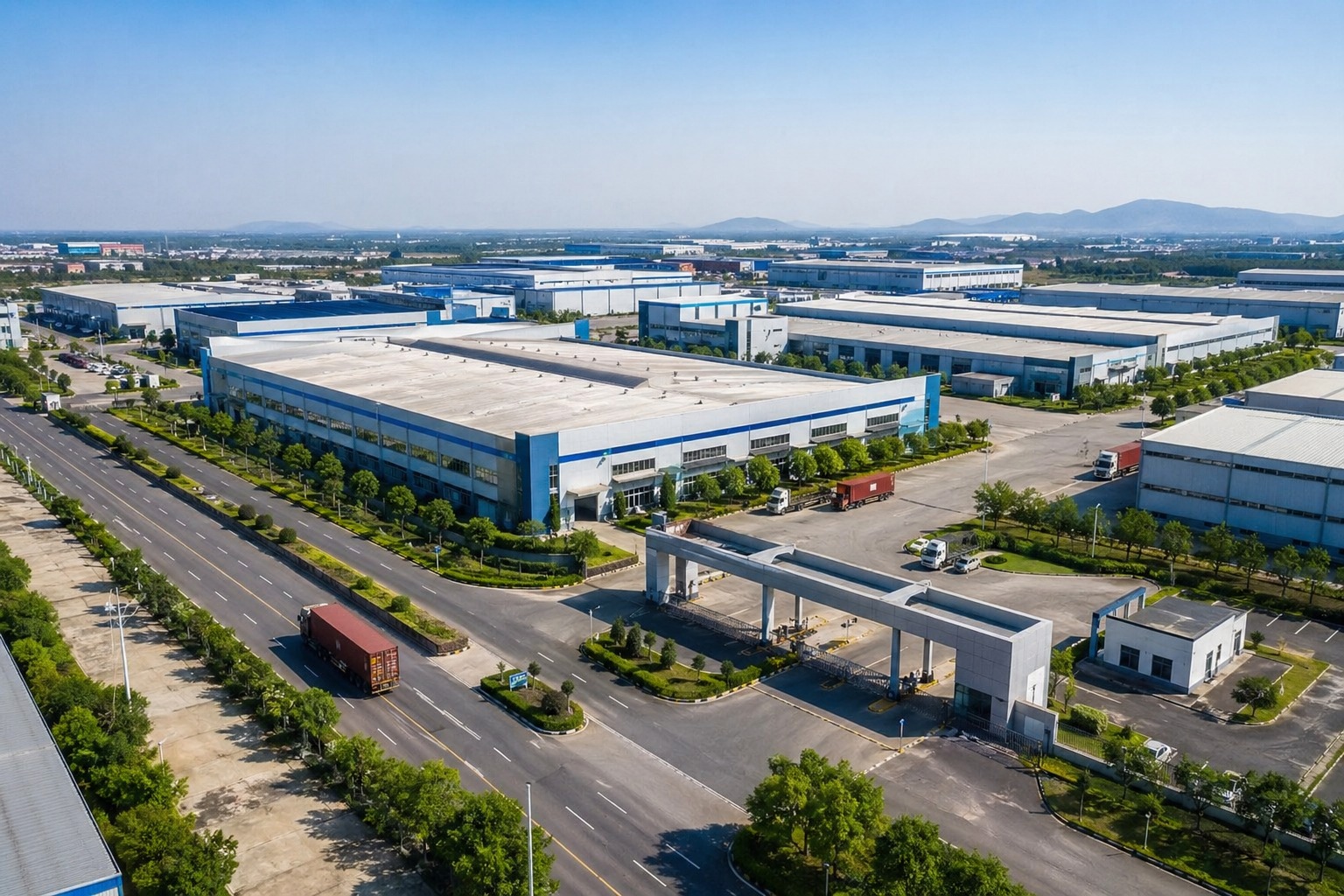
In this context, India’s manufacturing strategy has increasingly focused on the development of integrated manufacturing hubs, spatial ecosystems that combine physical infrastructure, regulatory support, common facilities, and connectivity. These hubs are designed to support scale, reduce transaction costs, and anchor long-term manufacturing activity, strengthening India’s position within domestic and global production networks.
This shift is taking place against a changing global manufacturing landscape. Competitiveness is no longer determined solely by low-cost labour or isolated production efficiency. Instead, reliability, resilience, and the ability to operate within stable, well-connected ecosystems have become critical.
Modern manufacturing increasingly depends on complex supply chains, advanced technologies, and synchronized operations across multiple geographies. In this context, countries that can offer integrated environments—where infrastructure, logistics, skilled labour, and governance systems function cohesively—are better positioned to attract and retain long-term industrial investment.
The Economic Survey 2025–26 observed that global manufacturing is undergoing a structural transition, with competitiveness shaped less by low-cost production and more by reliability, resilience, and strategic indispensability. As production processes become more technology-intensive and system-dependent, the ability to operate within stable, integrated manufacturing environments has emerged as a critical determinant of long-term industrial competitiveness.
Countries that are able to provide stable production environments are supported by infrastructure, logistics, skills, and institutional coordination, and they are better positioned to sustain manufacturing activity and retain long-term production mandates.
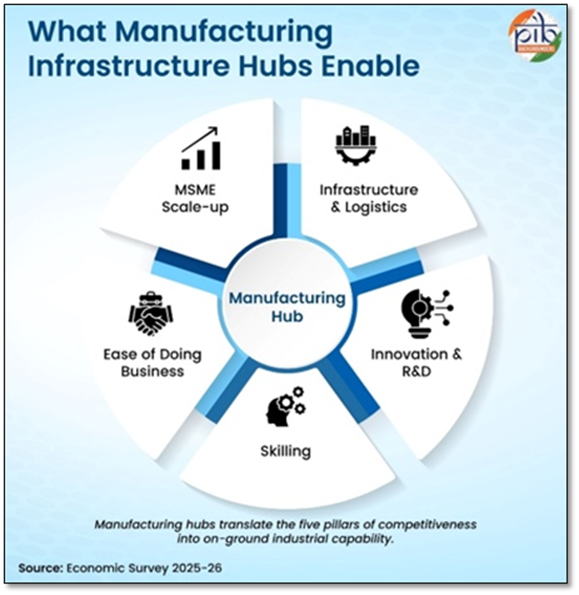
This global shift and the ongoing industrial momentum have been underpinned by a move towards high-technology manufacturing and a growing emphasis on strategic indispensability within GVCs. As manufacturing becomes increasingly technology-intensive and system-dependent, it underscores the importance of preparedness, productivity, and the capacity to scale. Manufacturing hubs providing integrated ecosystems with shared infrastructure, supply chain linkages, and logistics connectivity, enable firms to operate at scale, move up the value chain, and integrate more effectively into global production networks.
India’s Industrial Manufacturing Trajectory
India’s infrastructure approach has undergone a structural transformation, with the focus moving from project-level execution to system-level planning. Such system-level planning directly enhances the effectiveness of manufacturing hubs by reducing bottlenecks, improving logistics efficiency, and supporting timely execution.
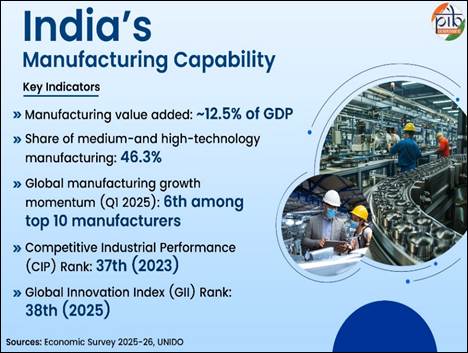
Global investment trends increasingly recognise India as a preferred manufacturing destination. The country is currently ranked as the third most sought-after manufacturing location worldwide. At the same time, the composition of production is evolving, with medium- and high-technology activities accounting for 46.3% of total manufacturing value added, indicating a gradual shift towards more sophisticated industrial structures.
India’s Manufacturing Hub Landscape
The manufacturing hub landscape across the country has evolved into a multi-layered ecosystem, reflecting differences in scale, sectoral requirements, and spatial planning. Rather than following a single model, policy interventions have supported diverse forms of manufacturing hubs. The manufacturing landscape today comprises large integrated parks, sector-specific ecosystems, MSME clusters, and corridor-linked industrial nodes, each designed to address specific production, logistics, and value-chain needs.
Large Integrated Manufacturing Hubs
These are master-planned industrial zones with plug-and-play infrastructure that host anchor manufacturers and their supplier ecosystems in one location. They provide shared utilities, logistics, and support infrastructure, enabling quick project implementation and economies of scale. These parks may be multi-sector or sector-anchored and can be developed independently or within industrial corridors.
National Industrial Corridor Development Programme (NICDP) is a transformative initiative designed to establish Greenfield Industrial Smart Cities across India, positioning the country as a global manufacturing hub. Till date, 20 industrial smart cities have been approved by the Government of India which cover 7 industrial corridors and 13 States. Of these, 4 industrial smart cities namely Dholera (Gujarat), Shendra-Bidkin (Maharashtra), Integrated Industrial Township at Greater Noida (Uttar Pradesh) and Integrated Industrial Township at Vikram Udyogpuri near Ujjain (Madhya Pradesh) have been completed and other 16 are under various stages of development. These industrial nodes are being developed with plug-and-play infrastructure and multimodal connectivity.
PM MITRA (Pradhan Mantri Mega Integrated Textile Region and Apparel) represents large integrated manufacturing hubs tailored for the textile value chain, combining processing, manufacturing, logistics, and common facilities within a single park framework. These parks have been announced in seven states, including Tamil Nadu, Telangana, Gujarat, Karnataka, Madhya Pradesh, Uttar Pradesh, and Maharashtra.
Sector-Specific Manufacturing Ecosystems
Certain manufacturing sectors require specialised and capital-intensive infrastructure, making ecosystem-based manufacturing hubs essential. These hubs integrate production units with supplier networks, testing, regulatory, and skilling infrastructure to support complete value chains.
-
Bulk Drug Park Scheme: This scheme is facilitating the establishment of three Bulk Drug Parks in Gujarat, Himachal Pradesh, and Andhra Pradesh to reduce the cost of bulk drug manufacturing through the creation of world-class common infrastructure. These parks provide shared facilities, including solvent recovery plants and common effluent treatment systems, to improve efficiency and environmental compliance.
-
Semiconductor and electronics ecosystems are supported under the Semicon India Programme and Electronics Components Manufacturing Scheme (ECMS) 2.0, covering fabrication, assembly, packaging, and testing. These hubs are designed to strengthen domestic manufacturing capacity in critical sectors while improving integration with global value chains.
-
Biopharma SHAKTI (Strategy for Healthcare Advancement through Knowledge, Technology and Innovation) has been announced, with an outlay of ₹ 10,000 crores over the next 5 years to develop India as a global Biopharma manufacturing hub.
Micro, Small, and Medium Enterprises (MSME) Manufacturing Clusters
Micro, Small, and Medium Enterprises (MSMEs) constitute a core pillar of India’s manufacturing ecosystem, with significant implications for manufacturing hubs at the regional level. MSMEs account for 35.4% of manufacturing output, contribute 48.58% of exports, and generate 31.1% of GDP, highlighting their substantial role in India’s industrial economy.
The MSME sector comprises over 7.47 crore enterprises and employs more than 32.82 crore persons, making it the second-largest source of employment after agriculture. With such scale, MSMEs are central to the development of manufacturing hubs, particularly in Tier-2 and Tier-3 cities, where clusters often form around shared skills, local supplier networks, and cost advantages.
-
The Micro & Small Enterprises – Cluster Development Programme (MSE-CDP) supports infrastructure creation, Common Facility Centres (CFCs), and technology upgradation in MSME clusters. Under MSE-CDP, a total of 580 projects have been approved, comprising 227 Common Facility Centres (CFCs) and 353 Infrastructure Development (ID) projects.
-
The India Industrial Land Bank (IILB) maps industrial estates, clusters, parks, and zones across the country.
-
State Industrial Development Corporations develop and manage industrial estates for MSMEs.
Corridor-Linked Industrial Nodes
Complementing these hub models are corridor-enabled industrial regions, which emphasise spatial integration and logistics efficiency as part of a broader industrial ecosystem, rather than functioning as standalone production units. These corridors provide trunk infrastructure, freight connectivity, and multimodal logistics, enabling industrial concentration at scale.
Industrial corridors such as the Delhi–Mumbai Industrial Corridor (DMIC), Chennai–Bengaluru Industrial Corridor (CBIC), Amritsar–Kolkata Industrial Corridor (AKIC), and Vizag Chennai Industrial Corridor (VCIC) are designed to support manufacturing hubs and clusters by improving connectivity and facilitating integrated planning across regions.
State Capacity and On-Ground Execution
The performance of manufacturing infrastructure hubs is overall shaped by state capacity in land aggregation, trunk infrastructure provisioning, and regulatory approvals. Strengthening execution and coordination has therefore been a key focus of recent infrastructure policy initiatives.
To address coordination challenges in infrastructure planning and delivery, the Government has launched the PM Gati Shakti National Master Plan, an integrated platform that brings together infrastructure-related data and projects of 44 central ministries and 36 states/Union Territories. The initiative enables coordinated planning of transport, logistics, and utility infrastructure, with a focus on multimodal connectivity, last-mile linkages, and time-bound execution.
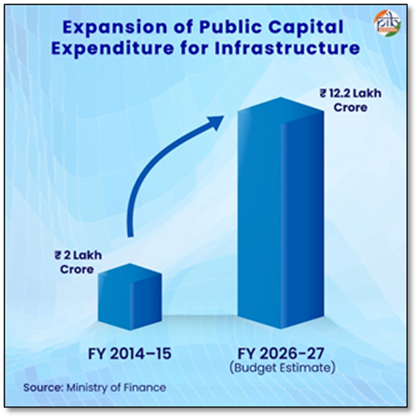
To reinforce infrastructure creation, public capital expenditure has increased substantially in recent years. The Government capital outlay has grown from ₹2 lakh crore in FY2014–15 to a Budget Estimate of ₹12.2 lakh crore in 2026–27. This sustained increase has strengthened the physical backbone required for large manufacturing ecosystems, including industrial parks, logistics infrastructure, and freight connectivity.
Institutional mechanisms have also been introduced to improve project preparedness and execution capacity. The India Infrastructure Project Development Fund (IIPDF) supports Central and State authorities by financing transaction advisers to develop bankable infrastructure projects, helping create a robust project pipeline. In parallel, the National Infrastructure Enablement Index (NIEI) has been developed to assess the institutional preparedness of States/UTs and Central Ministries/Departments for infrastructure delivery.
These measures have improved the enabling environment for manufacturing hubs. State-level initiatives across the country illustrate the development of manufacturing hubs across different sectors and regions:
-
Uttar Pradesh is developing the Defence Industrial Corridor across six nodes, including Aligarh, Agra, Chitrakoot, Jhansi, Kanpur, and Lucknow, to support defence and aerospace manufacturing.
-
Tamil Nadu, also known as the Detroit of Asia, has expanded electronics and automobile manufacturing clusters, supported by dedicated industrial parks and logistics infrastructure.
-
Gujarat continues to leverage industrial estates and port-linked manufacturing hubs to attract large-scale manufacturing investment.
Comments are closed.