

Sehreena Maqbool
The maiden export of premium Areko cherries and Scentrose plums from Kashmir to the UAE marks a shift in India’s horticulture landscape—where Kashmir’s orchards are steadily finding space in premium global retail chains, driven by scientific farming, better logistics, and sustained institutional support.
On a crisp summer morning in the orchards of Shopian and Pulwama, rows of cherry and plum trees glisten under the Himalayan sun. For generations, these fruits have been part of Kashmir’s agricultural identity—harvested, packed, and sold in nearby mandis or transported to metropolitan markets across India.
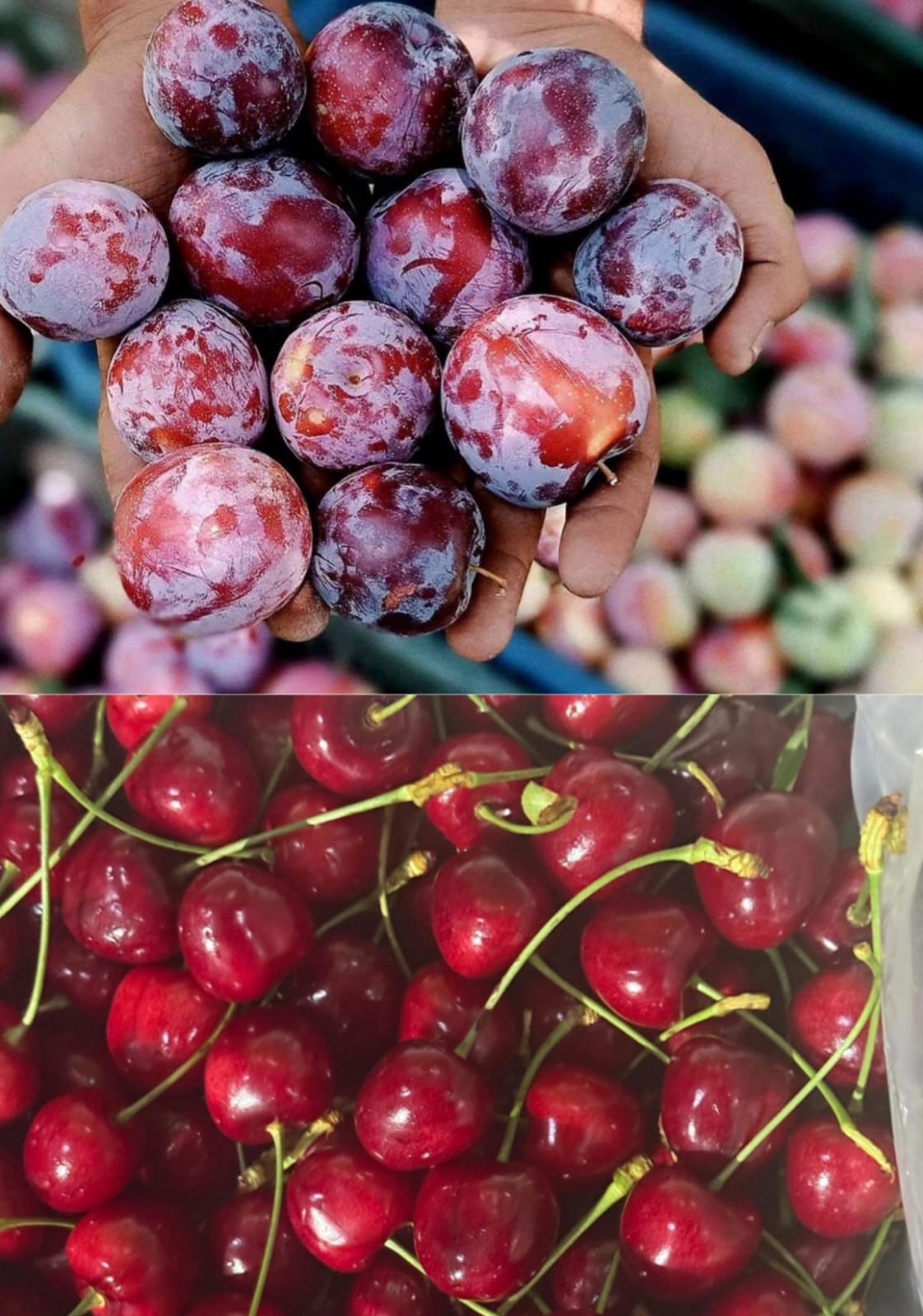
This year, a consignment quietly marked a shift in that long-standing pattern. Premium Areko cherries and Scentrose plums, sourced from orchards in South Kashmir, were airlifted to the United Arab Emirates, destined for the shelves of Lulu Hypermarket in Abu Dhabi and Dubai.
The shipment, facilitated by the Agricultural and Processed Food Products Export Development Authority (APEDA), was dispatched on July 4. For the first time, these specific premium fruit varieties from Kashmir entered a structured export channel into one of the most competitive and quality-sensitive fresh produce markets in the world.
“The export of premium Areko cherries and Scentrose plums to the UAE marks a new chapter for Kashmir’s horticulture sector, demonstrating that the region’s orchards are increasingly capable of meeting the quality, traceability and consistency demanded by premium global markets.”
Changing Landscape
Jammu & Kashmir has long been known as India’s fruit bowl for temperate horticulture, with apples traditionally dominating its agricultural economy. But beneath that familiar identity, a quiet transformation has been underway.
Over the past decade, farmers in districts such as Shopian, Pulwama, Baramulla, and Budgam have increasingly adopted high-density plantation systems, scientific pruning, controlled irrigation, and integrated nutrient management practices. These changes have not only improved yields but have also significantly enhanced fruit quality.
Areko cherries is a new generation of European sweet cherry varieties cultivated under Kashmir’s unique agro-climatic conditions. The variety is known for its deep red colour, large size, firm texture, and high sweetness levels, making it suitable for long-distance air freight.
Similarly, Scentrose plums have an aromatic profile, and balanced sweet-tart flavour. Their ability to retain firmness during transport makes them particularly suitable for export-oriented cultivation.
Together, these fruits reflect a shift from volume-based horticulture to quality-driven, value-oriented production systems.
Gradual Transformation
For decades, Kashmir’s horticulture sector has been largely dependent on domestic markets, with limited exposure to structured exports of fresh fruits. High perishability, fragmented supply chains, and lack of export-grade infrastructure often restricted global competitiveness.
The recent shipment indicates that this gap is beginning to narrow.
If the recent shipment to the UAE signals a turning point, a key driver of this transformation has been the Agricultural and Processed Food Products Export Development Authority (APEDA), which established its Regional Office in Srinagar in 2021. APEDA has worked closely with the authorities and Farmer Producer Organizations (FPOs), exporters, and logistics partners to strengthen the entire value chain from orchard to overseas market.
Many growers in the region, despite producing high-quality fruits, had limited exposure to international standards such as Good Agricultural Practices (GAP), phytosanitary requirements, and export-grade grading and packaging protocols.
APEDA’s interventions included training programs for farmers and FPOs, workshops on post-harvest management, and guidance on export documentation and compliance.
A key attention was given to filling infrastructure gaps. Packhouses, cold-chain facilities, and pre-cooling systems are critical for perishable commodities like cherries and plums.
A Series of Early Export Milestones
In recent years, shipments of fresh cherries, apples, walnuts, saffron, and other horticultural products have reached destinations in the United Arab Emirates, Saudi Arabia, Oman, Qatar, Bahrain, and the UK.
These early consignments played an important role in establishing buyer confidence and demonstrating Kashmir’s produce. APEDA also organized buyer-seller meets, reverse buyer-seller delegations, and participation in international trade fairs.
According to Abhishek Dev, Chairman, APEDA, strengthening India’s fresh produce exports requires sustained investment in quality, infrastructure, and market development, especially for Jammu & Kashmir.
APEDA’s focus remains on enabling farmers to access premium markets through improved production practices, efficient logistics, and better integration with global supply chains, Dev added.
Adding to this, Ms. Sehreena Maqbool, Regional Head, APEDA, Jammu and Kashmir said the latest shipment reflects the steady progress on how transformation underway in Kashmir’s horticulture sector is not limited to a single export event but is the result of continuous engagement with growers and stakeholders.
The focus has been on building an ecosystem where farmers can consistently produce export-quality fruits by adopting scientific cultivation practices, improving post-harvest handling, and ensuring strict adherence to international standards, she added.
The Challenge
Experts suggest the challenge in Kashmir’s horticultural exports lies in maintaining an uninterrupted cold chain. Cherries and plums are highly perishable, and even minor delays or temperature fluctuations during handling, storage, or transportation can significantly impact quality. This makes coordination between growers, packhouses, transporters, and air cargo operators essential.
APEDA’s role in coordination becomes critical in ensuring export consignments reach their destination without any possible damage.
The export of Areko cherries and Scentrose plums to the United Arab Emirates is more than a standalone trade event as it reflects a gradual but meaningful shift in how Jammu & Kashmir’s horticulture sector is positioning itself in global markets.
For thousands of orchardists across Shopian, Pulwama, Baramulla, and other fruit-growing belts, the transition reflects that the premium export markets can significantly improve price realization.
Impact for Growers
The export initiative is expected to significantly benefit farmers by providing access to premium international markets and ensuring better price realisation. Growers associated with the export supply chain realised nearly 60 per cent higher returns for cherries and 120 per cent higher returns for plums compared to prevailing domestic market prices
For growers, the most immediate benefit of export-led horticulture is better price discovery. Premium cherries and plums that meet export standards often fetch higher and more stable returns compared to domestic wholesale markets.
The UAE: A Strategic Gateway
The United Arab Emirates plays a particularly important role in this evolving export story. Beyond being a consumption market, it functions as a regional distribution hub for fresh produce across the Gulf Cooperation Council (GCC) countries.
For Kashmir’s fruits, this market offers a combination of proximity, premium pricing potential, and established retail networks. Supermarket chains such as Lulu Hypermarket provide structured entry points where quality produce can reach a diverse and discerning consumer base.
Success in such markets also enhances credibility, paving the way for entry into other high-value destinations in Europe and Southeast Asia.
A Sector in Transition
Jammu & Kashmir’s horticulture sector is steadily moving from a production-driven model to a market-integrated, export-oriented system.
APEDA’s sustained engagement has played a catalytic role in this transition. By focusing on capacity building, market linkage, infrastructure support, and global buyer engagement, it has helped create early pathways for exports that were previously limited or fragmented.
With expanding adoption of high-density orchards, improved post-harvest systems, and deeper integration with global supply chains, the region’s premium fruits are likely to see increasing presence in international retail markets.
The journey from Himalayan orchards to supermarket shelves in the Gulf is still evolving but it is now firmly underway. For growers, exporters, and institutions alike, the message is clear: Kashmir is no longer just a fruit-producing region, it is becoming a serious contender in the global market for premium temperate fruits.
Comments are closed.