

Shabeer Ahmad Lone
Mystical and philosophical traditions reinforce this insight: the Heart Sutra declares “Form is emptiness; emptiness is form,” the Tao Te Ching counsels that “the sage knows without traveling; sees without looking; works without doing,” and Tillich observes that ultimate reality is “that which sustains all that is,” yet cannot be objectified.
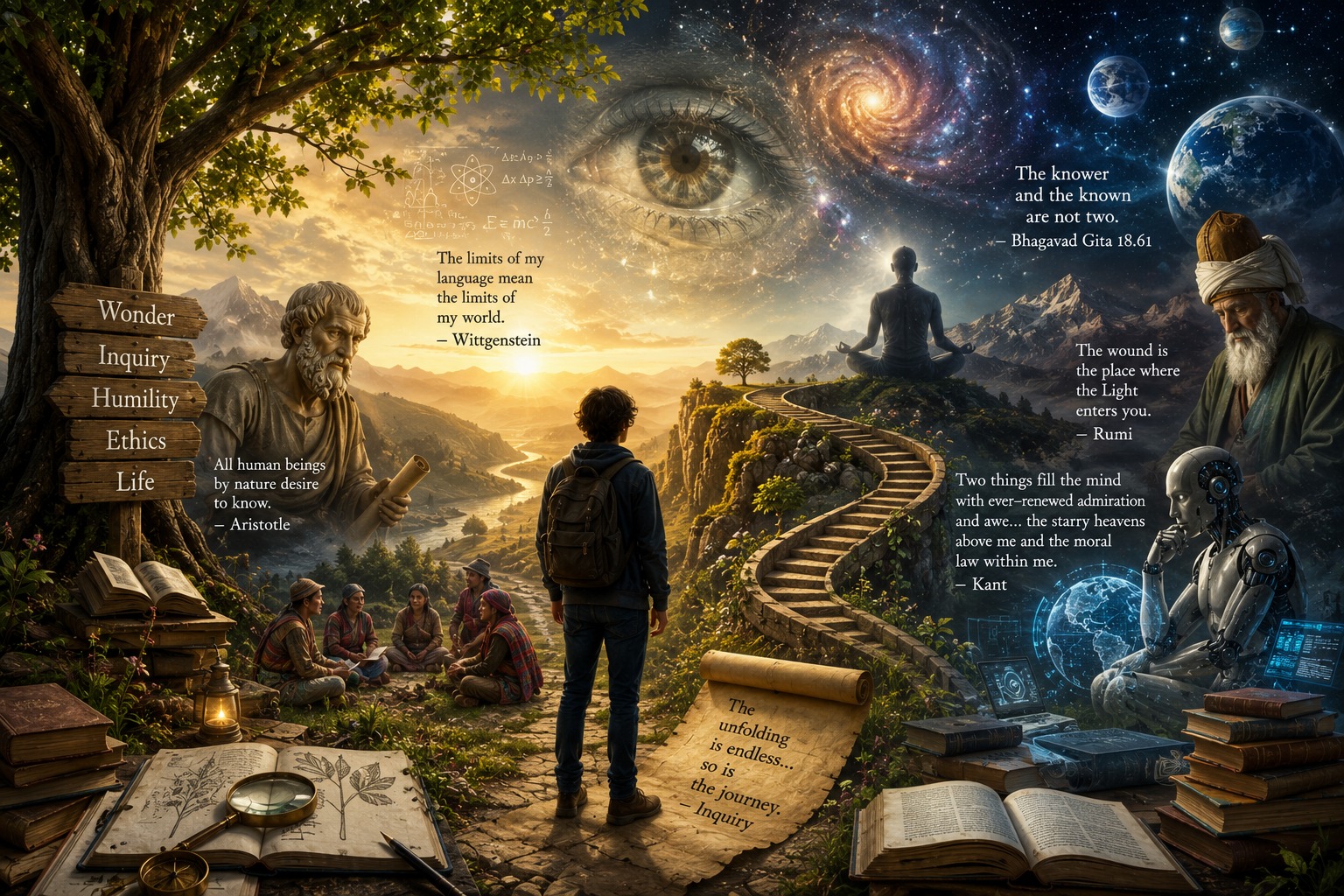
Human inquiry arises from a persistent, insistent openness-a recognition that what is immediately given is never the whole of what is real. From the first questions of children to the abstractions of scientists and the meditations of mystics, humans have sought not merely to describe but to participate in the unfolding of reality. As Aristotle reminds us, “all human beings by nature desire to know” (Metaphysics), yet this desire is always tempered by the boundaries of comprehension, for “the limits of my language mean the limits of my world” (Wittgenstein, Tractatus Logico-Philosophicus). Each advance in knowledge-from Newtonian mechanics to quantum physics, from neural mapping to contemporary AI-reveals new dimensions even as it exposes limits, reminding us that reality is dynamic, relational, and inexhaustible. Mystical and sacred traditions converge with scientific insight in emphasizing that understanding is participatory: the Bhagavad Gita declares “the knower and the known are not two” (18.61), the Upanishads proclaim “Tat Tvam Asi” (You are That), Meister Eckhart observes that “the eye with which I see God is the same eye with which God sees me,” and Rumi writes, “The wound is the place where the Light enters you,” portraying inquiry as both ethical and transformative. Wonder, awe, and ethical attentiveness are inseparable from knowledge, as Kant notes that “two things fill the mind with ever‑renewed admiration and awe… the starry heavens above me and the moral law within me” (Critique of Practical Reason). Inquiry is thus not a deficit to be remedied but a constitutive trait of consciousness, a relational and ethical engagement with a reality that reveals itself endlessly to those who approach with curiosity, humility, and courage.
Inquiry is inseparable from the contexts in which it occurs. Knowledge is produced in histories, cultures, institutions, and power structures that shape which questions are asked, which answers are amplified, and which perspectives are marginalized. Michel Foucault reminds us that inquiry is always a negotiation between power and truth, while Amartya Sen shows how ethical reasoning depends on the inclusion of diverse human voices. Technology now extends this interplay: artificial intelligence generates correlations, predictions, and patterns invisible to human senses, reshaping the epistemic landscape. AI participates in inquiry without consciousness, prompting urgent questions about agency, responsibility, and the meaning of understanding itself. Inquiry is no longer solely human, yet its ethical stakes remain intimately ours.
The embodied, affective, and relational dimensions of knowing further complicate the picture. Understanding emerges through sensation, emotion, empathy, and care. Trauma can constrict insight; joy, awe, and creative play can expand it. Art, ritual, music, and contemplative practices disclose truths inaccessible to logic alone. Indigenous and feminist epistemologies enrich this perspective, emphasizing relationality, situated knowledge, and the moral responsibilities entailed by participation in reality. Knowledge is never neutral; it is lived, communal, and ethically charged. Reality, in this sense, is not an object among objects but a field of relationships in which humans, nonhumans, and the cosmos co-constitute one another.
In the mysticalpersuits , sacred scriptures, philosophy of religion veins there is an unending dialogue.Humans seek understanding because, as Aristotle observed, “all human beings by nature desire to know,” yet our grasp is limited: “the limits of my language mean the limits of my world” (Wittgenstein). Inquiry awakens awe and responsibility: “two things fill the mind with ever‑renewed admiration and awe… the starry heavens above me and the moral law within me” (Kant) and “the knower and the known are not two” (Bhagavad Gita 18.61). Curiosity fuels this pursuit: “I have no special talent. I am only passionately curious” (Einstein), and the beginner’s openness reveals infinite possibilities (Shunryu Suzuki).
Reality remains elusive: “one cannot step into the same river twice” (Heraclitus), and “what we observe is not nature itself, but nature exposed to our method of questioning” (Heisenberg). Sacred and mystical traditions affirm this quest: Upanishads- “Tat Tvam Asi” – reveal self and ultimate reality; Meister Eckhart: “the eye with which I see God is the same eye with which God sees me”; Rumi: “The wound is the place where the Light enters you”; Heart Sutra: “Form is emptiness; emptiness is form”; Tao Te Ching: “The sage knows without traveling; sees without looking; works without doing.” Kierkegaard stresses that truth is lived, not merely conceptual, and Tillich reminds us ultimate reality is “that which sustains all that is,” yet cannot be objectified. In this unending dialogue, inquiry becomes a partnership with the world, a transformative engagement where wonder, ethical responsibility, insight, and participation in the sacred ground of being coalesce (David Bohm).
World literature and thought show that understanding is never final but always unfolding. Dante’s Divine Comedy portrays knowledge as a layered pilgrimage toward the ineffable; Borges’s The Aleph captures infinity and paradox as mirrors of curiosity; Proust reveals insight through memory and perception; Joyce dissolves boundaries between self and world in Ulysses; Eliot’s Four Quartets meditates on time’s continuity; Camus’s The Myth of Sisyphus finds meaning in engagement rather than closure. Arabic and Persian voices illuminate relational and transformative inquiry: Rumi-“What you seek is seeking you”; Ibn ʿArabī teaches that “He who knows himself knows his Lord”; Saʿdī counsels that “A heart attuned to humanity sees deeper truths”; Hafiz celebrates paradox and the generosity of insight: “Even after all this time, the sun never says to the earth, ‘You owe me.’ Look what happens with a love like that.
It lights the whole sky”; Al-Mutanabbi declares, “The heart is like a lamp; as it is illuminated, it illuminates everything around it.” Iqbal exhorts the self to “rise above the stagnant self, and discover the boundless possibilities within,” portraying inquiry as an ethical, creative, and self-realizing act. Urdu and Punjabi voices: Mir’s questioning gazes; Ghalib’s paradoxes of self; Faiz’s fusion of love and justice; Bulleh Shah-“Bullah ki jaana main kaun.” Hindi: Kabīr dissolves binaries; Tulsī illuminates inner reality. Across these figures, inquiry emerges as participatory, ethical, imaginative, and relational, revealing that reality discloses itself not once but in an ever-unfolding dance of question and discovery, where curiosity, attentiveness, and ethical engagement illuminate both self and cosmos.
Mortality presses urgency into this quest. The finitude of human life gives depth to questions of ultimate reality and ethical responsibility. The search for understanding is intertwined with the desire to leave the world in better shape than we found it. The awareness of impermanence transforms inquiry from mere accumulation of facts into a reflective, participatory practice oriented toward care, stewardship, and meaning. This temporality reminds us that inquiry is not a task to be completed but a journey whose significance is measured by the depth of engagement and the quality of attention.
Ultimate reality may remain elusive because it is inherently dynamic, relational, and participatory. It cannot be fully objectified without being diminished, because it includes the very knower attempting to grasp it. Its resistance preserves freedom, creativity, and moral growth, ensuring that inquiry remains a living, ethical engagement rather than a conquest. Yet this elusiveness is not despairing: it invites wonder, awe, and profound ethical reflection. Inquiry matures as it integrates knowledge, action, and care, balancing intellectual rigor with ethical and aesthetic sensitivity. It thrives in humility, dialogue, and attentiveness to perspectives historically marginalized or silenced.
Contemporary visionaries illustrate this principle in action. Scientists like Jane Goodall demonstrate that inquiry informed by empathy transforms both knowledge and the world; thinkers like Amartya Sen and Vandana Shiva show that ethical insight arises from attentiveness to social and ecological interconnection; technologists like Fei-Fei Li remind us that artificial intelligence expands human understanding while demanding ethical responsibility; and spiritual teachers such as the Dalai Lama model the integration of contemplative awareness with worldly engagement. Their lives show that inquiry, when pursued with curiosity, compassion, and courage, is both illuminating and transformative, reaching beyond the merely cognitive into the moral and relational spheres.
Does inquiry ultimately satisfy humanity’s deep thirst? Perhaps not in the sense of closure, but in the sense of vitality, coherence, and deep engagement. Satisfaction emerges not from final answers but from the capacity to engage with reality responsibly, creatively, and attentively.
Wonder, joy, and the playful exploration of ideas are themselves forms of fulfillment, revealing that curiosity is not a lack but a conduit for ethical and imaginative expansion. Inquiry satisfies when it shapes not only understanding but character, when it integrates cognition, emotion, and ethical responsibility, and when it participates in the flourishing of life in all its forms.
Ultimate reality may forever elude full capture, not because it is hidden, but because it is abundant, relational, and participatory. Its elusiveness safeguards freedom, creativity, and moral responsibility, ensuring that inquiry remains a living, socially and ethically grounded engagement rather than a mere conquest. As Heraclitus warns, “one cannot step into the same river twice,” and Heisenberg reminds us that “what we observe is not nature itself, but nature exposed to our method of questioning,” emphasizing that the process of inquiry itself is inseparable from the knower.
Satisfaction does not lie in closure but in the capacity to engage responsibly, imaginatively, and ethically with the world; as Einstein confessed, “I have no special talent. I am only passionately curious,” and Shunryu Suzuki notes that “in the beginner’s mind there are many possibilities.” Inquiry becomes transformative when it integrates cognition, emotion, and ethical responsibility, cultivating character, fostering relational awareness, and participating in the flourishing of life across cultures, generations, and species.
Mystical and philosophical traditions reinforce this insight: the Heart Sutra declares “Form is emptiness; emptiness is form,” the Tao Te Ching counsels that “the sage knows without traveling; sees without looking; works without doing,” and Tillich observes that ultimate reality is “that which sustains all that is,” yet cannot be objectified.
In its inexhaustible openness, reality invites not mastery but co-creation, not possession but participation. Inquiry, in this sense, is itself the life-affirming horizon-the manifestation of human wonder, ethical attentiveness, and imaginative courage, a timeless conduit through which the universe continues to disclose itself to those who seek with humility, love, and attentiveness.
Comments are closed.