Srinagar, June 17: Even as the rest of the country gasps under a brutal heatwave and anxiously watches a weakening monsoon, the Kashmir Valley finds itself in the grip of an entirely different weather phenomenon—one that has residents reaching for sweaters in the peak of summer.
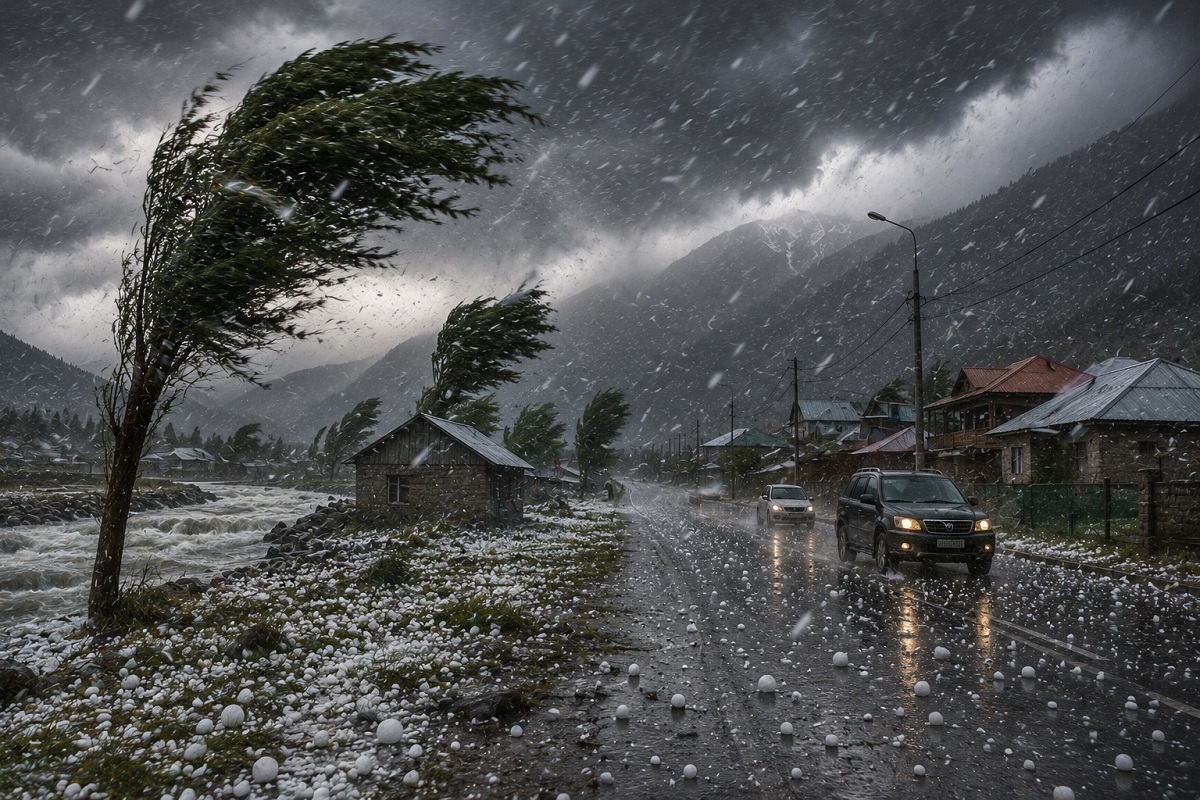
Unrelenting rains, thunderstorms, hailstorms, and gusty winds have pushed temperatures down to unusually cool levels, transforming June into a month more reminiscent of early spring. But the relief has come at a cost. A flash flood in different parts of Kashmir has already triggered panic, inundated homes, and disrupted normal life, as the MeT Department warned of more such events in the days ahead.
The Meteorological Department has predicted generally cloudy weather with intense showers, thunderstorms, hailstorms, lightning, and strong winds across Kashmir from June 18 to June 22. Conditions are expected to ease marginally between June 23 and 25, with partly cloudy skies and light rain at isolated places.
In a detailed advisory, the MeT has urged farmers to conduct spraying operations only during early morning hours. Residents have been cautioned against standing near loose structures, electrical poles, overhead wires, and old trees during bad weather. Shikara operators on Dal Lake have been specifically directed to suspend rides during thunderstorms and lightning to ensure tourist safety.
Unlike most of the country, Kashmir receives only a fraction of its annual rainfall from the southwest monsoon. Its weather is predominantly shaped by western disturbances—storm systems originating over the Mediterranean. According to the MeT Department, the current cool spell is a direct result of repeated western disturbances, not any large-scale phenomenon like El Niño.
However, scientists and environmentalists point to a more troubling narrative. The intense hailstorms that have repeatedly struck Kashmir across March, April, May, and now June over the past several years are not isolated weather events—they are alarm bells.
“Traditionally, spring in Kashmir meant moderate to heavy rainfall. But lately, weather systems have become erratic. Periods of unusual warmth are swiftly followed by cold air intrusions from higher latitudes. This creates strong atmospheric instability—warm, moisture-rich air rises rapidly and meets colder air aloft, forming powerful convective clouds that produce hailstones,” said Sameer, an environmentalist.
He added, “Climate change may not increase the number of storms, but it intensifies them. A warmer atmosphere holds more moisture and energy, fueling stronger storms capable of producing intense rainfall, lightning, and hail.”
The numbers substantiate the concern. A 2023 study by researchers from the University of Kashmir and the Indian Institute of Hyderabad documented over 200 hailstorm events in the Valley between 2007 and 2022. The rise is dramatic—from just two events in 2007 to 27 in 2022. In the past decade alone, more than 80 severe hailstorms have been recorded. Crucially, these are no longer evenly distributed across the year but are increasingly concentrated between April and June—the critical flowering period for apple orchards.
Yasir Altaf, Assistant Professor at the Islamic University of Science and Technology’s Department of Environment, Sustainability and Climate Change, explained the underlying dynamics: “Over the last decade, it is not just about how much it rains but how it rains. Warmer surface temperatures fuel stronger vertical air currents, which are essential for hail formation. Kashmir’s geography amplifies this effect.”
Sameera Qayoom, Professor and Head of the Division of Agrometeorology at SKUAST-Kashmir, underlined the economic devastation: “Rising temperatures, erratic western disturbances, and increased atmospheric instability are all contributing factors. Their coincidence with the flowering stage makes them disproportionately damaging to our orchards.”
The implications extend far beyond damaged crops. Kashmir’s water resources depend on a delicate balance between snowfall, rainfall, glacier melt, springs, rivers, lakes, and groundwater. Intense rainfall and hailstorms generate rapid runoff, reduce infiltration into soils, limit groundwater recharge, and increase erosion and flood risk. With springs and groundwater sustaining drinking water supplies during dry periods, changes in precipitation patterns threaten not just agricultural productivity but the long-term water security of the Valley.
Mountain environments are among the most sensitive to climate change. The Himalayas are warming faster than the global average, altering temperature patterns, snow cover, atmospheric circulation, and moisture transport. These changes influence not only water availability but also the frequency and intensity of extreme weather events.
Recent research suggests that warming over the Himalayas may be altering the behaviour of western disturbances themselves. Warmer surface conditions increase atmospheric moisture, and the interaction between these disturbances and locally generated convective activity creates favourable conditions for severe thunderstorms.
What happened in Kupwara last week is not an isolated event. Scientists point to a clear trend of declining overall precipitation, rising temperatures, and more erratic weather. The Valley may have escaped the heatwave, but the hailstorms and flash floods carry a stark message: the climate is changing, and the Himalayas are ringing the alarm.
As Kashmir shivers in June, the question before policymakers, scientists, and citizens alike is no longer whether the climate is shifting—but how quickly the Valley can adapt to a future where the seasons no longer behave as they once did.
Meanwhile, Agriculture Minister Javid Ahmad Dar said earlier this month said thatgovernment is moving ahead with a weather-based crop insurance scheme, with the bidding process set to begin soon. “All formalities are expected to be completed within a month. Farmers and growers will benefit significantly once it is implemented,” the minister said.
Minister Dar also said the government has taken up with the Centre the implementation of a marketing intervention scheme, with formalities currently underway.


Comments are closed.