

S Ahmad
India’s rise as a technology power is no longer a distant aspiration. The challenge now is to ensure that innovation remains inclusive, indigenous and globally competitive.
For much of the early digital era, India was viewed primarily as a vast market—a country of over a billion people consuming technology developed elsewhere. Global technology firms saw India as an enormous user base for smartphones, software applications, social media platforms and digital services. While India excelled in information technology services and software talent, the perception persisted that the country remained more of a consumer than a creator of cutting-edge technologies.
That perception is changing rapidly.
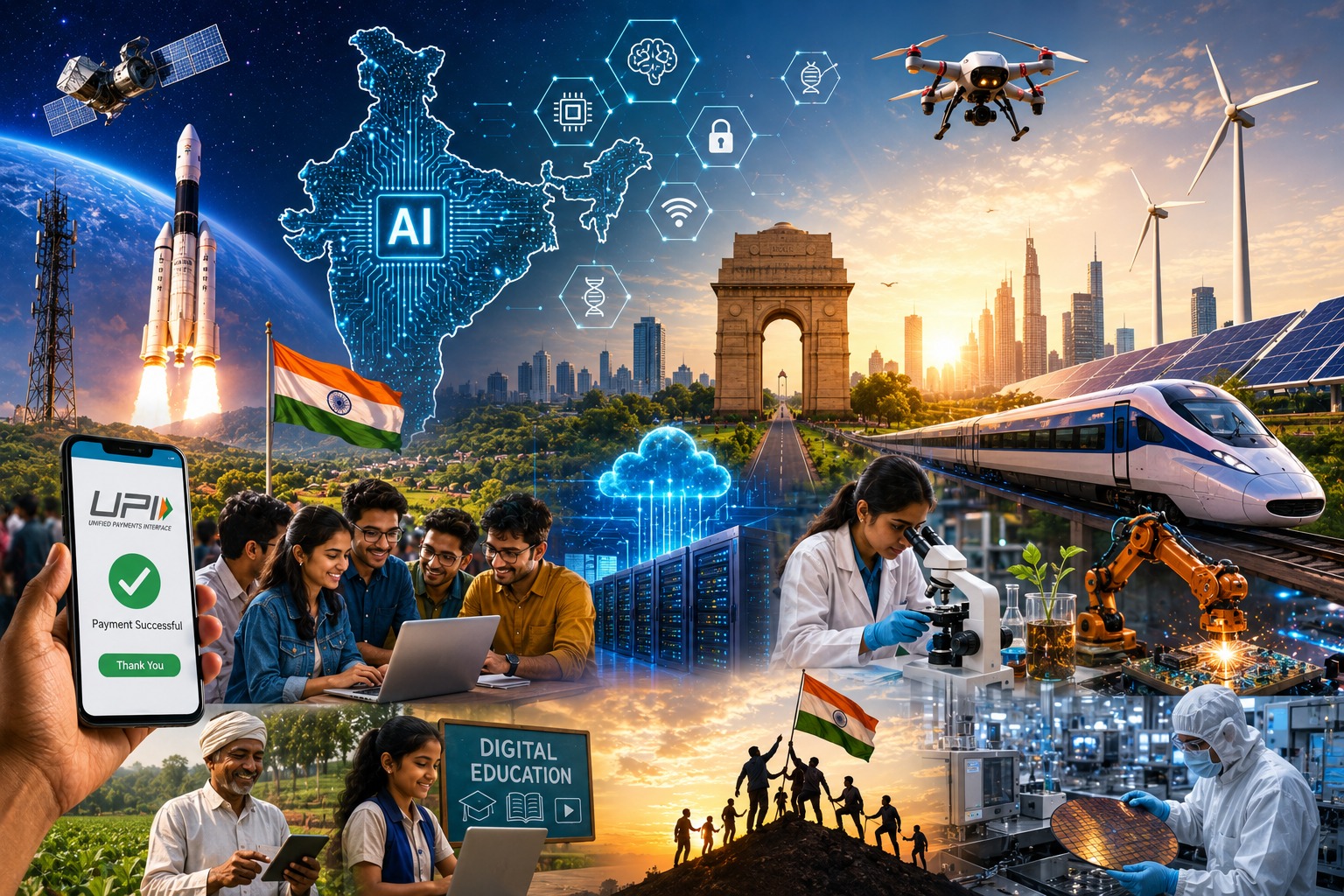
Over the past decade, India has embarked on one of the most ambitious technological transformations undertaken by any developing nation. What began as an effort to improve digital governance and connectivity has evolved into a comprehensive strategy aimed at positioning India as a global technology leader. Today, the country is investing simultaneously in artificial intelligence, semiconductors, quantum computing, biotechnology, cloud infrastructure, cybersecurity, blockchain technologies and high-performance computing.
The significance of this transformation extends far beyond technology itself. It is fundamentally linked to India’s economic ambitions, national security priorities, employment generation, global competitiveness and the vision of becoming a developed nation by 2047 under the broader framework of Viksit Bharat.
The story of India’s emerging technology ecosystem is therefore not merely about innovation. It is about nation-building in the twenty-first century.
The Foundation: Digital India’s Silent Revolution
Every technological revolution requires a foundation. In India’s case, that foundation was laid through the Digital India programme launched in 2015.
When Digital India was introduced, the country’s digital infrastructure was far from adequate. Internet penetration remained limited, broadband connectivity was uneven, rural areas suffered from poor access and digital public services were fragmented. Policymakers recognised that advanced technologies could not flourish without first creating the basic digital ecosystem required to support them.
The results have been transformative.
Massive investments in optical fibre networks, broadband expansion and telecommunications infrastructure have connected hundreds of millions of citizens to the digital economy. Affordable mobile data has become one of India’s greatest technological advantages. Today, India boasts some of the world’s lowest data costs while supporting one of the largest internet user bases globally.
Equally important has been the development of Digital Public Infrastructure (DPI), often referred to as India Stack. Platforms such as Aadhaar, UPI, DigiLocker, UMANG and CoWIN have demonstrated that technology can be deployed at population scale while remaining accessible, affordable and inclusive.
The success of UPI, in particular, has attracted international attention. It has shown that digital innovation can emerge from the Global South and provide solutions relevant not only to developing nations but also to advanced economies.
This infrastructure has become the launchpad for India’s broader technological ambitions.
Beyond Connectivity: Building Strategic Technological Capability
Digital connectivity alone does not create technological leadership. Nations become technology powers when they develop capabilities in strategic sectors that define future economic and geopolitical competition.
Recognising this reality, India has shifted its focus from digital adoption to technological capability building.
Perhaps the most visible example is the country’s push into semiconductors.
Semiconductors are often called the “new oil” because they power virtually every modern technology—from smartphones and electric vehicles to artificial intelligence systems and defence equipment. The disruptions experienced during the global chip shortage exposed the vulnerabilities of relying heavily on external supply chains.
India’s semiconductor initiatives, supported by significant government investment and policy incentives, aim to reduce these vulnerabilities while creating a domestic manufacturing ecosystem. The goal is not simply import substitution but participation in global value chains as a trusted and competitive partner.
The challenge is formidable. Semiconductor manufacturing requires massive capital investment, specialised talent and long-term policy consistency. However, the strategic importance of achieving even partial self-reliance makes the effort indispensable.
Similarly, India’s investments in quantum technologies reflect a recognition that future technological leadership will depend on mastering emerging frontiers before they become mainstream.
Quantum computing, quantum communication and quantum sensing have the potential to revolutionise sectors ranging from healthcare and logistics to defence and financial services. Countries that establish leadership in these domains today are likely to enjoy significant strategic advantages tomorrow.
India’s National Quantum Mission represents an important step toward ensuring that the country participates actively in shaping this future rather than merely adapting to it.
Artificial Intelligence: The Defining Technology of the Era
If one technology symbolises the current age, it is undoubtedly artificial intelligence.
AI is transforming industries, redefining productivity and reshaping global competition. Nations that successfully harness AI will enjoy significant advantages in economic growth, innovation and governance.
India enters this race with several strengths.
The country possesses a large pool of technology professionals, extensive digital infrastructure and one of the world’s largest repositories of digital public data. These factors create a favourable environment for AI development and deployment.
The IndiaAI Mission reflects a growing understanding that AI leadership requires more than talented programmers. It demands computing infrastructure, high-quality datasets, research institutions, startup ecosystems and ethical governance frameworks.
One of the most promising aspects of India’s AI strategy is its emphasis on inclusive and responsible innovation. Rather than viewing AI solely through a commercial lens, policymakers have highlighted its potential applications in agriculture, healthcare, education, urban planning and public service delivery.
The true test of AI success in India will not be the number of algorithms developed or investments attracted. It will be the extent to which AI improves the lives of ordinary citizens, particularly those living outside major metropolitan centres.
Technology must remain a tool for empowerment rather than exclusion.
Supercomputers, Cloud Infrastructure and Digital Sovereignty
Technological leadership increasingly depends on computational power.
From climate modelling and drug discovery to artificial intelligence and advanced manufacturing, modern innovation relies heavily on high-performance computing capabilities.
India’s National Supercomputing Mission represents an effort to strengthen domestic computational infrastructure while reducing dependence on foreign technologies. Indigenous systems such as the PARAM series demonstrate the country’s growing capacity in advanced computing.
At the same time, cloud infrastructure has emerged as a strategic necessity.
As governments, businesses and institutions generate unprecedented amounts of data, the ability to store, process and secure information becomes critical. Programmes such as MeghRaj have helped establish a national cloud ecosystem capable of supporting large-scale digital governance.
The broader concept at stake is digital sovereignty.
Countries increasingly recognise that data, computing infrastructure and digital platforms constitute strategic assets. Maintaining control over these assets while remaining integrated into the global economy is becoming a central challenge of modern governance.
India’s investments in cloud computing, data centres and cybersecurity reflect this emerging reality.
Biotechnology and the New Innovation Frontier
While discussions about emerging technologies often focus on AI and semiconductors, biotechnology may ultimately prove equally transformative.
The convergence of biology, computing and engineering is creating new possibilities in healthcare, agriculture, environmental sustainability and industrial manufacturing.
India’s biotechnology sector has experienced remarkable growth over the past decade, supported by targeted investments, research institutions and startup ecosystems.
The significance of biotechnology extends beyond economic opportunity. It directly affects national priorities such as food security, public health and climate resilience.
As the world confronts challenges ranging from pandemics to environmental degradation, biotechnology will play an increasingly central role in developing solutions.
India’s growing capabilities in this sector position it to contribute meaningfully to global scientific and technological progress.
The Human Capital Imperative
Infrastructure and investment are necessary, but they are not sufficient.
The ultimate determinant of technological success is human capital.
A country may possess state-of-the-art laboratories, advanced manufacturing facilities and sophisticated digital infrastructure. Yet without skilled researchers, engineers, entrepreneurs and innovators, these assets cannot fulfil their potential.
India’s emphasis on skilling initiatives, research funding and educational reform reflects an understanding of this reality.
Programmes such as FutureSkills PRIME, NIELIT initiatives, semiconductor training schemes and AI-focused educational programmes aim to prepare the workforce for emerging technological opportunities.
Particularly noteworthy is the effort to expand access beyond major urban centres.
The future of India’s technology ecosystem cannot be confined to Bengaluru, Hyderabad, Pune, Chennai or Delhi. Innovation must emerge from smaller cities, rural regions and underserved communities as well.
Technology-driven growth becomes truly transformative only when opportunities are broadly distributed.
The expansion of digital education, online learning platforms and skill development initiatives offers a pathway toward greater inclusion.
Startups and the Innovation Economy
India’s startup ecosystem has become one of the world’s largest.
This growth represents more than entrepreneurial enthusiasm. It reflects the emergence of an innovation economy in which new ideas can be transformed into scalable enterprises.
Government initiatives such as Startup India, incubation centres, innovation missions and research-commercialisation programmes have played important roles in creating a supportive environment.
The increasing presence of deep-tech startups working in AI, semiconductors, biotechnology, robotics and advanced manufacturing is particularly encouraging.
Unlike consumer internet startups, deep-tech ventures often require longer development timelines and greater technical expertise. However, they also generate higher-value intellectual property and contribute more directly to national technological capability.
Supporting these enterprises will be essential for sustaining long-term innovation.
India’s Growing Global Technology Credibility
Technology today is inseparable from geopolitics.
Nations increasingly compete not only for economic advantage but also for influence over technological standards, supply chains and governance frameworks.
India’s growing credibility in the global technology ecosystem reflects its ability to combine innovation with trust.
The country’s success in deploying Digital Public Infrastructure at scale has attracted international attention. Several countries are exploring collaboration on digital governance systems inspired by India’s experience.
Similarly, India’s rising rankings in innovation indices, expanding network readiness and growing role as a destination for Global Capability Centres demonstrate increasing international confidence.
The country’s participation in international technology partnerships, AI governance discussions and semiconductor collaborations further strengthens its global standing.
Perhaps most importantly, India is emerging as a voice advocating technology that is inclusive, democratic and human-centric.
In an era marked by concerns over surveillance, misinformation and technological concentration, this perspective carries significant global relevance.
Challenges That Cannot Be Ignored
While India’s technological progress deserves recognition, it is important to avoid complacency.
Significant challenges remain.
Research and development expenditure as a percentage of GDP remains lower than that of many leading innovation economies. Greater private-sector participation in research is essential.
The gap between technological ambition and execution capacity must also be addressed. Large-scale projects require effective coordination among government agencies, academic institutions and industry stakeholders.
Digital inequality remains another concern. Despite substantial progress, disparities in connectivity, skills and access persist across regions and social groups.
Cybersecurity threats are growing in complexity. As digital systems become more integrated into governance and economic activity, vulnerabilities can have far-reaching consequences.
Environmental sustainability presents another challenge. Data centres, semiconductor manufacturing facilities and advanced computing infrastructure consume substantial energy and resources. Future growth must therefore align with sustainability goals.
Addressing these challenges will determine whether India’s technological rise becomes enduring or episodic.
The Road to Viksit Bharat 2047
The vision of Viksit Bharat 2047 is ultimately about creating a prosperous, innovative and inclusive nation.
Technology is not the destination. It is the vehicle.
India’s emerging technology ecosystem demonstrates what is possible when long-term vision is combined with sustained policy commitment and institutional investment. The progress achieved over the past decade shows that developing nations can build world-class technological capabilities while pursuing inclusive growth.
Yet the next phase may be even more important than the first.
The challenge ahead is not merely to adopt technologies or build infrastructure. It is to create an ecosystem where innovation becomes self-sustaining, where research translates into commercial success, where talent finds opportunities at home and where technological advancement contributes meaningfully to social progress.
India’s technological journey is still unfolding. But the direction is increasingly clear.
The country is moving from being a consumer of global technologies to becoming a creator of them; from participating in technological change to helping shape it.
If this momentum continues, the coming decades may witness not only India’s rise as a major economic power but also its emergence as one of the world’s most influential technology nations.
That would represent far more than a technological achievement. It would mark the arrival of a confident, innovative and future-ready India.
Comments are closed.