

S. Ahmad
“For India’s middle class, the past decade has brought significant change. The coming decades will determine whether that change becomes the foundation of lasting prosperity or merely a stepping stone toward even greater expectations.”
The story of the past decade is not merely one of government schemes and economic indicators. It is also the story of India’s middle class navigating aspiration, opportunity, and uncertainty in a rapidly changing nation.
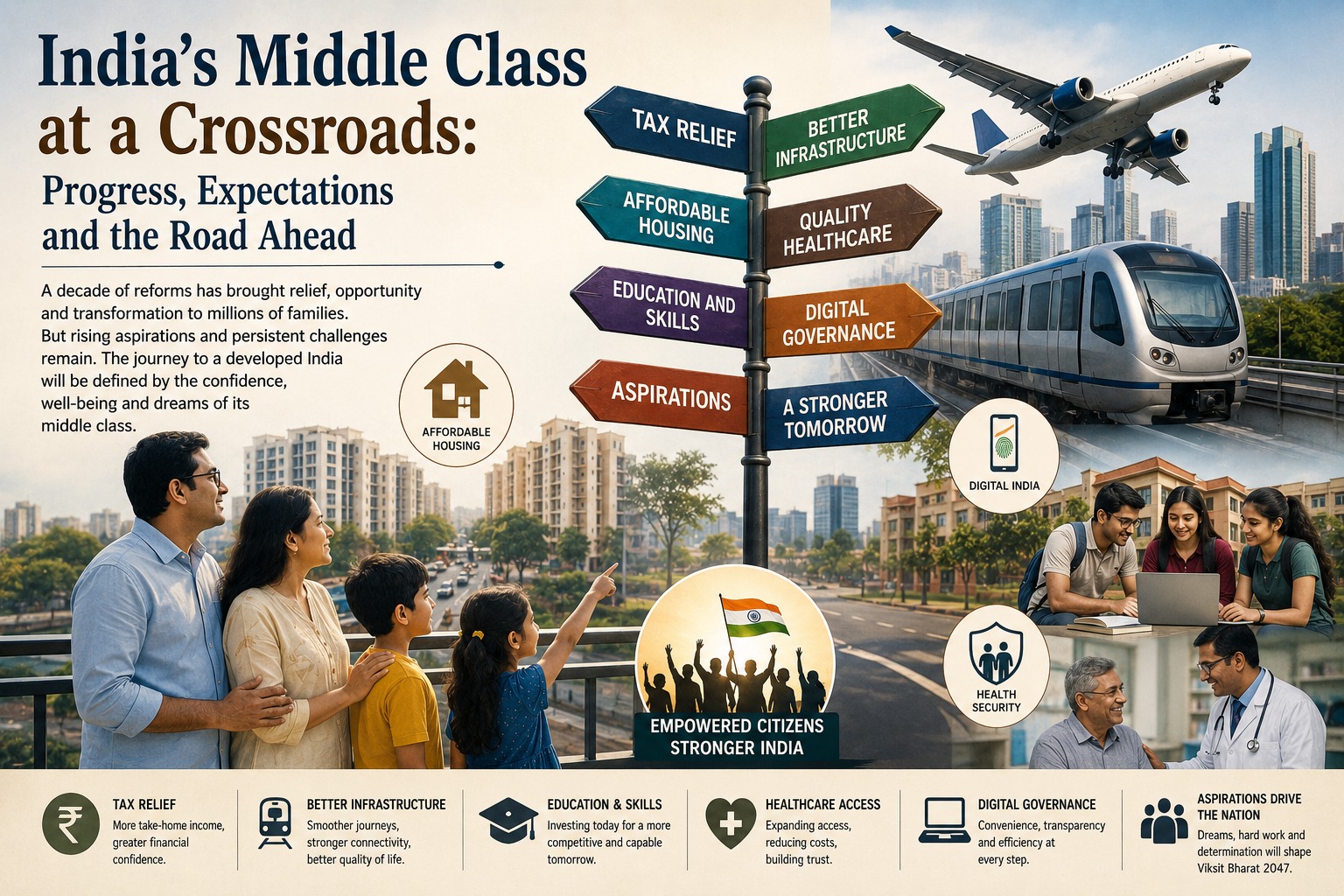
India’s middle class has often been described as the backbone of the country’s economic and social transformation. It is the segment that pays taxes, fuels consumption, invests in education, buys homes, supports entrepreneurship, and aspires to upward mobility. More importantly, it represents the hopes and ambitions of a nation seeking to transform itself into a developed economy by 2047.
For decades, the Indian middle class occupied an unusual position in public policy. It was neither poor enough to qualify for extensive welfare support nor wealthy enough to remain unaffected by economic shocks. It often found itself carrying the burden of rising costs while receiving limited direct assistance. Over the past twelve years, however, successive policy interventions have attempted to address some of the structural challenges faced by middle-income families.
From tax reforms and housing initiatives to healthcare access, digital governance, and transport infrastructure, a range of measures has altered the everyday experience of millions. Yet the story of India’s middle class is more complex than a simple narrative of success. It is a story of progress accompanied by rising expectations, new opportunities coupled with persistent anxieties, and achievements that coexist with unresolved challenges.
The question before policymakers today is not whether progress has occurred. It undoubtedly has. The more important question is whether that progress is sufficient to secure the confidence of a class whose aspirations continue to grow faster than ever before.
The Taxpayer’s Relief
Few issues resonate more strongly with middle-class households than taxation. Income tax directly affects disposable income and shapes decisions regarding savings, investments, education, and lifestyle.
The expansion of the income tax exemption threshold over the years has undoubtedly provided relief to a significant section of salaried and self-employed individuals. For many families, lower tax liability translates into greater financial flexibility and a modest cushion against inflationary pressures.
Tax reforms matter not only because they reduce immediate burdens but also because they send a broader signal about the government’s approach toward the middle class. When citizens feel that their earnings are not excessively taxed, confidence in the formal economy tends to improve.
However, taxation cannot be viewed in isolation. Rising living costs, educational expenses, healthcare spending, and housing commitments continue to place substantial pressure on household budgets. While tax relief helps, many families still feel financially vulnerable in the face of economic uncertainty.
The challenge for policymakers is to ensure that tax reforms translate into meaningful improvements in quality of life rather than merely offsetting the impact of inflation.
Housing: From Aspiration to Ownership
For generations of Indians, home ownership has represented stability, security, and social achievement. Owning a house remains one of the most important aspirations of middle-class families.
Historically, however, the housing sector was plagued by delays, stalled projects, regulatory gaps, and financing challenges. Thousands of families found themselves trapped in situations where life savings were invested in apartments that remained incomplete for years.
Initiatives aimed at affordable housing and the revival of stalled projects have therefore had a profound psychological as well as economic impact. For families who spent years waiting for possession of their homes, policy interventions that unlocked delayed projects restored not only financial investments but also trust.
Lower home loan interest rates have further contributed to affordability. Even a small reduction in borrowing costs can significantly reduce the overall burden of long-term mortgages.
Yet housing affordability remains a challenge in many urban centers where property prices continue to outpace income growth. The dream of home ownership remains difficult for many young professionals entering the workforce today.
The future of housing policy will depend not only on constructing more homes but also on ensuring that homes remain genuinely affordable for emerging generations.
Mobility and the New Urban Experience
Perhaps no aspect of daily life has changed more visibly than transportation infrastructure.
The expansion of metro rail systems across multiple cities has transformed urban commuting. For millions of office workers, students, and professionals, metro networks have reduced travel time, increased predictability, and improved convenience.
The benefits extend beyond transportation. Improved mobility affects productivity, family life, work opportunities, and even mental well-being. Time saved during daily commutes can be redirected toward education, recreation, or personal development.
Similarly, the expansion of air connectivity through regional aviation initiatives has made travel more accessible than ever before. Smaller cities that once remained isolated from major economic centers are increasingly integrated into national networks.
Improved highways, railway modernization, and airport expansion collectively contribute to a more connected India.
However, infrastructure development must continue keeping pace with rapid urbanization. Congestion, pollution, and uneven urban planning remain significant concerns in many regions. The next generation of infrastructure policy must focus not only on expansion but also on sustainability and quality.
Healthcare: A Continuing Concern
If housing represents aspiration, healthcare represents security.
No middle-class family is immune to the fear of a medical emergency. A serious illness can erase years of savings and push households into financial distress.
Initiatives such as Ayushman Bharat and the expansion of affordable generic medicine outlets have undoubtedly improved healthcare accessibility. The Jan Aushadhi network, in particular, has helped many families reduce medicine costs significantly.
The growth of primary healthcare infrastructure through health and wellness centers has also brought services closer to communities.
Yet healthcare remains one of the biggest sources of anxiety for the middle class.
While welfare schemes provide important support, many middle-income households fall outside eligibility criteria for certain benefits while still struggling with rising treatment costs. Expensive private healthcare, specialist consultations, diagnostic procedures, and long-term treatment continue to place enormous pressure on family finances.
The challenge is not merely expanding healthcare coverage but ensuring affordability, quality, and accountability across the entire system.
A developed India cannot be built on world-class infrastructure alone. It must also ensure that citizens do not face financial ruin because of illness.
Education and the Promise of Opportunity
Education remains the most powerful instrument of social mobility in India.
For middle-class families, investment in education often takes precedence over every other expenditure. Parents willingly sacrifice comforts and savings to secure better opportunities for their children.
The expansion of premier institutions such as IITs, AIIMS, and medical colleges reflects an effort to increase educational capacity. At the same time, education loan schemes have helped reduce financial barriers for many students.
The emergence of international university campuses in India may further expand opportunities while reducing the financial burden associated with studying abroad.
However, the central challenge remains quality.
While access has improved, disparities in educational standards continue to exist across institutions and regions. Graduates today face an increasingly competitive job market that demands not only academic qualifications but also practical skills, adaptability, and technological competence.
The success of India’s educational reforms will ultimately be judged by employment outcomes and the ability of graduates to thrive in a rapidly changing economy.
The Digital Transformation of Everyday Life
One of the most significant yet often underappreciated changes has been the digitization of public services.
Platforms such as DigiLocker, UMANG, Aadhaar-enabled services, and Digi Yatra have reduced paperwork, simplified verification processes, and improved convenience.
For citizens accustomed to lengthy queues and bureaucratic procedures, these changes represent more than technological upgrades. They signify a shift in how government interacts with people.
Digital governance has improved efficiency and reduced friction in everyday transactions.
However, digital inclusion remains a critical challenge. Elderly citizens, rural populations, and individuals with limited digital literacy can still face difficulties navigating technology-driven systems.
The next phase of digital transformation must focus on ensuring that convenience does not come at the cost of accessibility.
The Aspiration Economy
Perhaps the defining characteristic of India’s middle class today is aspiration.
Unlike previous generations, today’s middle-class families are not merely seeking stability. They are seeking advancement.
They want quality education for their children, better healthcare, reliable infrastructure, global career opportunities, and a higher standard of living. They want clean cities, efficient governance, environmental sustainability, and economic security.
These aspirations are a sign of progress.
As societies develop, citizens naturally demand more from institutions and policymakers. Rising expectations should not be viewed as dissatisfaction but as evidence of growing confidence and ambition.
The challenge for governments is to ensure that policy keeps pace with these evolving expectations.
Comments are closed.