Srinagar, June 23: Two years ago, Mohammad Ashraf Shiekh watched his daughter slip away in a hospital ward—40 agonising days, the same relentless fever, the same raft of inconclusive tests. The diagnosis Haemophagocytic Lymphohistiocytosis (HLH), a rare and aggressive immune disorder that, back then, had no cure within his reach. “She died,” he says, the words still raw.
Then came Luqman. At just 12 months old, the test results delivered the same devastating verdict. But this time, Shiekh refused to surrender.
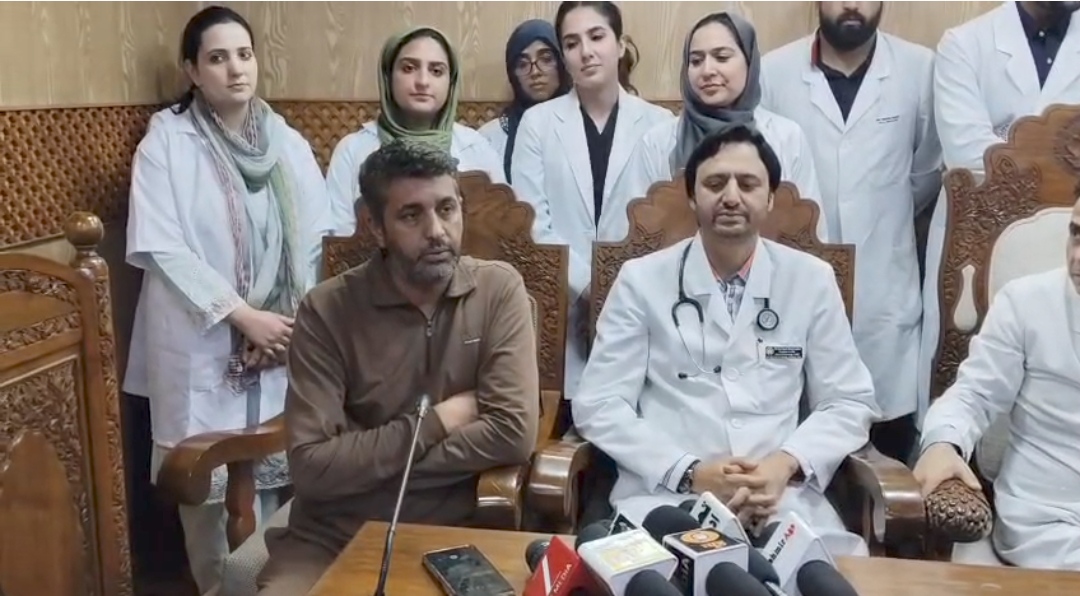
“I went abroad. I went everywhere,” the 40-year-old father from Safapura, Mansbal, told Kashmir Convener his voice steady despite the tremor of memory. “Then I heard about Dr Reshma. She is known to be very capable. I came to her. She supported me a lot.”
That trust, combined with a team of specialists at SKIMS, has now scripted a historic first for Jammu and Kashmir—a successful Matched Unrelated Donor (MUD) stem cell transplant performed on three-year-old Luqman. The donor, identified through an international registry, came from Poland—a remarkable departure from the conventional reliance on siblings, who provide a compatible match in only a quarter of cases.
For Shiekh, the financial arithmetic remains a blur. “I haven’t done the total yet. According to the doctor, it will be done by 12—I don’t know if it will be 8 or 6,” he says, referring to the cost in lakhs of rupees. He has painstakingly collected every bill. “Now the doctor can come and collect it himself. I can’t say how much it is. Because whoever faces this in the future can also think—how much should this estimate be? What should it be?”
Hospital authorities note that such procedures typically command between Rs 30 lakh and Rs 40 lakh at leading centres across the country. At SKIMS, the transplant was executed at a fraction of that, with most expenses confined to medicines—donor identification, transportation and logistics were facilitated through the international network at no additional cost.
But for Shiekh, the true measure of this medical milestone is not monetary. It is the memory of a promise made in despair. “She comforted me a lot,” he recalls of Dr Reshma. “She said, ‘It’s okay, there is a treatment. We will do it, but you stay standing.’ I told her, ‘I am ready to do whatever you say.’ Dr Reshma and Dr Insha have also supported me immensely. I can’t express it. Now, with the help of these people, especially the director, my child is fine.”
Wiping his face, he turned to an appeal that emerged from the depths of personal tragedy. “Donor registration should be opened here. First of all, I will become a donor myself. Because I have studied a little for this. I am not illiterate. But I can’t express it at this time.”
“I can’t express it,” he repeats, his voice cracking. But his eyes—and his three-year-old son, now on the mend—say everything that words cannot.
Addressing the media, SKIMS Director Dr Ashraf Ganie hailed the transplant as a watershed moment for the region’s healthcare landscape. Doctors from the Department of Hematology emphasised that the achievement would offer a lifeline to patients who lack a fully matched family donor, adding that success rates at SKIMS now compare favourably with national and international benchmarks.
The team has made a fervent appeal to the public to register as stem cell donors, underscoring that the procedure is entirely safe—a message that Shiekh, who has buried one child and held another through the ordeal, now echoes with everything he has.


Comments are closed.