

S Ahmad
The Centralised Public Grievance Redress and Monitoring System (CPGRAMS) has transformed public grievance redressal in India through digital innovation, institutional reforms and citizen-centric service delivery. Connecting all Central Ministries, Departments, States and Union Territories through a single platform, CPGRAMS enables timely grievance resolution, promotes accountability, and strengthens transparent governance while ensuring that every citizen’s voice is heard and addressed.
CPGRAMS is evolving from a complaint portal into an institutional mechanism for accountability, but its real test will be whether every grievance leads to meaningful action rather than merely a digital closure
Democracy is often measured by elections, representation and the institutions that make laws. Yet there is another, quieter measure of democratic governance: what happens when an ordinary citizen complains.
A broken road, a delayed government service, an unresolved administrative matter, a missing document, a public facility that does not work or a grievance that has remained buried in an office for months can tell citizens more about the state than any policy document.
For decades, India’s grievance redressal system was largely defined by physical applications, departmental correspondence and the uncertainty of not knowing where a complaint had gone. Citizens often had to identify the right office, submit written representations, make repeated visits and wait for a response that might never arrive.
Technology is changing that relationship.
The Centralised Public Grievance Redress and Monitoring System, or CPGRAMS, has emerged as one of the most important digital instruments through which citizens can communicate their grievances to government. Available round the clock and connected to Central Ministries, Departments, States and Union Territories, the platform provides a common mechanism to lodge, track and monitor complaints relating to public service delivery.
But the significance of CPGRAMS is not simply that a complaint can now be filed online.
Its larger significance lies in the possibility of changing the culture of governance—from a system in which citizens pursue government offices to one in which government institutions are expected to track, respond to and learn from citizens’ complaints.
That is a profound shift.
From complaint registration to governance reform
The evolution of CPGRAMS over the past decade reflects the broader transformation of India’s public administration.
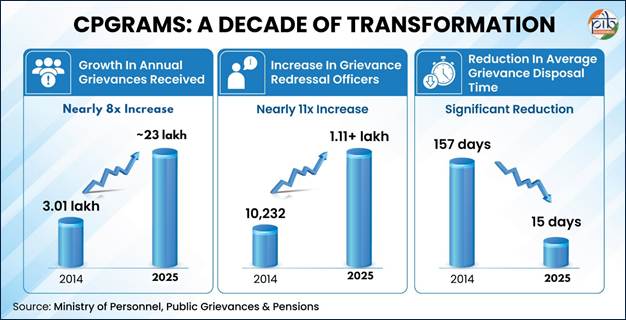
In 2014, the system handled around 3.01 lakh grievances annually. By 2024, the number had increased nearly nine-fold to around 27 lakh. At the same time, the number of Grievance Redressal Officers expanded from 10,232 in 2014 to more than 1.11 lakh by 2025.
These numbers tell two stories.
The first is administrative capacity. A grievance mechanism cannot work unless there are officials responsible for receiving, examining and resolving complaints.
The second is citizen engagement.
The dramatic rise in grievances handled through the system can be interpreted as evidence that more citizens are aware of the platform and willing to use it. A grievance platform becomes meaningful only when citizens believe that raising a complaint is worth their time.
The reduction in average disposal time is equally significant. The average time taken to dispose of grievances in Central Ministries and Departments fell from 157 days in 2014 to 15 days in 2025.
That is not merely an administrative statistic.
For a citizen waiting for a pension-related service, a certificate, a public utility response or action on a civic problem, the difference between five months and two weeks can be enormous.
The digital system is therefore changing one of the most frustrating features of traditional bureaucracy: uncertainty.
The psychological value of being heard
A grievance is not always about obtaining money or a particular government benefit. Sometimes, it is about being heard.
Citizens can feel powerless when their complaints disappear into departmental files. Even where an official eventually takes action, the absence of information during the intervening period can create the impression that nobody is responsible.
CPGRAMS attempts to address this through registration numbers, automated routing and status tracking.
Once a grievance is registered, the system facilitates its routing to the appropriate authority. The citizen can track its status using the unique registration ID.
This simple feature has larger implications than it may initially appear.
Tracking creates accountability because the complaint leaves a digital trail.
The question is no longer simply whether an application was submitted. It becomes possible to ask: Who received it? Where is it pending? Has it been disposed of? What action was taken?
Digital records therefore have the potential to reduce the space in which administrative inaction can remain invisible.
This is one of the central promises of digital governance: not simply speed, but traceability.
The shift from disposal to resolution
Yet there is an important distinction that must remain at the heart of any discussion about grievance redressal.
Disposal is not necessarily resolution.
A complaint can be closed because it has been transferred, answered formally or referred to another authority. But the citizen’s underlying problem may remain.
This is why the evolution of CPGRAMS towards feedback, appeals, monitoring and root-cause analysis is particularly important.
The guidelines issued in August 2024 rationalised the grievance disposal timeline from 30 days to 21 days and strengthened grievance cells, escalation mechanisms and root-cause analysis. Citizens can also provide feedback after a grievance is marked resolved and may approach an appellate authority if dissatisfied.
This introduces a more meaningful concept of accountability.
A government department should not merely be judged by how many grievances it closes. It should increasingly be judged by how effectively it resolves genuine public problems.
That distinction will become even more important as digital platforms handle millions of complaints.
A high disposal rate can look impressive on a dashboard. But citizen satisfaction is a more demanding measure.
The available data offers an indication of this transition. CPGRAMS recorded 1,99,968 grievances redressed in June 2026, while the average disposal time stood at 14 days. The citizen satisfaction rate between January and June 2026 was reported at 76 per cent.
The satisfaction figure is particularly important because it introduces the citizen’s experience into the measurement of administrative performance.
A complaint platform that became a reform platform
CPGRAMS did not remain static.
A major turning point came with the 10-Step Reform Programme introduced in 2022 following a review by the Prime Minister. The reforms sought to make the grievance mechanism more efficient, accessible and citizen-centric.
One of the most consequential reforms was the universalisation of CPGRAMS 7.0.
Instead of depending on manual forwarding, automatic routing enables grievances to be directed towards the appropriate authority. By 2022, all Central Ministries and Departments had been onboarded.
The significance of such integration is easy to understand. In a traditional system, the citizen may have to know which office is responsible for a particular problem. In a digital system, the burden can increasingly shift towards the administration to correctly identify where the complaint belongs.
That is a fundamental principle of citizen-centric governance.
The state has more institutional knowledge about its own administrative structure than an ordinary citizen does. Technology should therefore be used to reduce the citizen’s burden of navigating bureaucracy.
Artificial intelligence enters the grievance system
The next stage is more ambitious.
CPGRAMS is increasingly using Artificial Intelligence and Machine Learning for real-time analysis, pattern recognition and identification of systemic issues. The objective is not merely to process individual complaints but to identify recurring problems that may require policy or administrative intervention.
This could be one of the most transformative aspects of the platform.
Imagine thousands of citizens independently complaining about the same service failure across different districts. In a conventional administrative system, each complaint might be treated as an isolated case.
An intelligent digital system can potentially recognise the pattern.
If complaints about a particular government scheme repeatedly arise from the same region, or if citizens consistently report delays at a particular stage of service delivery, the data can point towards a systemic weakness.
This changes the meaning of grievance redressal.
A complaint is no longer merely a problem to be closed. It can become a piece of evidence about how government is functioning.
That is the difference between reactive governance and learning governance.
Reactive governance responds when citizens complain. Learning governance studies complaints to prevent the same problem from recurring.
From language barrier to language bridge
Digital governance can only be inclusive if it recognises India’s extraordinary linguistic diversity.
A platform available only in English would automatically exclude or discourage large sections of the population.
CPGRAMS now supports submissions in 22 scheduled languages in addition to English, while integration with BHASHINI enables grievance officers to respond in the language used by citizens.
This is more than a technological achievement.
Language is an important component of access to government.
A citizen should not need sophisticated knowledge of administrative English to explain a problem with a public service. The more naturally a person can communicate, the more accurately an institution can understand the grievance.
This is why multilingual digital governance should be seen as an instrument of democratic inclusion.
Samadhan Didi and the arrival of voice-based governance
The launch of the AI-enabled CPGRAMS voice chatbot, Samadhan Didi, on May 30, 2026, takes this idea further.
Instead of navigating forms, categories and menus, citizens can register grievances simply by speaking in their preferred language. The system uses AI alongside BHASHINI’s speech-to-text, text-to-speech, translation and transliteration capabilities. It can analyse the complaint and identify the relevant Ministry, Department, category and sub-category while seeking additional information where required.
This may prove particularly valuable for citizens who are uncomfortable with typing, online forms or complex administrative terminology.
The importance of voice technology is often underestimated.
A smartphone may be common, but digital literacy is not universal. Someone may know how to make a phone call but struggle to navigate a government website. Voice interfaces can narrow that gap.
The deeper idea behind Samadhan Didi is therefore not simply AI.
It is democratisation of access.
The interface between the citizen and the state becomes more natural when a person can describe a problem in ordinary language rather than fitting it into a rigid bureaucratic form.
The proposed expansion to regional and indigenous languages could make this even more significant.
The rural citizen cannot be left behind
But digital governance carries its own danger.
If government services move online without adequate support, citizens who lack connectivity, devices or digital literacy can become more marginalised.
CPGRAMS attempts to address this through Common Service Centres. Citizens can use more than five lakh CSCs associated with around 2.5 lakh Village Level Entrepreneurs to register grievances. Even complaints received offline by post can be digitised and uploaded into the system.
This is an important model.
Digital transformation does not necessarily mean eliminating human intermediaries. In many cases, it means using technology while retaining a human interface for those who need assistance.
The lesson is relevant beyond grievance redressal.
India’s digital public infrastructure will succeed only when digital services remain accessible to people who are not digitally fluent.
The objective should never be to create a government that is technologically advanced but socially distant.
The data beneath the complaints
Another important development is the creation of a Data Strategy Unit within the Department of Administrative Reforms and Public Grievances.
Its purpose is to use advanced analytics to identify trends, support policy improvements and optimise grievance redressal.
This is where the true potential of CPGRAMS may lie.
India receives millions of complaints. Those complaints represent an enormous body of information about citizens’ experiences with public institutions.
If analysed properly, the data can reveal where government systems are struggling.
For example, a recurring pattern of complaints about a particular service could indicate inadequate staffing. Repeated complaints from a particular geographical region could indicate weak implementation. A sudden rise in grievances could signal an emerging problem before it becomes a larger administrative crisis.
In this sense, grievance data can function almost like a diagnostic system for governance.
The state can learn where it is failing by listening systematically to where citizens say it is failing.
GRAI and the culture of competition
The Grievance Redressal Assessment and Index, or GRAI, adds another dimension by creating a performance benchmarking framework for Ministries and Departments.
Such benchmarking can encourage institutions to compare performance, identify weaknesses and improve grievance-handling mechanisms.
Healthy institutional competition can be useful.
Government departments often operate within complex bureaucratic structures, and performance can become difficult for citizens to judge. A transparent framework can create incentives for improvement.
But benchmarking must be designed carefully.
The danger is that departments may begin optimising for the indicator rather than the outcome.
If an officer is rewarded simply for disposing of grievances quickly, there could be an incentive to close complaints rather than resolve them comprehensively.
That is why speed must always be balanced by quality, citizen feedback and substantive resolution.
One Nation, One grievance ecosystem
The integration of State grievance portals and other government platforms with CPGRAMS is another significant development.
The idea of a unified grievance ecosystem reflects the larger philosophy behind India’s digital public infrastructure: citizens should not have to understand the administrative boundaries of government in order to access government services.
For a citizen, the state is one broad system.
A problem may involve a Central scheme, a State department or a local implementing agency. Administrative jurisdictions may be important for officials, but they should not become an unnecessary obstacle for citizens.
The One Nation–One Portal approach attempts to simplify this relationship by creating a more unified grievance architecture.
This could be particularly useful in a federal system as complex as India’s, where responsibilities are distributed across multiple levels of government.
A real-world example: when a complaint changes a road
The value of a grievance platform is ultimately best understood through outcomes.
The case of a citizen named Harsh in Gujarat offers one example. He raised a grievance concerning unsafe road conditions, poor maintenance and inadequate safety measures on a busy highway stretch at Ashapuri Chowkdi bridge in Rajkot.
Following escalation through CPGRAMS, construction activity was streamlined, underpasses were opened for public use, pending works were expedited and safety arrangements—including barricades, reflectors, warning signs and traffic marshals—were strengthened.
The grievance was addressed within four days.
The importance of such a case lies not in the individual number.
It demonstrates the principle that a grievance can become an administrative trigger.
A citizen notices a problem. The problem enters a formal system. The system assigns responsibility. Officials act. The citizen receives a response.
That is what responsive governance should look like.
The next generation of grievance redressal
The proposed NextGen CPGRAMS suggests that this transformation is still in its early stages.
The next-generation platform is expected to include voice-enabled registration, AI-based categorisation and intelligent routing, integration of State grievance categories, multilingual support, omni-channel registration through email, social media and mobile applications, automated escalation, accessibility features for persons with disabilities and real-time analytics.
Perhaps most significantly, it proposes AI-enabled validation of grievance redressal to assess the quality of resolutions and identify cases where complaints may have been closed through transfer or procedural disposal without effective resolution.
That feature addresses one of the central weaknesses of any grievance system: the difference between administrative closure and citizen satisfaction.
If technology can help detect cases where the system has technically disposed of a grievance but has not genuinely addressed the underlying problem, the platform could become significantly more accountable.
The danger of believing technology is enough
Yet there is a limit to what technology can accomplish.
A digital portal cannot repair a road. An algorithm cannot substitute for an absent official. A chatbot cannot compensate for a poorly designed policy. Artificial intelligence cannot create accountability where an institution is unwilling to accept it.
Technology is an enabler, not a substitute for administrative responsibility.
The ultimate quality of CPGRAMS will depend on what happens after a complaint reaches an office.
Does the officer investigate properly?
Is the citizen’s evidence considered?
Is the response understandable?
Is action actually taken?
Is the same problem likely to recur?
These questions are more important than how sophisticated the platform becomes.
The digital architecture can create transparency and traceability. But only institutional culture can convert those advantages into meaningful governance.
From grievance redressal to preventive governance
The most mature stage of CPGRAMS will therefore be reached when government begins using complaints not merely to respond to individual citizens but to prevent recurring problems.
If thousands of people complain about the same issue, the answer should not be thousands of individual replies.
The answer should be a policy correction.
This is where artificial intelligence, data analytics and root-cause analysis become genuinely important.
A grievance system should ultimately function like an early-warning mechanism for government.
Citizens are often the first to discover that a public service is failing. They encounter broken infrastructure, delays, procedural obstacles and implementation gaps long before these problems appear in official reports.
A responsive state should therefore treat citizens not simply as beneficiaries or complainants, but as sources of real-time information about governance.
CPGRAMS can potentially institutionalise that relationship.
The democratic value of responsiveness
A government earns public trust not only by announcing policies but by responding when those policies fail to reach people as intended.
That is why grievance redressal is not a peripheral administrative function. It is part of the democratic contract.
Citizens pay taxes, follow laws and interact with public institutions throughout their lives. They should have a credible mechanism to ask when something goes wrong.
CPGRAMS is attempting to create such a mechanism at national scale.
The platform’s journey—from around three lakh grievances handled annually in 2014 to around 27 lakh in 2024, from a fragmented process towards an integrated digital ecosystem, and now towards AI-enabled voice interaction—illustrates how the relationship between citizens and government is evolving.
The real measure of success, however, will not be the number of complaints received.
It will be the number of problems solved, the number of recurring failures prevented and the degree to which citizens believe that raising a grievance can actually make a difference.
That is a much higher standard.
A government that listens
The larger story of CPGRAMS is ultimately not about software.
It is about listening.
For too long, citizens often experienced government as a hierarchy of offices, forms and procedures. Digital governance offers the possibility of making that relationship more direct.
A complaint can now be registered from a mobile phone. It can be routed automatically. Its status can be tracked. The citizen can provide feedback. An appeal can be made. Data can be analysed. Patterns can be identified. And, increasingly, artificial intelligence can help citizens communicate in their own languages and even through their own voices.
That is a remarkable transformation.
But technology should not make government merely faster at saying “disposed.”
It should make government better at asking: Why did this citizen have to complain in the first place?
That is the question that can turn grievance redressal into governance reform.
India’s digital transformation is often described in terms of platforms, applications and technological infrastructure. CPGRAMS adds another dimension to that story. It represents an attempt to place the citizen’s experience inside the administrative feedback loop.
If that loop works properly, today’s grievance can become tomorrow’s policy improvement.
And if the system can move from responding to complaints to preventing them, digital grievance redressal will have achieved something far more important than administrative efficiency.
It will have helped create a state that listens, learns and responds.
For a democracy of India’s scale and diversity, that may be one of the most valuable forms of digital transformation of all.
Comments are closed.