From “Noble Cause” to “Urgent Requirement”: How One Vision Connected Schools with Swachhata 50-50

 Tawheed Parvaiz Bhat


“A student who picks up that wrapper, segregates it and tells others why it should not be there has learned something far more important. That is education for life. Swachhata is not merely about cleaning what is dirty. It is about changing the behaviour that makes things dirty. Waste is not waste when we segregate it, manage it and use it properly.”

    It was around 10 p.m. I was about to go to sleep when my phone rang. A friend told me, almost casually, “Tomorrow you have to attend a meeting with the Worthy Deputy Commissioner, Bandipora, Ms. Indu Kanwal Chib (JKAS), at 9:30 a.m. at the Knowledge Centre, Bandipora.” A few minutes later, I received another call from the Worthy Deputy Chief Education Officer, Mr. G.M. Puju, conveying the same message. The meeting, I was told, was related to solid waste segregation.

At around 8:15 the next morning, I started my car and headed towards the DC Office. I reached the Knowledge Centre at about 9:15 a.m. At exactly 9:30, the Worthy Deputy Commissioner entered. I had expected an official meeting. What followed was much more than that. A vision beyond administration, As the Deputy Commissioner began speaking to us, I realised that her vision for Bandipora was not confined to files, meetings and government programmes. She spoke with a deep sense of belonging and responsibility towards the district.

  Bandipora- known for its Alim, Adab and Aab, has a unique cultural and ecological identity. Her concern was equally unique. She spoke about her desire to see a Bandipora free from pollution and about protecting the beauty that nature has gifted to the district. At that moment, I felt that she was not born in Bandipora, but born for Bandipora. Then came a sentence that stayed with me. When someone described the initiative as a “noble cause,” Madam responded:

“It is not only a noble cause; it is an urgent requirement.” Those words changed the entire perspective. Cleanliness is often treated as an activity. Waste management is often treated as a municipal responsibility. Plantation is often reduced to a photograph. But she was presenting Swachhata as a responsibility, a necessity and a mission. she made it clear: “You are a part of this mission.”

This was not my first encounter with her vision. Earlier, during a one-day convention on solid waste management, I had raised a question concerning Gurez Valley, one of the most beautiful eco-tourism destinations of Jammu and Kashmir.

I asked: If Gurez is an eco-tourism destination, what will happen if plastic and polythene continue to enter the valley? Will we one day lose the very beauty that attracts people there? Her answer was brief: “Wait and watch.” She spoke about establishing a plastic check-post on the Gurez road. Honestly, I took it lightly at that time. I wondered whether such a difficult initiative would actually materialise. But it did. Within days, the plastic check-post became a reality, not merely as a mechanism to restrict plastic from entering Gurez, but also as an opportunity to generate employment for people involved in making cloth bags.

That was the moment I realised that this was an administrator who did not merely make announcements. She converted ideas into action.

I began referring to her, in my own thoughts, as a “Lady of Words” and an “Iron Lady” not because of her position, but because of her determination to translate

I wished to work with such a person perhaps, Allah was listening. When I was nominated as District Nodal Officer (DNO) from the Education Department, I received the opportunity to contribute to this mission.

The launch of the Swachhata 50:50 initiative gave this vision a wider dimension.

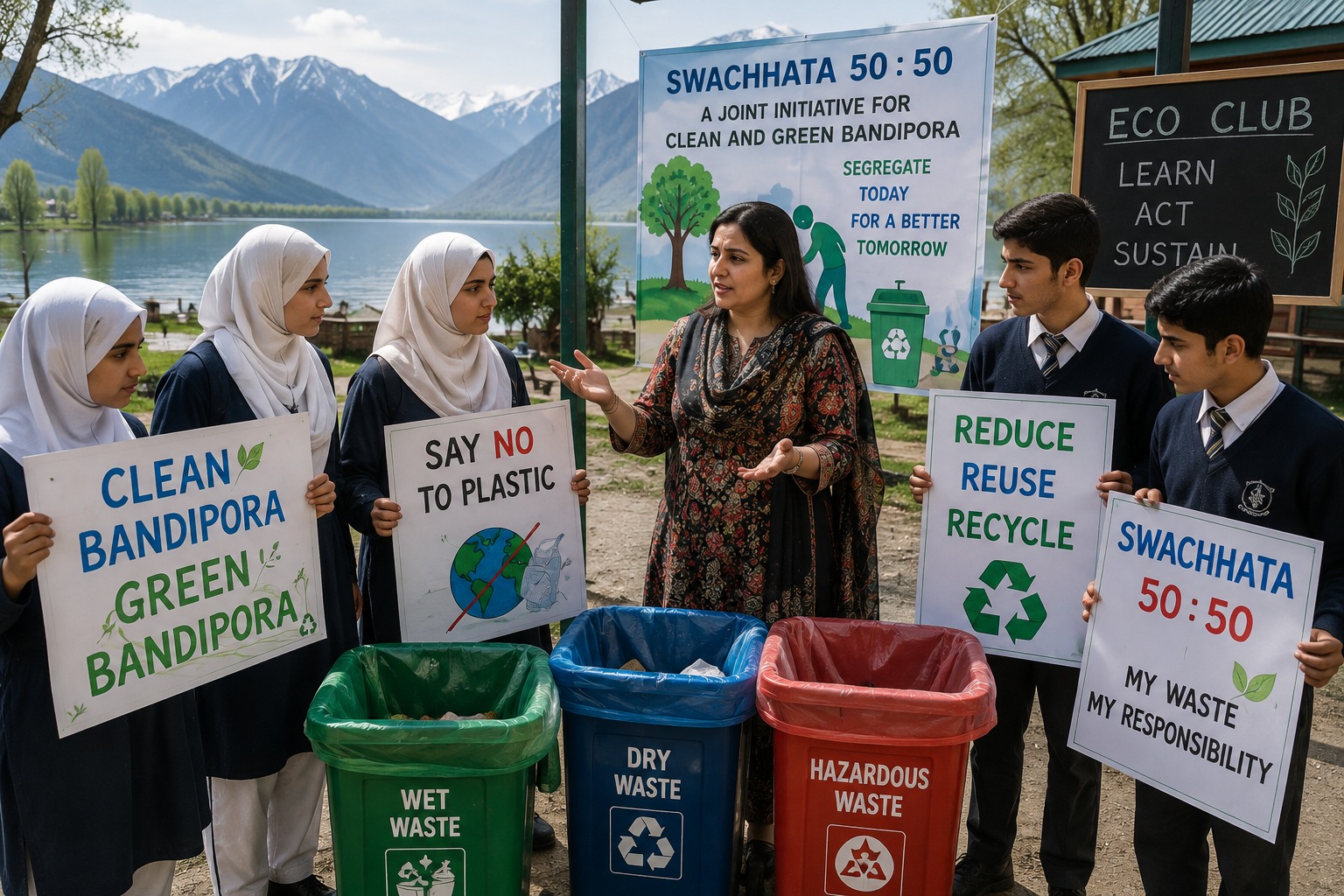
The objective was not simply to clean Bandipora. It was to create a culture in which citizens understood that waste is a resource when segregated and managed properly- and a problem when ignored. But then came another transformative idea: “We will connect the schools with this initiative.” This was perhaps one of the most important decisions in the entire campaign. Because if we want a clean Bandipora tomorrow, we have to educate the children of Bandipora today.  who better than the Eco Clubs of schools? Eco Clubs had already been established in schools for years. But, in many places, their activities had become limited to plantation drives, cleanliness photographs and occasional celebrations of environmental days. The structure existed; the potential existed. But the mission was often missing. In some schools, even Eco Club in-charges were not fully aware of how to transform the club into a meaningful platform for environmental action. The Swachhata initiative began changing that. Eco Club in-charges were brought together for training and orientation. Eco Club members were involved. Experts and delegations from outside the region were invited to share experiences and strengthen the programme. For me, this was a significant moment. Because an Eco Club should not be a name written on a school notice board. It should be a living institution within the school. The real classroom is now outside the classroom Today, as a DNO, I can see a visible change. Teachers are becoming active, Eco Club members are participating, Students are conducting awareness activities, Schools are undertaking baseline surveys related to waste management.

Students are learning about segregation. Awareness programmes are being organised and most importantly, children are beginning to understand that environmental responsibility is not something to be practised only on World Environment Day. It is a daily habit, this, to me, is real education. Education is not merely about producing degree holders. Education must produce responsible citizens. A student who knows the definition of pollution but throws a plastic wrapper on the road has learned a fact—not a value. But a student who picks up that wrapper, segregates it and tells others why it should not be there has learned something far more important. That is education for life. The transformation of Eco Clubs under this initiative is therefore significant. Earlier, the Eco Club was often associated with: Plantation, Photograph and Report Now the vision is much broader: Understand → Survey → Segregate → Educate → Act → Sustain.

The school has become a bridge between the administration and the community.

Students become environmental ambassadors. Teachers become facilitators. Parents become partners and communities become participants. This is precisely where Swachhata becomes a movement rather than a campaign.

“Waste is not waste”

One of the ideas that has remained deeply embedded in my mind is the vision of transforming places such as Zalwan, on the banks of Wular Lake, from dumping grounds into clean and productive spaces. The larger message is even more powerful: Waste is not waste when we segregate it, manage it and use it properly. Waste can become a resource, Waste can generate livelihoods, Waste can support a circular economy, Waste management can create employment and waste segregation at source can reduce the burden on our environment. This is where environmental protection and economic development meet.

Instead of asking only, “How do we dispose of waste?”, we should also ask:

“How can we transform waste into value?” That is the foundation of sustainable development. The School as the First Laboratory of Sustainability. If Bandipora wants to become a cleaner and greener district, schools can become its most powerful partners. Every school can become a mini sustainability laboratory.

The most important lesson I have learned from this journey is that Swachhata is not merely about cleaning what is dirty. It is about changing the behaviour that makes things dirty.

And most importantly, it has entered the minds of our children. If we can nurture this generation into responsible environmental citizens, perhaps the dream of a clean, green and pollution-free Bandipora will no longer remain a dream.


The author is a teacher, writer and columnist focused on education, ethics, environment and emerging social challenges in the digital age.

Comments are closed.