


Mohammad Muslim
The fact that the high dropout rates exist in the secondary level schools is indicative of how this is precisely the age when a girl’s educational path begins to differ dramatically from that of boys’ in terms of the long-term prospects available to them, and this implies that Jammu and Kashmir will have to pay particular attention to this phase while implementing reforms.
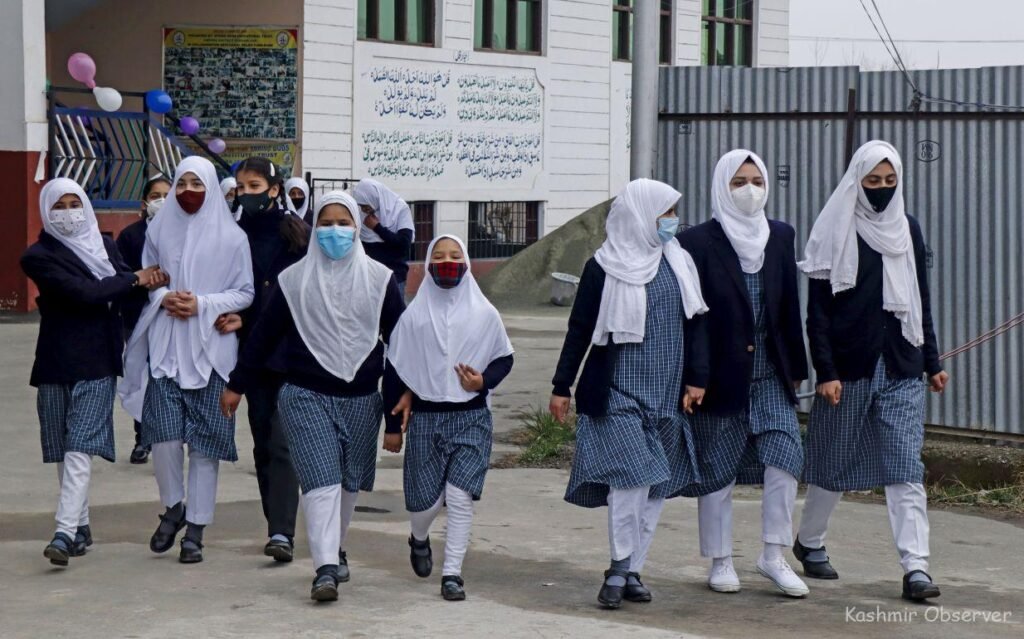
While sitting at the back of her class in a tiny village in Kashmir, Aasiya’s eyes were fixed to the floor as she was months into dropping out of school silently. Math terrified her and reading aloud was torture, and at home, there was no end to what was expected of her – taking care of her siblings, performing housework and the subtle threat of a marriage she did not desire. The tale of a young girl like Aasiya, told by the very teacher who helped get her back into the classroom, encapsulates perfectly the phenomenon that keeps coming up in the education statistics of Jammu and Kashmir – girls in rural and remote areas face unique obstacles which prevent them from entering classes that offer any opportunity at all.
The numbers are a mixed bag of progress and persisting problems. For instance, at the upper primary education level, which encompasses classes six to eight, the dropout rates for girls have fallen continuously from about 4.1 percent in 2020-21 to just 3.2 percent in 2024-25. At this level, Jammu and Kashmir has done better than the national average of 3.5 percent. But it is at the secondary education level that things get interesting. The dropout rates for girls at this level (classes nine and ten) have been quite high and variable. While they start out from 4.6 percent in 2020-21, the dropout rate increases to reach 12.6 percent in 2023-24, before falling to 12.2 percent the very next year, which is much higher than India’s national average of 9.6 percent.
In the case of boys, too, the performance has been no better. As per parliamentary figures made available in December 2025, the dropout ratio among the boys in the territory was 12.1 percent compared to 8.3 percent at the national level, whereas the girls’ dropout ratio was 10.3 percent compared to 5.7 percent at the national level. Thus, paradoxically, while the difference between Jammu and Kashmir and the rest of India is less when it comes to the boys’ dropout ratio, it is more when it comes to the girls’ dropout ratio, though in absolute terms, the dropout ratio of boys is higher. It must be noted that only 39.1 percent of children who enroll in Class 1 continue up to Class 12 in Jammu and Kashmir, and of those who complete Class 10, only 74.7 percent of the boys and 76.3 percent of the girls join Class 11, which is the point of discontinuation for many poor/rural children.
These reasons vary in depth and depend on the particular situation at hand; however, there are common issues that emerge in the studies that have been carried out on the topic. Issues of access in remote regions play a significant role, with a lack of girls’ schools in convenient proximity, a lack of female teachers, a lack of hostels and means of transportation making secondary and higher secondary levels of education inaccessible to girls outside of the immediate area of such a resource-rich institution. Economic concerns add to the difficulties with access. Families that have many children and a low budget might give priority to educating sons over educating daughters due to general cultural trends that slowly disappear but still persist. Girls become involved in housework and agricultural work at an earlier age and, in some cases, marriage becomes a consideration before secondary and higher education.
The lack of administrative efficiency has only exacerbated the problem further. The rationalization initiative that resulted in consolidation or closure of more than 4,300 government schools has created empty school buildings and schools where there are no enrollees at all or only one teacher left, thus reducing the infrastructural resource in places where there was dire need for such schools. The Bandipora district, for instance, lacked a number of administrative officials as of mid-2024, including the post of Chief Education Officer and two Zonal Education Officers. Such an administrative void only adds to the difficulties in keeping pupils in general, but especially girl students, who are more concerned about the quality of the school environment.
There is another type of distortion which emerges from the pupil-teacher ratio figures. On an average, the pupil-teacher ratio in Jammu & Kashmir is 1:16, which is well within the national standards, but this is just an average figure, hiding an imbalance wherein the ratios in Srinagar have been as low as 1:5, indicating that there are more teachers than pupils in some urban schools. The rural areas, on the other hand, suffer from the opposite situation, with very few teachers to many pupils.
Nonetheless, there is something positive happening which should be recognized. The Education Report of 2024-25 shows a marginal increase in secondary retention rate to 47.2 percent from 45.6 percent. Moreover, the number of female teachers increased, an important development which research on education repeatedly associates with greater inclusiveness and sensitivity towards gender issues in classrooms, thereby making educational institutions more safe and friendly places for girls in the long run. Efforts have been made by community-based programs which included scholarships and campaigns for families that were thinking about whether to continue educating their daughters or not. A good example is the case of Aasiya, who finally came back to classes as a result of interventions aimed at eliminating her fears both of the learning process and family pressure.
Comments are closed.