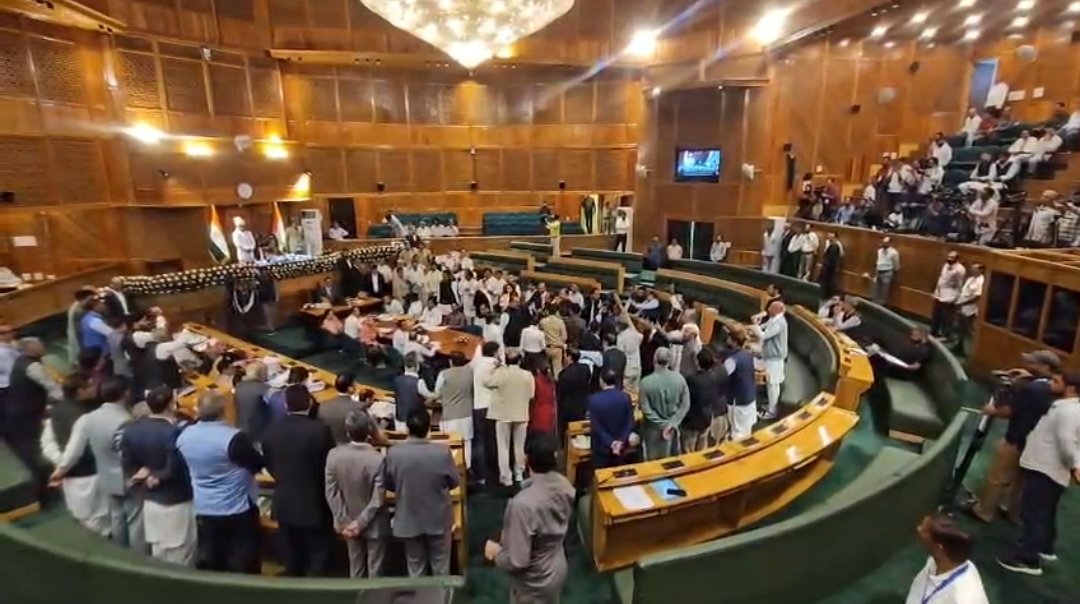
Srinagar, Sept 22: The Jammu and Kashmir legislative Assembly witnessed a stormy face-off between BJP and ruling National Conference (NC) members on Tuesday over the commemoration of the birth anniversaries of Maharaja Hari Singh and Sheikh Mohammad Abdullah, a day before the public holiday marking the birth anniversary of J&K’s last monarch.
The row erupted after the Centre, following the abrogation of Article 370 in 2019, withdrew the public holiday on Sheikh Abdullah’s birth anniversary and declared Maharaja Hari Singh’s birth anniversary a public holiday in Jammu and Kashmir.
Soon after the House convened for its second day, NC legislator Abdul Majid Larmi raised the issue, demanding that the holiday on Maharaja Hari Singh’s birth anniversary be withdrawn if the holiday on Sheikh Abdullah’s birth anniversary was not restored.
The demand triggered an uproar, with BJP members raising slogans of “Maharaja Amar Rahay” in support of Maharaja Hari Singh and accusing the NC of insulting his legacy.
NC legislators retaliated with slogans of “Sher-i-Kashmir Zindabad” in support of Sheikh Abdullah, describing him as a symbol of democracy who fought against autocratic rule and secured political and democratic rights for the people.
Participating in the discussion, senior NC leader and MLA Eidgah Mubarak Gul said the NC remained in power for many years but never altered any holiday or important day.
“We remained in power for decades, but we never removed any holiday. We never played with history. If BJP or any other party’s leader had a holiday, we never removed it. Holidays represent collective memory,” Gul said.
He said restoring the December 5 holiday would be a tribute to Sheikh Abdullah’s contribution to the people of J&K.
PDP members also joined the demand, seeking restoration of the public holiday on July 13, observed as Martyrs’ Day in the erstwhile state.
Besides withdrawing the holiday on Sheikh Abdullah’s birth anniversary, observed on December 5, the Centre also discontinued the public holiday on July 13 Martyrs’ Day. September 23, Maharaja Hari Singh’s birth anniversary, is now observed as a public holiday in Jammu and Kashmir.
Amid the uproar, Speaker Abdul Rahim Rather attempted to calm both sides, but slogan-shouting continued. The Speaker said the power to declare or withdraw public holidays did not fall within his jurisdiction.
Appealing to all members to let the House run smoothly, the Speaker said, “We all should maintain discipline so that the House will run smoothly.” He urged all sides to cooperate in making the House function.
Congress leader and Bandipora MLA Nizamuddin Bhat backed the Speaker’s appeal, saying, “We should maintain discipline to run this House smoothly.”
BJP legislators, however, continued to press for answers to the issues they had raised on Day 1, even as the Speaker made repeated appeals for order. Alleging that the ruling National Conference was deliberately trying to disrupt the House to avoid a discussion on issues concerning the people, they walked out in protest.
Before walking out, the BJP demanded that the House answer the issues it had raised on Day 1, including the problems of daily wagers and NHM employees.
Traditionally, July 13 was observed as a public holiday in Jammu and Kashmir, with official functions held at the Martyrs’ Graveyard to pay tribute to the 22 people killed during the 1931 uprising against the Dogra monarchy under British rule.
However, after the abrogation of Article 370 and the bifurcation of the erstwhile state into two Union Territories in 2019, July 13 was removed from the list of public holidays. Official commemorations and ceremonial police tributes were also discontinued.
The 1931 killings and the unrest that followed led to the appointment of two separate commissions to examine the grievances of the Muslim community in Kashmir and eventually resulted in limited political reforms.
The first Assembly elections in Jammu and Kashmir were held in 1934, marking the beginning of the electoral process in the region, although the Maharaja continued to retain sweeping powers on key matters.


Comments are closed.