New Delhi, June 19: Astronomers have uncovered crucial clues to the origin of mysterious cosmic explosions known as Fast X-ray Transients (FXTs), energetic and short-lived bursts of X-rays that have puzzled scientists for years.
A new study led by researchers from the Indian Institute of Astrophysics (IIA) has traced the likely mechanism behind a rare FXT event, designated EP241107a, detected on November 7, 2024, by China’s Einstein Probe mission. The findings suggest that the event was linked either to the collapse of a massive star or the merger of two neutron stars, both among the most violent phenomena in the universe.
FXTs are a recently identified class of cosmic events that appear as sudden flashes of low-energy X-rays lasting from a few minutes to several hours before rapidly fading away. Their brief nature has made them difficult to study, leaving their origins largely uncertain.
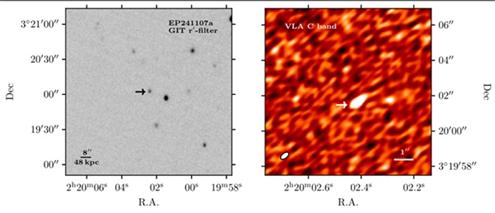
To investigate EP241107a, the research team employed a comprehensive multi-wavelength approach combining observations across radio, optical and X-ray wavelengths. Scientists detected a radio counterpart to the X-ray flash using the Karl G. Jansky Very Large Array in New Mexico, USA.
Indian observatories also played a key role in the study. The Himalayan Chandra Telescope (HCT) and the GROWTH India Telescope (GIT) at the Indian Astronomical Observatory in Hanle, Ladakh, monitored the event in visible light, while the Upgraded Giant Metrewave Radio Telescope (uGMRT) contributed follow-up observations. Additional data were gathered using international facilities, including the Keck Observatory in Hawaii and the Southern Astrophysical Research Telescope in Chile.
By comparing the optical and radio signatures of EP241107a with other known cosmic transients and examining the characteristics of its host galaxy, researchers concluded that the event most likely originated from a gamma-ray-burst-like explosion.
Detailed modelling revealed that the explosion generated a powerful jet carrying kinetic energy comparable to the total energy emitted by all the stars in the Milky Way over several months if distributed equally in all directions.
Researchers believe EP241107a represents one of the rarest cosmic events ever studied in detail—an explosion linked to a gamma-ray burst that was not directly detected in gamma rays. Such events are often referred to as “orphan afterglows” because only their afterglow emissions are observed.
The findings suggest that EP241107a may belong to the lower-energy end of the known gamma-ray burst population, providing valuable insights into the diversity and evolution of these powerful cosmic explosions.
The study has been published in the journal Monthly Notices of the Royal Astronomical Society. It was led by Dr. Deepak Eappachen and Dr. Arvind Balasubramanian of the Indian Institute of Astrophysics, along with collaborators from IIT Bombay, the California Institute of Technology, the University of North Carolina at Chapel Hill and the Center for Astrophysics, Harvard & Smithsonian.
Scientists say the discovery could significantly improve understanding of extreme cosmic explosions and the physical processes that drive them, opening new avenues for studying the dynamic and transient universe.


Comments are closed.