
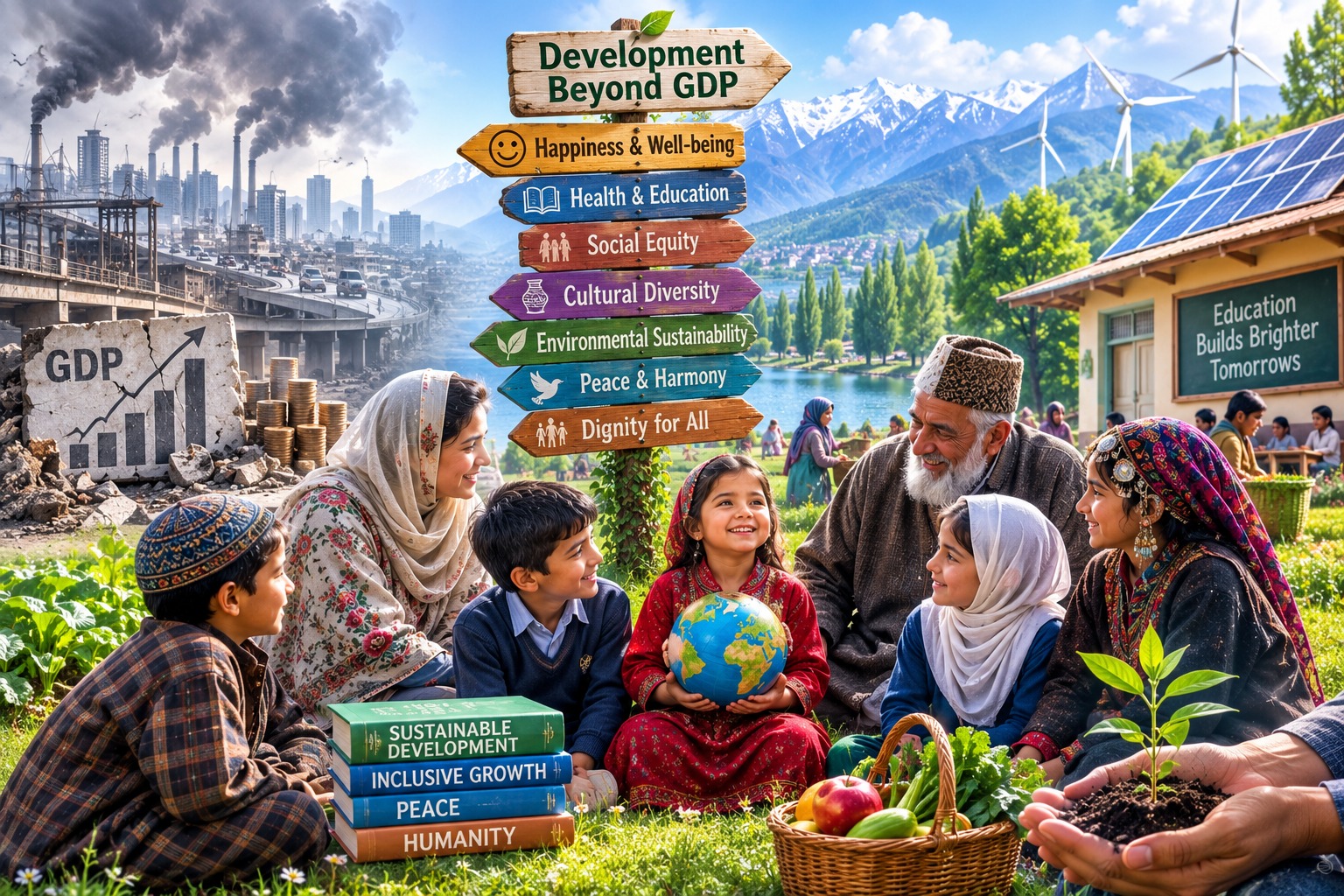

A Critique of Developmental Models Across Cultures

Shabeer Ahmad Lone


Only by weaving together indigenous insights with global perspectives can we construct a model of progress that is not only inclusive but profoundly transformative, forging a world where humanity thrives in all its diversity, where all-sided welfare of humanity is the priority.

“Gross National Happiness is more important than Gross National Product.”-Jigme Singye Wangchuck,

“A good life is not measured by material wealth, but by harmony with oneself, others, and the natural world.”-Andean Buen

“Not everything that can be counted counts, and not everything that counts can be counted.”-William Bruce Cameron

“What we call development is often destruction cloaked in progress.”-Vandana Shiva

“A nation’s greatness is measured by how it treats its weakest members.” -Mahatma Gandhi

“A model of growth should lift the least / That all may rise, from west to east.”

The concept of development, often celebrated as humanity’s collective ascent toward prosperity and progress, conceals a deeply contested terrain of assumptions, power dynamics, and cultural impositions. While conventional models equate growth with GDP, industrialization, technological advancement, and material wealth, this perspective has perpetuated a one-dimensional narrative of human advancement rooted in Western industrialization. Such paradigms not only marginalize indigenous and non-Western worldviews but also fail to address the holistic dimensions of well-being, happiness, joy, and harmony that underpin many cultural frameworks. ‘

From the Andean philosophy of Buen Vivir to Bhutan’s Gross National Happiness, alternative models remind us that true development transcends economic metrics, seeking instead to honor the intricate interplay of spiritual, social, and ecological flourishing. As the world grapples with interconnected crises-inequality, cultural erosion, and environmental degradation-there is a pressing need to reimagine development as a pluralistic, sustainable, inclusive, human-centric, and context-sensitive endeavor that empowers societies to chart their unique paths toward meaningful progress and development which includes all-sided human welfare.

Several prominent economists have recognized the importance of happiness and well-being as critical indicators of development, moving beyond traditional measures like GDP. Some prominent figures are as ;Amartya Sen, Joseph Stiglitz, Richard Layard, Jeffrey Sachs, Jean Drèze, Daniel Kahneman, Bruno Frey, Mahbub ul Haq, Bhutanese economists and policymakers, Richard Easterlin, Marcel Fafchamps, and Partha Dasgupta.

These economists have significantly influenced global debates on how happiness, well-being, and quality of life should guide development policies, urging a shift away from narrow, growth-centric models. And Countries that have adopted Happiness Index (HI) or similar well-being-focused models as a developmental framework include are Bhutan, New Zealand, Iceland, Finland, Scotland, United Arab Emirates (UAE), Costa Rica etc These countries integrate happiness and well-being into their development policies, demonstrating a shift from traditional GDP-centric models to more inclusive frameworks that prioritize holistic progress.

Developmental models, traditionally framed, often reflect a homogenized and linear view of progress rooted in the Western experience of modernization. This approach, exported globally, assumes that all societies must traverse a similar trajectory-industrialization followed by urbanization and liberal democracy-to achieve “progress.”

Such frameworks disregard the cultural, historical, and ecological specificities of different societies, imposing an ill-fitting mold that can undermine local traditions, economies, and social structures. Critics highlight that this ethnocentric model is not merely a neutral prescription for advancement but a hegemonic tool that continues colonial patterns of domination, where the global North dictates the terms of development for the global South.

Central to this critique is the prioritization of economic indicators such as GDP over more holistic measures of societal happiness and over all well-being. Economists and development thinkers like Amartya Sen and Mahbub ul Haq have argued for broader frameworks that emphasize human development and freedom. These thinkers propose development as the expansion of human choices-enabling individuals to live lives they value. Such an approach foregrounds education, health, social equity, and cultural respect rather than mere economic productivity. Even alternative metrics like the Human Development Index (HDI), while a step forward, have faced criticism for their implicit Western biases in defining a “good” life, often ignoring indigenous and alternative conceptions of well-being.

Postcolonial scholars like Arturo Escobar have further challenged the idea of development as a universal goal. Escobar argues that development discourse has historically framed non-Western societies as “underdeveloped,” requiring intervention to modernize and catch up. This narrative has often resulted in the erosion of local identities, practices, and ecosystems.

In contrast, many indigenous and non-Western societies have long defined progress in terms of harmony with nature, communal well-being, and spiritual fulfillment. The Latin American concept of Buen Vivir-“living well” in balance with nature and community-offers a compelling alternative to Western development ideals, advocating for collective well-being over individual accumulation.

Recent critiques also underscore the environmental consequences of traditional development models. The relentless pursuit of growth, typified by resource-intensive industrialization, has led to ecological crises, including climate change, deforestation, and biodiversity loss. Developing nations, often on the receiving end of these unsustainable models, are now questioning whether to replicate these practices or pioneer alternative paths.

Movements rooted in sustainability, such as regenerative economics and circular development, have gained traction, emphasizing resource conservation, equity, and intergenerational justice. These frameworks draw inspiration from indigenous ecological knowledge, which advocates living within planetary boundaries while fostering societal resilience.

In response to these limitations, contemporary development models are increasingly embracing more inclusive and human-centric measures. The emergence of the World Happiness Index, which evaluates nations based on well-being, life satisfaction, and mental health rather than economic output, represents a paradigm shift. Bhutan’s Gross National Happiness (GNH) framework, for instance, has become a global exemplar, prioritizing equitable socio-economic development, cultural preservation, environmental conservation, and good governance.

These models highlight the growing recognition that true progress cannot be reduced to financial metrics but must encompass the emotional and psychological dimensions of human life.

The critique of developmental models underscores the urgent need to reimagine progress in more diverse and inclusive terms. Development should no longer be seen as a unidirectional journey toward a singular ideal but as a pluralistic process rooted in the specificities of culture, history, and geography. It must honor the multiplicity of ways societies define and pursue well-being-whether through material prosperity, spiritual fulfillment, or communal harmony.

In a world marked by interconnected challenges, from inequality to climate change, the future of development lies not in imposing a uniform vision but in embracing the rich diversity of human aspirations. A truly enlightened developmental model is one that lifts the weakest, sustains the planet, and respects the dignity of all cultures-a model that is not merely inclusive but profoundly transformative.

Critiques of traditional developmental models highlight their failure to account for diverse cultural realities and aspirations. From postcolonial scholars denouncing the imposition of Western norms to environmentalists advocating for sustainable alternatives, the discourse underscores the inadequacy of one-size-fits-all frameworks. Indigenous knowledge systems, often dismissed by mainstream paradigms, emphasize balance, community, and harmony with nature, offering profound insights into sustainable living.

 For instance, the Maori in New Zealand prioritize the health of their lands and waters as integral to their societal well-being, challenging the exploitative ethos embedded in many industrialized models. Similarly, the rise of happiness-oriented indices such as the World Happiness Report signals a transformative shift from materialist notions of progress toward measures that embrace emotional and psychological well-being.

In reimagining development, humanity stands at a critical crossroads. The challenges of the 21st century demand not merely an adjustment of existing frameworks but a radical transformation in how progress is conceptualized and pursued.

 Development must evolve into a process that celebrates cultural diversity, fosters environmental stewardship, and prioritizes the dignity and autonomy of every community. This requires breaking free from the colonial legacy of imposing universal solutions and instead embracing a mosaic of approaches that reflect the richness of human experience.

It is must be understood and recognised that no single path can encompass the aspirations of all societies.  As timeless wisdom across cultures reminds us, the true measure of progress is how it uplifts the most vulnerable .

This ethos calls for a shift from dominance to dialogue, from extraction to harmony, and from exclusion to inclusion. Development must become a deeply human endeavor, rooted in shared values yet adaptable to the unique challenges of each society.  Only by weaving together indigenous insights with global perspectives can we construct a model of progress that is not only inclusive but profoundly transformative, forging a world where humanity thrives in all its diversity, where all-sided welfare of humanity is the priority.


Author can be mailed at shabirahmed.lone003@gmail.com

Comments are closed.