

Suhail Khan
New Delhi, Nov 4: Defence Minister Rajnath Singh on Wednesday flagged growing threats to global maritime security, warning that deliberate disruptions to international trade, challenges to freedom of navigation and the weaponisation of strategic maritime passages were putting pressure on the international order.
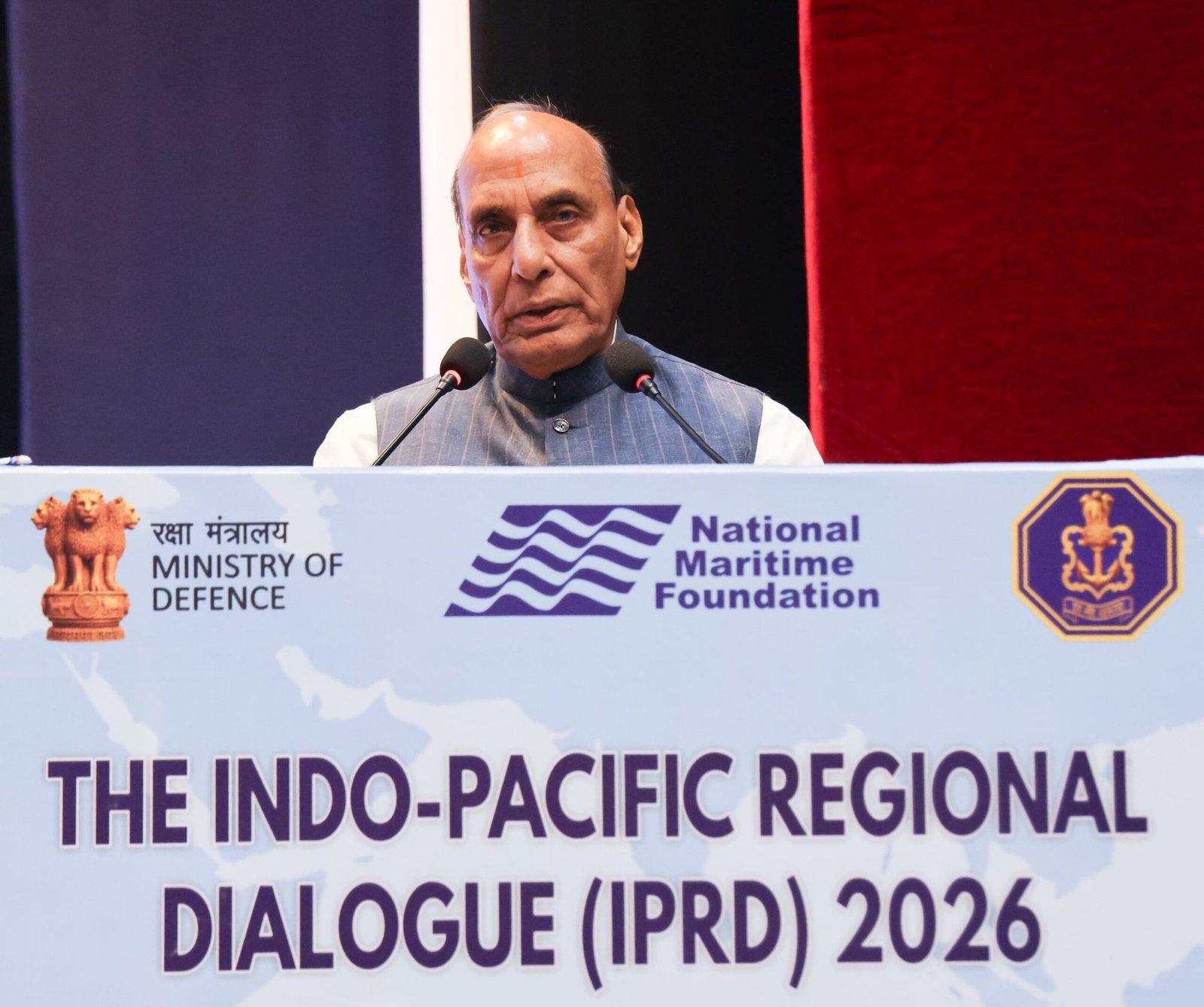
Addressing the Indo-Pacific Regional Dialogue 2026 in New Delhi, Rajnath Singh as per Kashmir Convener said certain countries and actors were exploiting the strategic importance of oceans for narrow unilateral gains, undermining the shared interests of the international community.
“Today, the global maritime security environment is strained by deliberate trade disruptions. We see blatant challenges to freedom of navigation and the weaponisation of narrow maritime passages,” Singh said.
He said the growing instability in the maritime domain had implications beyond regional security, affecting international trade, economic connectivity and the movement of essential commodities.
Highlighting the importance of maritime routes to the global economy, Singh said more than 95 per cent of global digital traffic travelled through fibre-optic cables laid across ocean floors. Factories, farms and cities also depended on the uninterrupted movement of goods through waterways, he added.
The Defence Minister stressed the need for supply-chain diversification, reliable maritime infrastructure, improved maritime awareness and greater cooperation among regional partners to withstand disruptions.
His remarks come against the backdrop of India’s broader security concerns, particularly cross-border terrorism and tensions with Pakistan.
Earlier, on October 15, Rajnath Singh had issued a strong warning to Pakistan, saying any future terrorist act originating from its territory would invite an even stronger response from India.
Citing the 2016 surgical strikes, the 2019 Balakot airstrikes and Operation Sindoor in 2025, he said India had moved beyond diplomatic condemnation towards proactive action aimed at eliminating terrorism at its source.
“India is committed to peace, but it should not be mistaken for weakness,” Singh had said, asserting that the country was fully prepared to safeguard its sovereignty, territorial integrity and national interests.
Operation Sindoor was launched on May 7, 2025, following the April 22 terror attack in Pahalgam that killed 26 people. Indian armed forces struck what the government described as terrorist infrastructure in Pakistan and Pakistan-occupied Kashmir.
The operation marked a significant escalation in India’s response to cross-border terrorism, with New Delhi maintaining that those responsible for attacks against the country would face consequences.
Singh has also called for international cooperation to dismantle the entire ecosystem of terrorism, including its financing, logistical support and safe havens, maintaining that there should be no double standards in dealing with the threat.
Returning to maritime security, Singh said oceans were not merely channels for trade but also played a critical role in sustaining livelihoods, regulating the global climate and providing resources for future industries.
The three-day Indo-Pacific Regional Dialogue 2026, being held from November 3 to 5, has brought together experts and representatives from 18 countries to deliberate on science, technology and academic cooperation, maritime governance, climate resilience and emerging technologies in the Indo-Pacific.
Comments are closed.